

Audio By Carbonatix
After days of anticipation about what US President Donald Trump's "Liberation Day" would mean for Canada, it seems the answer is not much. But that still hasn't helped bring relief to America's northern neighbour.
Trump said on Wednesday that countries worldwide will be hit with blanket 10% US tariffs. He also released a list of 60 nations facing additional "reciprocal" tariffs, though Canada was notably not on that list.
Instead, much of the American tariff scheme on Canada will stay the same: a blanket 25% on all goods, except those under the existing North American free trade agreement. Energy and potash is tariffed at a lower 10%, while a 25% levy on Canadian steel and aluminium remains in place.
The White House tied the tariffs to the flow of fentanyl and migrants from both Canada and Mexico, which Trump has declared an emergency. Officials signalled that some may be lowered if that declaration is cancelled.
Trump also confirmed a 25% tariff "on all-foreign made automobiles" coming into effect at midnight on Thursday. He did not say whether Canada, whose auto industry is heavily intertwined with that of the US, would be exempt.
Prime Minister Mark Carney, who has paused his campaign for the second time in as many weeks to respond to the tariffs, vowed Wednesday that Canada will soon retaliate "with purpose and with force."
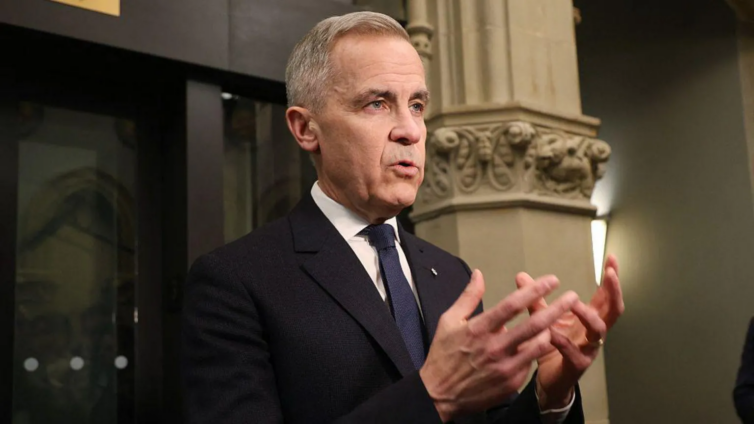
Speaking to reporters in Ottawa, Carney said the current US tariffs on Canada "will directly affect millions".
He added that Canada's reaction will be hammered out once he meets with province and territory premiers on Thursday.
Carney's response to the tariffs so far has been a political win for him and his Liberal party - now ahead in national polls - as the Conservative party and its leader Pierre Poilievre trail slightly behind.
As the incumbent, Carney has the advantage of playing the role of prime minister while simultaneously auditioning for it, and national polls show Canadians trust him more with handling Trump and the Canada-US relationship.
This success - at least so far - has forced Poilievre to pivot his messaging. On Wednesday, the Conservative leader held an event in Toronto hours ahead of Trump's announcement to outline his party's response.
He pushed for immediate, "targeted" retaliation, and said his party would introduce a temporary loan program to support businesses directly hit.
Poilievre urged Canada to renegotiate the existing North American trade agreement with Canada, the US and Mexico as soon as possible. The agreement, known as CUSMA, is up for review in 2026.
"Why wait? Why not get it done now?" Poilievre asked.
The rest of Canada's federal leaders laid out their own responses Wednesday - a sign of how much these tariffs have overshadowed Canada's federal election, scheduled for 28 April.
New Democratic Leader Jagmeet Singh said during an early afternoon campaign stop in Winnipeg that his party would put measures in place to help workers impacted by the tariffs.
He also called Trump an "arsonist", saying that the US president is "setting fire to the economy — his own economy, and ours as well."
Bloc Quebecois leader Yves-Francois Blanchet, whose party only runs candidates in French-speaking Quebec, said counter-tariffs should be "surgically chosen" to preserve the country's "fragile" economy.
Meanwhile in the US Senate, an effort to block Trump from imposing tariffs on Canada passed, 51-48, on Wednesday, with four Republican senators aligning with all Democratic senators. But it is not expected to be taken up by the House of Representatives, which holds a narrow Republican majority.
While Canada has been spared from additional tariffs, this reprieve has not changed the overall tone in the country.
Candace Laing, president of the Canadian Chamber of Commerce, said that Wednesday's announcement means "the world is waking up to a reality that Canada has been living with for months."
"Businesses around the world have had their uncertainty expanded, the effects of which will undoubtedly boomerang to Canada as well," she said in a statement.
"This chain reaction of tariffs and counter-tariffs will have a real and distressing economic impact on Americans, Canadians and the global economy."
Carney echoed those comments Wednesday, telling reporters the tariffs will "fundamentally change the international trading system."
The focus for now, he said, is how Canada can protect its workers and build what he vowed will be "the strongest economy in the G7."
Latest Stories
-
NDC threatens sanctions over oversized campaign posters, gives aspirants 5 days to comply
14 minutes -
Star Oil paid GH¢2.7bn in taxes, levies in nine months of 2026
28 minutes -
Samson’s Take: The rule of law is cheaper before the bulldozer
29 minutes -
GRA blames system failure for delay in issuing receipt over passenger’s customs duty
50 minutes -
Livestream: Newsfile discusses World Cup visa scandal, beach demolitions, education strikes, BRICS bid
54 minutes -
NC-PTAs welcomes end of teachers’ strike, urges parents to prepare children for Monday
1 hour -
Government procures over 2,000 transformers as Ghana’s electricity access hits 89.13% – Energy Minister
2 hours -
UTAG-UG threatens strike on October 19 over unpaid allowance
2 hours -
Let The Constitution direct Chieftaincy to deliver “All Development Is Local”
3 hours -
John Jinapor outlines renewable energy, nuclear power priorities for 2027
3 hours -
Ghana explores centre of excellence for hearing, communication and cochlear implant care
4 hours -
Schizophrenia-related disorders lead mental health cases recorded in Ghana
5 hours -
Dutch authorities enlist Ghana in hunt for fugitive drug lord Bolle Jos
5 hours -
Ghana housing finance conference adopts communiqué to improve affordable housing access
9 hours -
Special Initiatives Minister urges Wa Technical Institute to enrol more girls as EU-backed solar training lab opens
10 hours