


Audio By Carbonatix
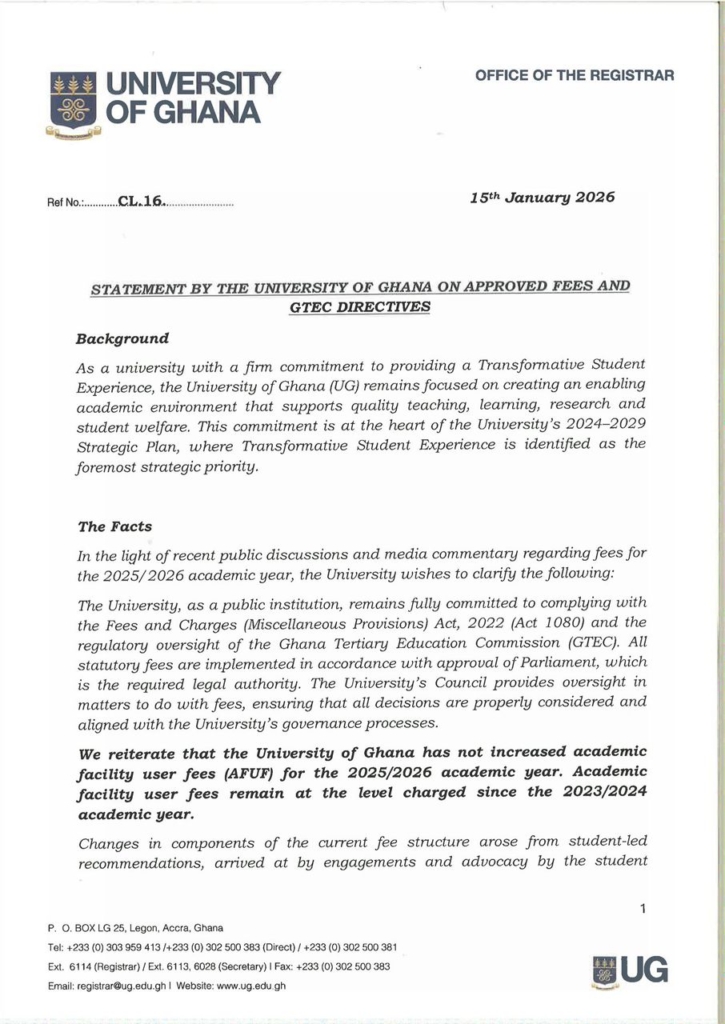
The Management of the University of Ghana (UG) has officially clarified that there has been no increase in Academic Facility User Fees (AFUF) for the upcoming 2025/2026 academic year.
In a detailed press statement released on January 15, 2026, the university emphasised that academic fees remain at the same level charged since the 2023/2024 academic cycle.
The clarification comes in response to recent public discussions regarding the institution's fee structure.
According to the University, all statutory fees are implemented in strict compliance with the Fees and Charges (Miscellaneous Provisions) Act, 2022 (Act 1080) and require the approval of Parliament.
The university revealed that recent changes to the fee components were actually driven by student-led recommendations and advocacy from the Students Representative Council (SRC) and the Graduate Students Association of Ghana (GRASAG).
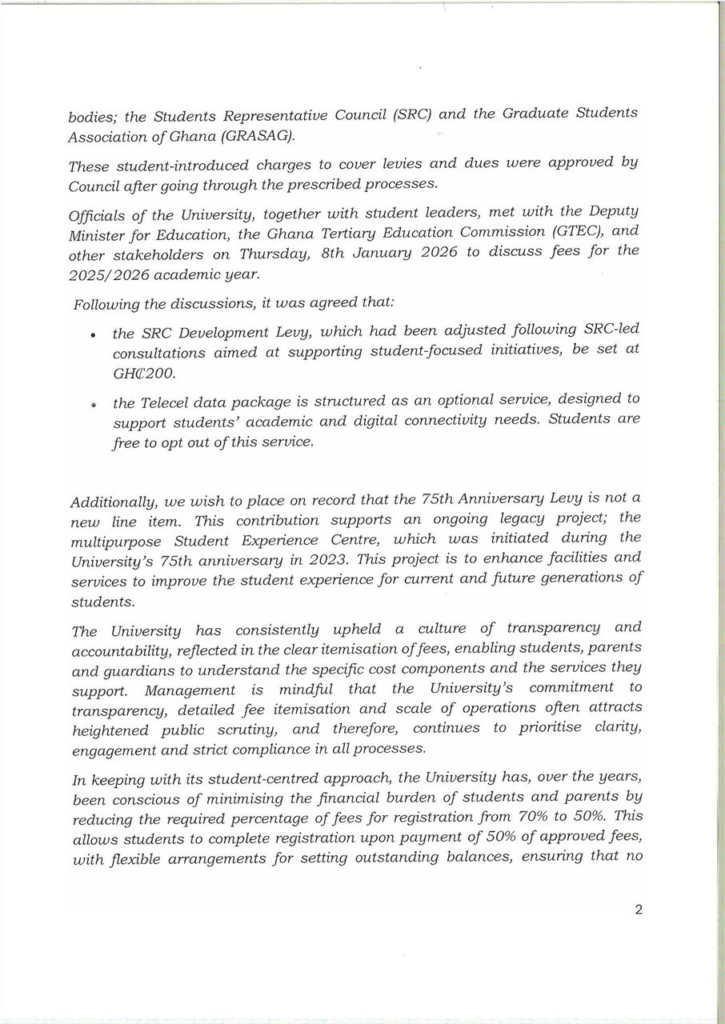
Following a consultative meeting on January 8, 2026—which included the Deputy Minister for Education and the Ghana Tertiary Education Commission (GTEC)—several agreements were reached regarding non-academic charges:
- SRC Development Levy: This fee has been set at GH¢200 following consultations aimed at supporting student-focused initiatives.
- Telecel Data Package: This levy is now structured as an optional service. Students have been granted the explicit right to opt out of the package if they do not wish to use it for their digital connectivity needs.
- 75th Anniversary Levy: Management clarified that this is not a new fee but an ongoing contribution to support the construction of the multipurpose Student Experience Centre, a legacy project initiated in 2023.
In an effort to minimise the financial strain on parents and students, the university has maintained a policy of reduced initial payments.
Students are now required to pay only 50% of approved fees to complete their registration, down from the previous requirement of 70%.
“Management is mindful that the University's commitment to transparency, detailed fee itemisation and scale of operations often attracts heightened public scrutiny, and therefore, continues to prioritise clarity, engagement and strict compliance,” the statement noted.
The university also highlighted that scholarship opportunities remain available through the Student Financial Aid Office to ensure that no eligible student is disadvantaged due to financial constraints.
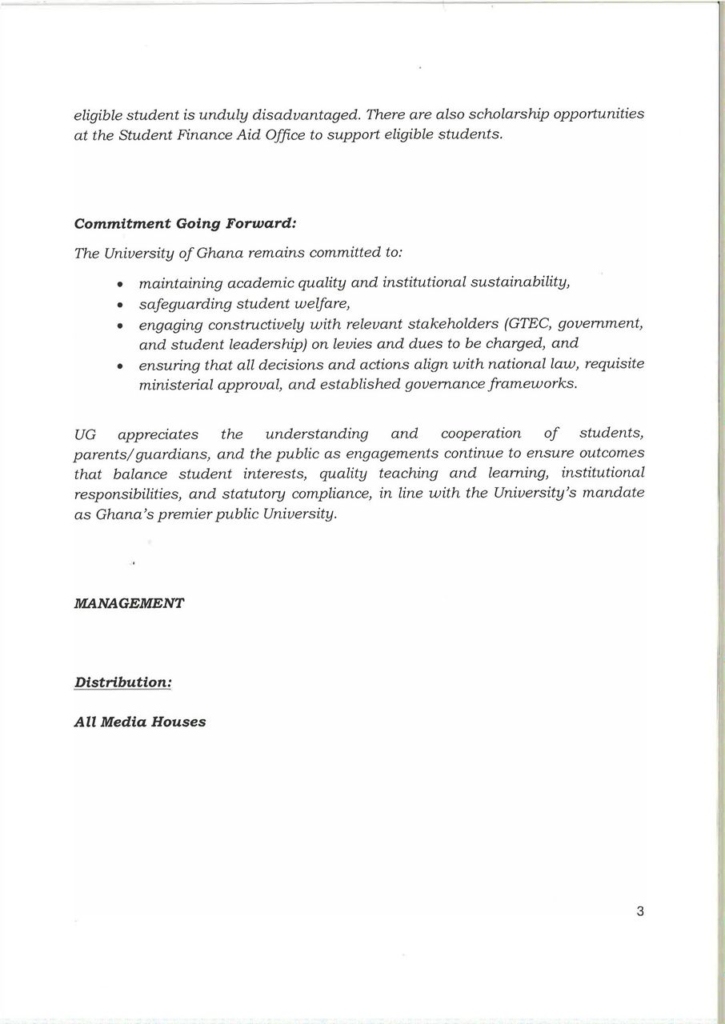
Moving forward, the University of Ghana pledged to remain committed to:
- Maintaining academic quality and institutional sustainability.
- Safeguarding student welfare.
- Engaging constructively with GTEC, the government, and student leadership on all levies and dues.
- Ensuring all actions align with national law and requisite ministerial approvals.
Latest Stories
-
Star Oil paid GH¢2.7bn in taxes, levies in nine months of 2026
7 minutes -
Samson’s Take: The rule of law is cheaper before the bulldozer
8 minutes -
GRA blames system failure for delay in issuing receipt over passenger’s customs duty
29 minutes -
Livestream: Newsfile discusses World Cup visa scandal, beach demolitions, education strikes, BRICS bid
33 minutes -
NC-PTAs welcomes end of teachers’ strike, urges parents to prepare children for Monday
43 minutes -
Government procures over 2,000 transformers as Ghana’s electricity access hits 89.13% – Energy Minister
1 hour -
UTAG-UG threatens strike on October 19 over unpaid allowance
1 hour -
Let The Constitution direct Chieftaincy to deliver “All Development Is Local”
2 hours -
John Jinapor outlines renewable energy, nuclear power priorities for 2027
3 hours -
Ghana explores centre of excellence for hearing, communication and cochlear implant care
4 hours -
Schizophrenia-related disorders lead mental health cases recorded in Ghana
4 hours -
Dutch authorities enlist Ghana in hunt for fugitive drug lord Bolle Jos
5 hours -
Ghana housing finance conference adopts communiqué to improve affordable housing access
9 hours -
Special Initiatives Minister urges Wa Technical Institute to enrol more girls as EU-backed solar training lab opens
9 hours -
In the matter of my first year at the Bar
10 hours