

Audio By Carbonatix
President John Mahama has cited the Northshore Apparel Hub as an example of how his government’s 24-hour economy initiative is expected to create jobs, increase production and accelerate Ghana’s exports.
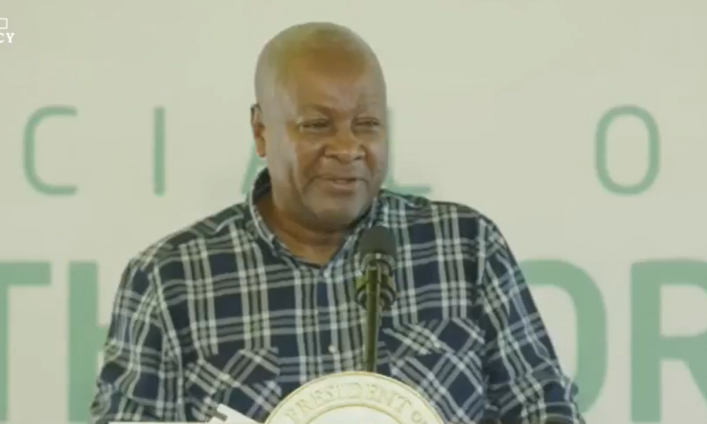
Speaking at the opening of the Northshore Apparel Hub, the President said the company’s plans to operate multiple shifts would create more employment opportunities for young people while increasing production for export.
“This is an example of what our vision, the 24-hour economy initiative, is meant to do,” President Mahama said.
He said Northshore was expected to run several shifts, allowing the company to employ more workers and increase its output.
“North Shore is going to run several shifts, and it means that several more young people will get jobs to do,” he said.
According to the President, Northshore is part of a wider wave of factories and businesses expected to adopt multiple shifts under the 24-hour economy initiative.
“And it is not only North Shore, there also are several other factories that are coming up that are going to run multiple shifts and create businesses for our people,” he said.
He said the initiative had two key objectives: creating jobs and increasing Ghana’s export earnings.
“And so the 24-hour economy is designed to achieve the creation of jobs and accelerated exports,” he said.
President Mahama said the apparel hub was already contributing to those objectives, having created at least 2,000 jobs.
“And North Shore qualifies for both because it has created at least 2,000 jobs already and the bulk of its products are going to be exported to bring foreign exchange into Ghana,” he said.
He said the company's export-oriented operations would help Ghana earn much-needed foreign exchange while creating employment opportunities locally.
The President also said Northshore had been registered under the Free Zones regime, allowing it to benefit from incentives available to businesses operating under the programme.
“North Shore is registered under the Free Zones, and so it will benefit from all the incentives that the Free Zones have to offer,” he said.
President Mahama said Northshore would also benefit from tax incentives available to manufacturers that locate in rural and northern parts of the country.
He explained that the current tax regime provided lower tax rates for manufacturers that established operations in rural areas and the northern parts of Ghana.
“Apart from that, it will also have tax incentives because the current tax regime gives a lower tax rate to manufacturers who go to rural areas and also to manufacturers who locate in the northern part of Ghana,” he said.
He added that companies such as Northshore would receive duty and tax exemptions on plants and equipment.
“They will also receive duty and tax exemptions on plants and equipment,” he said.
The President said the company had indicated its intention to proceed with a second phase of development, which would allow it to benefit from further exemptions.
“A large new regime has already said they have intentions of continuing the second phase. And so in the second phase, they will enjoy the exemptions from duties and taxes that they deserve,” he said.
President Mahama also announced plans for the government to introduce a net-metering framework that would allow companies with solar power plants to supply excess electricity to the national grid.
He said Parliament would be asked to pass legislation to establish the system.
“Apart from that, we are going to get Parliament to pass a net metering bill,” he said.
The proposed system would be particularly useful to companies such as Northshore that generate part of their electricity through solar power.
Under net metering, the President explained, excess electricity generated by a company's solar plant could be fed into the national grid, with a meter recording the amount supplied.
“That will allow companies like North Shore that have their solar plants to net meter with the electricity company or NETCO so that if they are producing more than they need from their solar plants, it will be integrated into the national grid and there will be a meter that calculates how much they are owed,” he said.
He said companies would then be compensated for electricity supplied to the grid.
“And so if they are owed, it means NETCO has to pay them,” he said.
On the other hand, companies that consume more electricity than they generate would be required to pay the difference.
“And if they consume more, then they will have to pay NETCO the difference in their power. They call it net metering,” he explained.
He said the government intended to introduce the system soon.
“And so we are going to introduce net metering in the country soon,” President Mahama said.
Latest Stories
-
Armah-Kofi Buah, Sam George, other MPs among newly qualified lawyers
6 minutes -
Ghana exporting eggs to Burkina Faso amid local surplus – Agric Minister
7 minutes -
Governance failure in Ghanaian football and a presidential reform agenda
13 minutes -
IJM Ghana welcomes country’s upgrade to Tier 1 in 2026 Trafficking in Persons report
14 minutes -
REAC urges stakeholders to comply with Real Estate Act or face sanctions
15 minutes -
‘Nkoko Nketenkete’ boosts local poultry production from 4.6% to 22% in one year – Agric Minister
39 minutes -
ARK Foundation boss warns against stigmatisation of abuse victims
46 minutes -
Health investment beginning to improve access to care – Akandoh
53 minutes -
“It is meaningless” – Parent laments as teachers’ strike leaves boarding school students idle
55 minutes -
Austin Gamey predicts possible end to teachers’ strike, urges better negotiation
58 minutes -
Mahama and Trade Minister champion local manufacturing during Ghato Foods visit
59 minutes -
Labour Minister, ILO Country Director strengthen partnership on decent work and jobs
59 minutes -
Approved vaccine for Yellow Fever to be rolled out in Upper West next week-GHS
1 hour -
Trump wants to reduce the cost of fuel as the midterms loom – will it work?
1 hour -
Fear, institutional bias and lack of support deter domestic abuse victims from reporting – Lawyer
1 hour