


Audio By Carbonatix
India has once again topped an annual list of cities with the worst air quality in the world, according to a new report, while Chinese cities have continued to show improvements from the previous year.
Twenty-one of the world's 30 cities with the worst air pollution are in India, according to data compiled in IQAir AirVisual's 2019 World Air Quality Report, with six in the top ten.
Ghaziabad, a satellite city of the capital New Delhi in northern Uttar Pradesh state, is ranked as the world's most polluted city, with an average PM 2.5 concentration measurement of 110.2 in 2019. That's far more than double the level which the US Environmental Protection Agency regards as healthy -- it's nine times more.
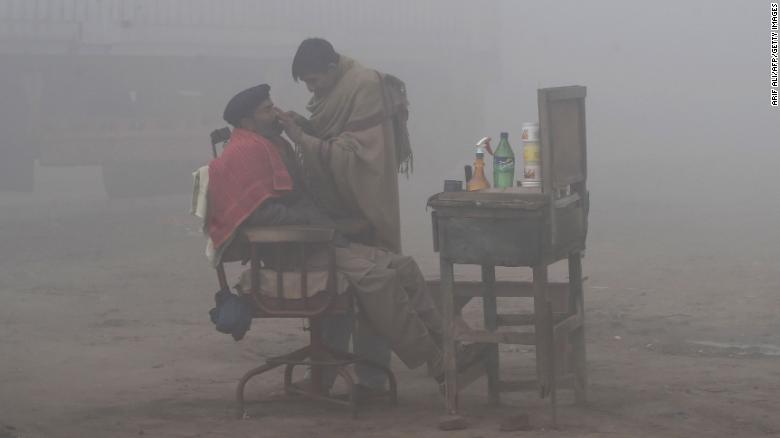 A Pakistani barber shaves a customer alongside a road amid heavy fog and smog conditions in Lahore.
 What we'll have to endure as the climate crisis gets worse
A Pakistani barber shaves a customer alongside a road amid heavy fog and smog conditions in Lahore.
Climate crisis and urbanization
The air quality data shows, "clear indications that climate change can directly increase the risk of exposure to air pollution" the report said, noting it impacts air quality in many cities through desertification and increased frequency of forest fires and sandstorms. Greenhouse gas emissions, with the burning of fossil fuel a key driver of the climate crisis, is also a major cause of dirty air. Many countries are still dependent on coal for their energy production, the biggest contributor to PM 2.5 emissions. China, for example, is the world's largest producer and consumer of coal. Exacerbating the problem is rapid urbanization in industrializing Southeast Asian cities, which is also a major cause of air pollution and poses severe challenges to managing PM 2.5 levels, the report found. Indonesia's Jakarta and Vietnam's Hanoi overtook Beijing for the first time among the world's most polluted capital cities, "in a historic shift reflecting the region's rapid industrialization," the report said. The two capitals have annual PM 2.5 levels which are about 20% higher than those of Beijing, according to the report. "Fast growing cities need to make a choice if they want to grow in a sustainable manner," said Yann Boquillod, director of air quality monitoring at IQAir. However, it's not all bad news. People power is bringing about change, he said. "Up to recently, growth was more important than the environment, but we're seeing a very clear trend that people are demanding more from their local governments," Boquillod said. "During the year 2019, citizens of Hanoi have massively become aware of the air quality in their city, thanks to the deployment of air monitors. This is an example how air quality data has helped to push government to improve the environment." And in the past year residents of Jakarta have sued the government over worsening air pollution in the city. Jakarta is Southeast Asia's most polluted city and the fifth most polluted capital -- up from 10th position in 2018, according to the report. It's on track to become the world's biggest megacity by 2030, with a population of 35.6 million, according to a 2018 Euromonitor report. "The city's rapid growth has coincided with heightened PM2.5 levels, as the growing population adds to its notorious traffic congestion, and coal-based energy demand," the AirVisual report said.
What we'll have to endure as the climate crisis gets worse
Bright spots
Chinese cities have overall seen marked improvements in recent years, with average concentrations of pollutants falling 9% from 2018 to 2019, according to the report. China's capital Beijing has more than halved its annual PM 2.5 levels over the past decade and has dropped out of the world's 200 most polluted cities following concerted efforts to get air pollution under control. However, 98% of Chinese cities still exceeded WHO guidelines and 47 feature among the top 100 most polluted cities in the 2019 World Air Quality Report. Dust and sandstorms in the desert city of Hotan, in western China's Xinjiang region, make it the world's second most polluted city in 2019, with an average AQI of 110.1. Another positive is that last year saw a significant increase in countries expanding their air quality monitoring, "with the number of monitoring stations increasing by more than 200% since the year prior." More monitoring data is important to inform communities about the quality of the air they are breathing and helps tackle air pollution globally, the report said. Continuous public air quality data is now available for the first time for Angola, the Bahamas, Cambodia, DR Congo, Egypt, Ghana, Latvia, Nigeria and Syria, the report found. Yet there is still a large gap in air quality data for many parts of the world, the report said, meaning the total number of cities exceeding the WHO PM 2.5 threshold could be higher.DISCLAIMER: The Views, Comments, Opinions, Contributions and Statements made by Readers and Contributors on this platform do not necessarily represent the views or policy of Multimedia Group Limited.
DISCLAIMER: The Views, Comments, Opinions, Contributions and Statements made by Readers and Contributors on this platform do not necessarily represent the views or policy of Multimedia Group Limited.
Latest Stories
-
Anti-LGBTQ Bill: Forget the rumour mongers, I’m a man of action, and will pass the bill – Speaker
24 minutes -
Women and children among those killed in Sudanese army shelling of wedding celebration
28 minutes -
President Mahama is not sincere with Ghanaians on LGBTQ bill matter – Hassan Tampuli
45 minutes -
Gov’t to establish Prison Industrial Hub to equip inmates with income-generating skills – Prison Service boss
1 hour -
Alhassan Tampuli donates cement, roofing sheets to support storm victims in Gushegu
1 hour -
Alhassan Tampuli appeals for urgent support for storm victims in Gushegu
1 hour -
The hypocrisy must stop; pass Anti-LGBTQ+ Bill now – Alhassan Tampuli to Mahama
1 hour -
Imprisonment should be rehabilitative, not punitive – Ghana Prisons boss at UNGA
2 hours -
Ga Adangbe traditional priests petition Mahama over McDan aviation licence revocation
2 hours -
Anti-LGBTQ Bill: NDC’s arrogance is worrying – Hassan Tampuli
2 hours -
Let’s give OSP time to mature, not to scrap it – Hassan Tampuli
2 hours -
Nigeria convicts 386 Islamist militants in mass trials
2 hours -
Djibouti president wins election with 97.8% of vote, state media says
2 hours -
We don’t have mandate to deduct tax from rent allowance of security services personnel – Interior Ministry clarifies
2 hours -
Ablakwa receives Presidential Special Envoy on Reparations to advance global agenda
3 hours