

Audio By Carbonatix
Over ten years ago, Dr. Siera Vercillo embarked on an experience where she is working to reshape the understanding of food systems with her focus on Northern Ghana.
As a recent graduate, she set foot in this vibrant region, and little did she know that her career in agrarian and food studies would become a fascinating tale of tradition, globalization, and personal choice.
A Humble Beginning
Dr. Vercillo vividly recalls her early days in northern Ghana, particularly her friends' amused reactions to her preference for fried rice.
They saw it as a foreigner's delight, a light choice compared to their beloved 'heavy' staple, TZ (Tuo Zaafi), a maize/millet flour dish commonly enjoyed every evening.
But fast forward to the present and these same friends are now craving fried rice and eagerly inquiring about pizza, a newfound fascination from her own country.

“They considered rice ‘light’ food that foreigners like myself ate. They compared this light food with the ‘heavy’ staple of TZ (Tuo Zaafi) which they preferred to eat every evening. Recently, those same friends asked me to bring them fried rice from a vendor in Tamale, or to a restaurant there serving pizza, a food they kept hearing about but had not yet tried,” she said.
A Decade of Engagement
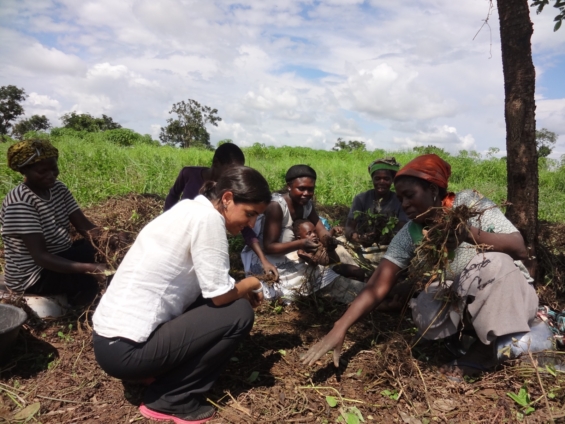
For over 10 years, Dr. Vercillo has continually returned to Northern Ghana, conducting participatory research with smallholder farming families in rural areas around Tamale. Her most recent project, however, has brought her focus squarely onto the city itself.

Here, she collaborates with neighborhood food producers, food vendors, restaurants, government and key other stakeholders, delving deep into the intricate web of local food practices and their connection to the global food system.
Divergent Food Trends
In her interactions with Tamale residents in 2022, Dr. Vercillo uncovered two contrasting food trends that mirror her friends' evolving tastes. On one hand, there was a discernible shift towards global food practices. People were embracing highly-processed ingredients and foods laden with inorganic fertilizers and agrochemicals.

On the other hand, a significant portion of the population clung tenaciously to local traditions, cultivating and selling staple ingredients grown in the vicinity with minimal external intervention.
A Rich Tapestry of Local Delicacies
Dr. Vercillo's journey through Tamale's culinary landscape unveiled a treasure trove of local and traditional foods. These dishes, often prepared with care and tradition, included soups made from locally grown greens and vegetables like amaranth, jute, and bean leaves.

These were paired with an array of ingredients, from hot peppers to smoked/salted fish and various meats. The staple TZ (Tuo Zaafi) remained a constant companion to these dishes.
One of the highlights of her research was her collaboration with Chef Amina, the proprietor of Duduhgu Experience, an indigenous food kitchen in Tamale.

Through captivating videos, they shared the secrets of crafting dishes like dawadawa jollof, a steamed rice delicacy that encapsulated the essence of Northern Ghana's culinary heritage. Chef Amina's kitchen not only preserved disappearing foods but also highlighted underutilized traditional ingredients.
The Global Influence
However, amidst the celebration of local flavors, Dr. Vercillo couldn't ignore the burgeoning influence of global cuisines. In Tamale, pizza had become a sensation, albeit with a local twist – a 'zoo' of meats adorning the pie.

Instant noodles, too, gained popularity as a quick, affordable meal, enjoyed late at night or even taken to school by children. Dr. Vercillo observed these global food practices reshaping local diets, contributing to what she passionately studies – the agrarian and nutrition transition theory.
The Nutrition Transition Theory
The nutrition transition theory posits that as local food economies industrialize and globalize, people gravitate towards highly processed foods associated with a global diet. Ghana, particularly Tamale, has witnessed a surge in obesity, driven by urbanization and shifting dietary preferences.
Complex Factors at Play
Yet, the choices people make regarding their diets are not solely driven by personal preference. Dr. Vercillo's research unveils a complex interplay of factors, including cost, convenience, and availability.
Highly processed spices and oils, along with foreign foods rich in salts, sugars, and fats, often become preferred choices due to their affordability and widespread availability.

“But people’s choices to consume foreign, highly processed foods and ingredients are more complicated than personal preferences associated with urbanism and upward mobility.
I learned there are several reasons for these dietary changes. Instant spices are cheaper, faster to use and sometimes more readily available in shops and stalls compared to locally produced and foraged flavourings like dawadawa, canton and smoked fish, especially during off season periods.”

Climate change, characterised by increasingly erratic rainfall patterns, shortened growing seasons, and increasing heat stress, poses additional challenges to local ingredients that are predominantly rain-fed.
Furthermore, NGO, donor, and government support for high-yielding monocrops like maize and rice, in line with the Green Revolution, have encroached upon lands where local staples once thrived.

“Acutely erratic and less rainfall overall, shortening growing seasons, heat stress and aridity associated with a changing climate also make many locally produced and foraged staples and flavourings less available since they are predominantly rain-fed,” she stated.
A Taste for Transformation
As people develop a taste for highly processed spices, oils, and foreign foods high in salts, sugars, and fats, they seek these choices more fervently.
Dr. Vercillo's research reveals that individuals from all walks of life, rich and poor, young and old, find themselves ensnared in cycles of taste addiction, consuming fewer local ingredients and more unhealthy ones.

Many describe this shift as a betrayal of cultural traditions and knowledge, fearing that these cherished practices will fade with time.
One poignant example comes from a focus group participant who remarked, "We used to eat the cotton seed and dawadawa with TZ and we were healthy. But now, there is Maggi. In the past, our great grandfathers were not eating Maggi."
The Culinary Challenge
Much like the battle against poverty, the struggle for healthier and more sustainable diets in the face of globalised food is an ongoing challenge.

Some individuals, often more affluent, seek out organically produced food and locally foraged flavorings because they are perceived as healthier and safer. However, these options can be more expensive and less accessible for the average person in the city compared to just two decades ago.
A New Perspective
To date, scholars have theorised that as countries in the Global South urbanize and industrialize people's tastes and food preferences orient towards global products, served largely by multinational corporations. However, Dr. Vercillo's fieldwork paints a different picture.

In Tamale, people consume global foods and ingredients in distinct ways and for varied reasons, often beyond their control. This fresh perspective challenges existing nutrition transition theories, shedding new light on why and how people's diets evolve in developing economies.
As Dr. Siera Vercillo continues her culinary exploration in Northern Ghana, one thing is clear – the story of food is far from simple. It's a story of adaptation, preservation, and the complex interplay of factors that shape our dining choices. And it's a story that continues to unfold, one delicious dish at a time, in the heart of Tamale.
Latest Stories
-
Sahara Group urges journalists to look beyond fuel prices in energy reporting
6 minutes -
Today’s front pages: Friday, October 16, 2026
10 minutes -
Ashanti Region: ECG urges customer cooperation with franchise officers
16 minutes -
Ghana’s research fund faces a test of turning funding promises into scientific breakthroughs
28 minutes -
Dîner en Blanc Accra returns on December 28 for second edition
31 minutes -
20% digital tax: Government hiding behind technicalities to cheat Ghanaians – Dr Boako
1 hour -
David Selassie Anthony declares bid for NDC Deputy National Organiser
2 hours -
Amin Adam proposes 13 measures to strengthen Ghana’s debt transparency and market confidence
2 hours -
Mahama announces $2bn annual investment to accelerate industrialisation
2 hours -
Amin Adam urges monthly disclosure of Sinking Fund as Ghana prepares for DDEP repayments
3 hours -
Stronger banks will fuel business growth and jobs – ADB MD
3 hours -
Galamsey: ‘Rivers that fed our grandparents now run the colour of chocolate milk’ – Sam Jonah
3 hours -
We have been scammed by NDC, government is only doing PR – Abanga Fuseini
3 hours -
Republic Bank–JoyNews Habitat Fair opens in Ho today
3 hours -
Dr Boako challenges government over new digital tax
3 hours