

Audio By Carbonatix
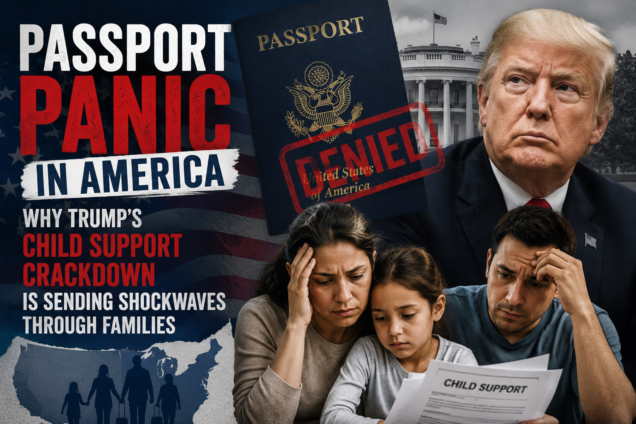
Fear is quietly spreading across many homes in America. Some men are reportedly making emergency travel plans. Others are desperately calling lawyers, negotiating payment plans, or avoiding international trips altogether. The reason is a tough enforcement policy now gaining momentum under President Donald Trump’s administration, a crackdown that could strip thousands of Americans of their U.S. passports over unpaid child support debts.
Supporters call it accountability.
Critics call it punishment.
But one thing is certain: the policy is shaking families, marriages, and immigrant communities across the country.
The United States government has intensified enforcement measures against Americans who owe substantial amounts in court-ordered child support, triggering widespread debate over whether the policy protects children or pushes already struggling families deeper into crisis.
Under the renewed enforcement strategy backed by President Donald Trump’s administration, the U.S. Department of State is working closely with the Department of Health and Human Services (HHS) to identify citizens who owe more than $2,500 in unpaid child support. Those affected risk having their passports denied or revoked until the debts are resolved.
For thousands of Americans, the implications are serious.
Once a passport is revoked, international travel becomes impossible. Individuals affected may lose the ability to travel for work, family emergencies, business opportunities, or immigration-related responsibilities abroad. To regain passport privileges, the individual must first clear the outstanding debt through state child support agencies and be removed from delinquency records maintained by HHS.
Government officials argue that the policy is necessary to protect children and force irresponsible parents to meet their obligations. “The State Department is putting American families first through our passport process,” the administration stated.
Federal authorities insist that raising children is not optional and that parents who deliberately refuse to support their children must face consequences. Supporters of the policy believe it sends a powerful message that financial neglect of children will no longer be tolerated.
However, critics argue that the crackdown could create devastating consequences for many working-class Americans already struggling under economic pressure.
Across social media platforms and immigrant communities, discussions surrounding the policy have become increasingly emotional. Some individuals believe the law unfairly punishes struggling fathers who may already be battling unemployment, rising living costs, divorce-related legal fees, or mental health challenges following family breakdowns.
Family law experts note that child support disputes in America have long been controversial. While many parents intentionally avoid responsibility, others fall behind due to financial hardship, job loss, or lengthy court disputes.
Critics argue that revoking passports may worsen the very problem the government hopes to solve.
“A passport is not just a travel document anymore,” one community advocate explained. “For many people, it is connected to their livelihood. Some travel internationally for work, contracts, trucking, shipping, consulting, or caregiving responsibilities. Taking away their passport may also take away the opportunity to earn money.”
The debate has become particularly sensitive among immigrant communities, including Africans living in the United States and Canada. Many immigrants maintain strong family ties overseas and often travel frequently to support relatives, attend funerals, invest in businesses, or manage family obligations back home.
Some community members fear that the policy could place additional strain on already broken relationships and increase tensions within families.
Others believe the policy may discourage marriage altogether among younger men who fear the long-term financial and legal consequences of divorce and custody battles in America.
“There are men quietly discussing whether it is even safe to marry anymore,” one Ghanaian community member stated during an online discussion. “Many feel the system is becoming too dangerous financially and emotionally.”
The issue has also revived debates surrounding fairness within family courts. Some critics claim the legal system can sometimes become hostile during difficult separations, particularly when accusations, emotional disputes, or custody conflicts escalate. Advocates for fathers’ rights argue that some men face overwhelming financial obligations while also struggling emotionally after losing access to their children or homes during divorce proceedings.
At the same time, child welfare advocates strongly defend the government’s actions, insisting that children should never suffer because a parent refuses to provide support. “Children still need food, housing, school supplies, healthcare, and stability,” one family support advocate noted. “Accountability matters.”
Despite the differing opinions, one reality remains clear: the policy is already creating anxiety for thousands of Americans with unresolved child support debt.
Legal experts are now advising affected individuals to urgently contact child support enforcement agencies, negotiate payment plans, and resolve outstanding arrears before passport restrictions take effect.
Meanwhile, debates continue over whether the crackdown represents responsible governance or excessive punishment.
Critics warn that harsh enforcement alone may not heal broken families. Instead, they argue that America should invest more heavily in mediation, job assistance, counseling services, co-parenting education, and economic support systems that help struggling parents recover financially rather than pushing them deeper into crisis.
Supporters, however, remain firm that responsibility must come before privilege and that no parent should escape obligations while children suffer financially.
As the policy expands nationwide, thousands of Americans may soon face a difficult and emotional choice: settle their debts or lose the freedom to travel beyond America’s borders. And for many families already carrying emotional scars from separation, divorce, and financial hardship, the debate over child support enforcement is no longer just political.
It has become deeply personal.
Latest Stories
-
Lawrence Kobena Nsarko Otoo, Esq
32 minutes -
Bel-Aqua intensifies mental well-being campaign ahead of 15th anniversary
35 minutes -
From banking to party finances: Alfred Kwadwo Thompson elected NPP Treasurer
40 minutes -
George Christian Papa Mends
45 minutes -
Ali Suraj elected NPP NASARA Coordinator
56 minutes -
Mustapha Hamid misses out on NPP Vice Chairmanship by 31 votes despite early poll lead
1 hour -
Kojo Bamba, Henry Nana Boakye and Nana Akomea elected NPP Vice Chairmen
2 hours -
From Delta Force to NPP First Vice Chairman – Kojo Bamba’s political journey
2 hours -
Police restore calm at Larteh following Odwira festival disturbance
3 hours -
‘All the camps will dissolve’ – Bawumia demands one NPP for 2028
3 hours -
There is no time to waste – Bawumia orders NPP to begin 2028 work
3 hours -
Sarkodie visits MobileMoney Fintech LTD
3 hours -
John Boadu unveils new NPP strategy to win back youth and modernise party
3 hours -
Hawa Koomson elected NPP National Women’s Organiser
3 hours -
John Boadu begins NPP rebuild from grassroots ahead of 2028 election
3 hours