

Audio By Carbonatix
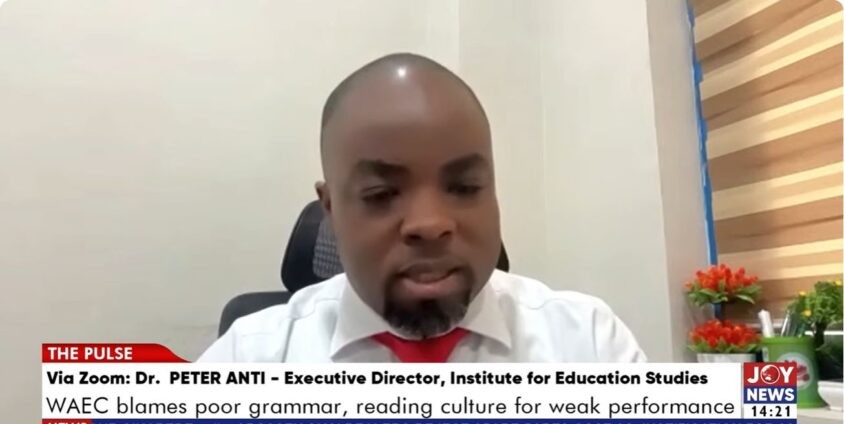
The Executive Director of the Institute for Education Studies (IFEST), Dr Peter Anti, says Ghana’s latest performance in English Language and Mathematics examinations is a clear indication of persistent challenges with literacy and numeracy in the country’s education system.
According to him, the situation, particularly at the basic education level, requires urgent attention from education managers to prevent students from carrying foundational learning gaps into higher levels of education.
Speaking on JoyNews’ The Pulse, Mr Anti noted that about 55,000 Basic Education Certificate Examination (BECE) candidates were unable to qualify to progress to the next level because they failed English Language, Mathematics or both subjects.
He said although the Ministry of Education has provided some flexibility for affected students, the figures should serve as a wake-up call for stakeholders.
“It’s a clear indication that we have had serious challenges with English Language and Mathematics,” he said.
Dr Anti also pointed to the performance of candidates in the West African Senior School Certificate Examination (WASSCE), noting that while there has been some improvement in Mathematics, the failure rate in both Mathematics and English remains a major concern.
He believes the persistent difficulties in the two core subjects demonstrate weaknesses in the development of foundational competencies among pupils.
“For me, it’s a clear message to the education managers that we are losing out on literacy, English Language and Mathematics,” he said.
Dr Anti stressed that efforts to address the problem must begin at the basic education level, where pupils acquire the foundational skills needed to succeed throughout their academic journey.
“If we want to work on that, we need to start at the basic level. That is where they build the competency, and that will carry them through the Junior High School to the Senior High School,” he explained.
He therefore called for a renewed focus on foundational literacy and numeracy, arguing that improving students’ performance at the basic level would have a significant impact on outcomes at the secondary and tertiary levels.
His comments come amid renewed concerns over examination performance and the number of students struggling to meet the minimum requirements to progress through Ghana’s education system after the release of results of the Basic Education Certificate examination and West African Senior School Certificate Examination.
Latest Stories
-
‘Do not let Russia pay for its madness with lives of your people’ – Zelensky to Ghana, 46 other countries
6 minutes -
6,079 promotion cases fully processed and paid – CAGD says amid nationwide teachers’ strike
26 minutes -
Teacher unions to meet government Monday over nationwide strike
41 minutes -
Photo story: Republic Bank-JoyNews Habitat Fair clinic wraps up after three days of housing solutions, expert engagement
45 minutes -
National Peace Council urges investment in youth to sustain Ghana’s peace
1 hour -
Afenyo-Markin urges youth to speak up against injustice
1 hour -
CAF annuls Edo Queens victory, orders WAFU B final to resume from extra time
2 hours -
Interior Minister urges traditional authorities to enforce anti-bushfire bye-laws
2 hours -
3rd Republic Bank-JoyNews Habitat Fair Clinic ends on a high note after three days of strong patronage
2 hours -
Ten climbers missing after avalanche hits Himalayan base camp
2 hours -
NPP had more permanent fuel relief measures than current GH¢2 diesel cut – Amin Adam
3 hours -
Photos from the 3rd Republic Bank-JoyNews Habitat Fair Clinic
3 hours -
Ethiopia’s army promises restraint amid fears of new civil war
3 hours -
Amin Adam calls for review of fuel taxes as diesel prices remain above GH¢18
3 hours -
World Vision Ghana, Ahafo districts sign MoU for universal WASH coverage
4 hours