


Audio By Carbonatix
A global study of adolescents from low-income neighborhoods revealed that teenagers from Baltimore, a city located just 40 miles from the US capital, are faring worse than their counterparts in Nigeria.
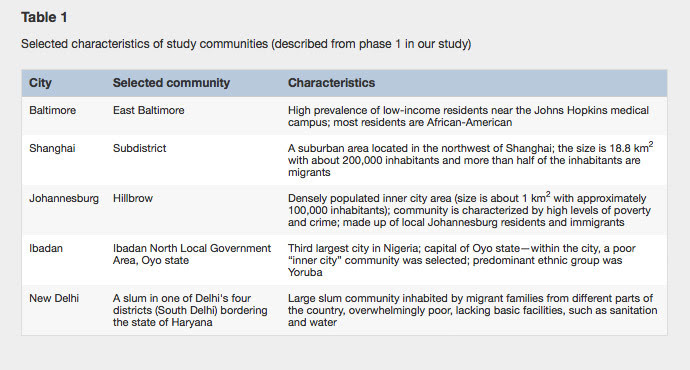
Many people tend to associate child poverty with desperate scenes out of Africa or India. But according to a recent WAVE study, an international survey that examined the living conditions of 15-19 year olds in poor areas in Baltimore, Shanghai, Johannesburg, New Delhi and Ibadan (third largest city in Nigeria), the problem is much closer to home than many people realize.
In the five neighborhoods examined in the study, poverty was the common thread that linked these culturally diverse locations. Differences among the teens in these urban areas became obvious, however, when it came to how they perceived their state of well-being.
Teens from Baltimore and Johannesburg, South Africa, viewed their communities more negatively than the other locations in the study.
The two cities showed the lowest number of teenagers who felt safe in their neighborhoods (percentages ranged from 43.9 percent among males in Johannesburg to 66.1 percent of females in Baltimore), as well as the highest averages for witnessing violence (8.9 percent for males and 7.0 percent among females in Johannesburg; 7.0 percent among males and 6.3 percent among females in Baltimore).
These two cities also showed “poor perceptions about their physical environments, their sense of social cohesion, and their sense of safety within their neighborhoods.”
In Baltimore, teenagers exhibited high rates of mental health problems, drug abuse, sexual violence and teen pregnancy. In comparison, teens in New Delhi, despite residing in a much poorer country than the United States, showed fewer signs of such social behavior.
The lead author of the study, Kristen Mmari, assistant professor at Johns Hopkins Department of Population, Family and Reproductive Health, said the perception teenagers have of their communities plays a large role in how they behave.
“For example, a young man in New Delhi and a young man in Baltimore may both live in neighborhoods with poor living conditions and little opportunity, but because the teenager in New Delhi is able to see his environment in a more positive light, he is less likely to experience to adverse health problems,” Mmari told Vocativ. “He paints a different picture.”
Also, the prevalence of violence and weak social cohesion, which ranks higher in Baltimore and Johannesburg than in the three other cities, also has an impact. In Baltimore, a high number of teenagers from impoverished homes grow up in single-parent homes, in many cases with the father in prison, while many adolescents in Johannesburg have lost a parent to HIV/AIDS.

“When you look at how they perceive their environments, kids in both Baltimore and Johannesburg are fearful. They don’t feel safe from violence,” Mmari said. “This is something we didn’t really see in other cities. In Shanghai, for example, there wasn’t a great deal of violence. You’d ask kids about their safety concerns, and they would say something like, ‘I’m afraid of crossing a busy street.’”
The study indicates a connection between the prevalence of violence and weak social bonds with issues of a sexual nature. Fifty percent of adolescent girls in Baltimore, and 29 percent in Johannesburg, had been pregnant, while more than 10 percent of teenage girls in both cities said they have been raped or assaulted by someone in the previous year.

The study concluded that individuals from Baltimore and Johannesburg give their neighborhoods the lowest ratings, while people from Ibadan and Shanghai recorded the highest ratings. Citizens from New Delhi ranked in the midrange.
“It is worth noting that in spite of its location in a high-income country, the Baltimore neighborhood had some of the lowest ratings,” Freya Sonenstein, of the Johns Hopkins Bloomberg School of Public Health, wrote in the study’s introduction. “In contrast, Ibadan with its high ratings is located in a lower middle-income country with substantially fewer resources.”
Latest Stories
-
‘Very intentional, very unique’ – HeFRA Registrar clarifies Free Primary Healthcare rollout
51 seconds -
14 Tamale Prison inmates pass NVTI exams with 100% score under rehabilitation programme
4 minutes -
Hands off the judiciary — Parliament warns against politicising bench
7 minutes -
DVLA cuts sod for ultra-modern Tema office, commissions new offices in Ashaiman and Teshie-Nungua
8 minutes -
Walewale NDC executives endorse youth concerns after protest, urge dialogue
23 minutes -
OSP brouhaha: Common sense over legal reasoning
23 minutes -
Nurses to receive medical backpacks under Free Primary Healthcare programme
29 minutes -
Prisons officers complete motorbike training with Police MTTD Riders Unit in Accra
41 minutes -
Sachet water price hike: Defying government is economic sabotage
46 minutes -
Resultant crimes involving moral turpitude of birth tourism and false dependency tax claims
51 minutes -
Gov’t ring-fences GH¢1.2bn for free primary health care rollout
53 minutes -
Prempeh College hosts impactful “becoming a man” summit on modern masculinity
1 hour -
Sylvia Sarfoa Ansong emerges as a fresh face in Ghana’s evolving advertising industry
1 hour -
Jury system should be reformed, not abolished — Deputy Attorney General
1 hour -
Supreme Court @150: Chief Justice calls for faster, closer and more accessible Justice delivery
1 hour