

Audio By Carbonatix
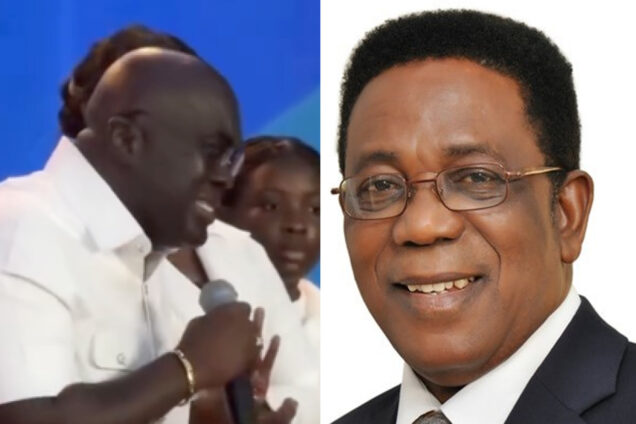
Former Minister of State and academic, Prof Kwesi Yankah, has criticised the recent emotional public apology by Chief of Staff Julius Debrah, arguing that national leaders should reserve public emotion for Ghana’s worsening environmental crisis rather than political controversies.
In an opinion piece titled “Weep Not Julius, Mourn Your Dying Nation,” published on Facebook on Tuesday, April 28, Prof Yankah described the Chief of Staff’s emotional apology to the leadership of the Church of Pentecost as misplaced, insisting that Ghana’s environmental destruction, particularly from illegal mining, should be the real cause for national grief.
Background
The Chief of Staff broke down in tears during a Thanksgiving service marking his 60th birthday at the Pentecost International Worship Centre (PIWC) Trasacco, where he apologised to Apostle Eric Nyamekye, Chairman of the Church of Pentecost, over controversial remarks made by the Chief Executive Officer of the Ghana Free Zones Authority, Dr Mary Awusi.
The dispute began after Apostle Nyamekye warned that pollution from illegal mining, popularly known as galamsey, had rendered some rivers in mining communities unusable for baptisms. His comments triggered a sharp response from Dr Awusi, which drew widespread criticism and public backlash.
During the service, Mr Debrah apologised on behalf of government officials, describing the remarks as a “slip” and pleading for forgiveness, an emotional gesture that drew national attention and mixed reactions.
Yankah questions ‘misplaced tears’
Reacting to the incident, Prof Yankah argued that public weeping by high-ranking officials should be reserved for matters of grave national significance rather than interpersonal or political disputes.
He criticised what he described as the symbolic nature of the apology, suggesting that the Chief of Staff appeared to be “shedding somebody’s tears” on behalf of another official who had been criticised for her remarks.
The academic also suggested that the emotional apology carried political undertones, noting that offending influential religious institutions could have electoral consequences if not swiftly addressed.
According to him, such gestures risk being interpreted as political damage control rather than sincere national reflection.
Read Also: Chief of Staff tears as he apologises to Pentecost Church over Free Zones CEO’s conduct
Focus should be on the environmental crisis
Prof Yankah argued that Ghana’s worsening environmental degradation caused by illegal mining presents a far more compelling reason for public sorrow than the apology controversy.
Quoting from what he described as a viral essay on polluted rivers, he highlighted the devastating state of water bodies across parts of the country, describing them as resembling “the fluid corpse of a nation flowing into the sea”.
He stressed that such environmental destruction—not political missteps—should move national leaders to tears.
Children’s health cited as national emergency
The former minister further reinforced his argument by referencing concerns raised by medical professionals, particularly warnings about the long-term health effects of mercury contamination linked to illegal mining.
He cited correspondence attributed to paediatric health advocates, which warned that exposure to mercury—especially before birth—can lead to irreversible brain damage, increased disease burden and long-term health complications among children.
According to Prof Yankah, such warnings demonstrate that the galamsey crisis is no longer only an environmental concern but a serious public health threat affecting future generations.
‘Cry for Mother Ghana’
Throughout the opinion piece, Prof Yankah repeatedly urged national leaders to prioritise the country’s environmental crisis above symbolic gestures aimed at resolving political tensions.
He argued that the destruction of rivers, forests and livelihoods constitutes a national tragedy deserving of urgent attention and emotional response from leadership.
Rather than focusing on individual controversies, he called on public officials to confront what he described as the broader “assault” on Ghana’s natural resources and the well-being of its citizens.
Latest Stories
-
Skipping breakfast bad for your health?
11 minutes -
Kpeshie Lagoon reclamation linked to first-ever flooding at Tse Addo – ISD
19 minutes -
GRA announces major policy proposal under Modified Taxation Scheme initiative
34 minutes -
TCL sues Samsung for false advertising over ‘Mini LED’ televisions
41 minutes -
US embassy child abuse images suspect flown from UK before police interview
50 minutes -
Payment dispute led to murder of Dr Jesse Amuah and wife at Asylum Down – Court told
51 minutes -
COPEC calls for GH¢1 petrol, continuation of GH¢2 diesel subsidy amid price surge
1 hour -
Petrol to sell at GH¢16.26, diesel GH¢19.07 from Wednesday – COPEC
1 hour -
Massive crowds flock to JoyNews–Republic Bank Habitat Fair on final day to explore mortgages and seek expert advice
2 hours -
Ghana’s Alice Banaaza spotlights fugu weaving at 2026 CHAN Festival in UK
2 hours -
Russia’s Youth Festival could unlock business partnerships and scholarships for Ghanaian youth – John Aggrey
2 hours -
The 21st Century Gold Standard was piloted in Ghana under Bawumia – Gideon Boako
2 hours -
Ahafo NDC Vice Chairman pays nomination fees for 168 constituency executives ahead of 2026 internal reorganisation
2 hours -
Upper West receives GH¢101.9m DACF for development projects
2 hours -
Ghana must use gold to reduce overdependence on dollar – Gideon Boako
3 hours