

Audio By Carbonatix
Health authorities in the Sekyere East District have expressed concern over the growing proportion of pregnant women diagnosed with anaemia, describing the trend as one of the district's most worrying public health challenges.
The concern was raised during the district's 2025 Annual Performance Review, where stakeholders assessed health indicators and discussed measures to address emerging challenges.
District Health Director, Dr. Justice Ofori-Amoah, said anaemia among pregnant women at 36 weeks of pregnancy has increased consistently over the past five years.
"What is more alarming in the district for the last five years consecutively is anaemia among pregnant women at week 36," he said.
According to Dr. Ofori-Amoah, the anaemia rate among pregnant women increased from 27.93 per cent in 2021 to 37.42 per cent in 2025. The rise occurred even as the number of women registering for antenatal care declined over the period.
In 2021, he said 1,579 pregnant women registered for antenatal care, with 27.93 per cent diagnosed with anaemia. Registrations dropped to 1,226 in 2022, when the anaemia rate increased to 33.12 per cent.
The trend continued in 2023, with 1,110 registrations and an anaemia rate of 35.77 per cent. In 2024, the district recorded 1,027 antenatal registrations and an anaemia rate of 36.32 per cent.
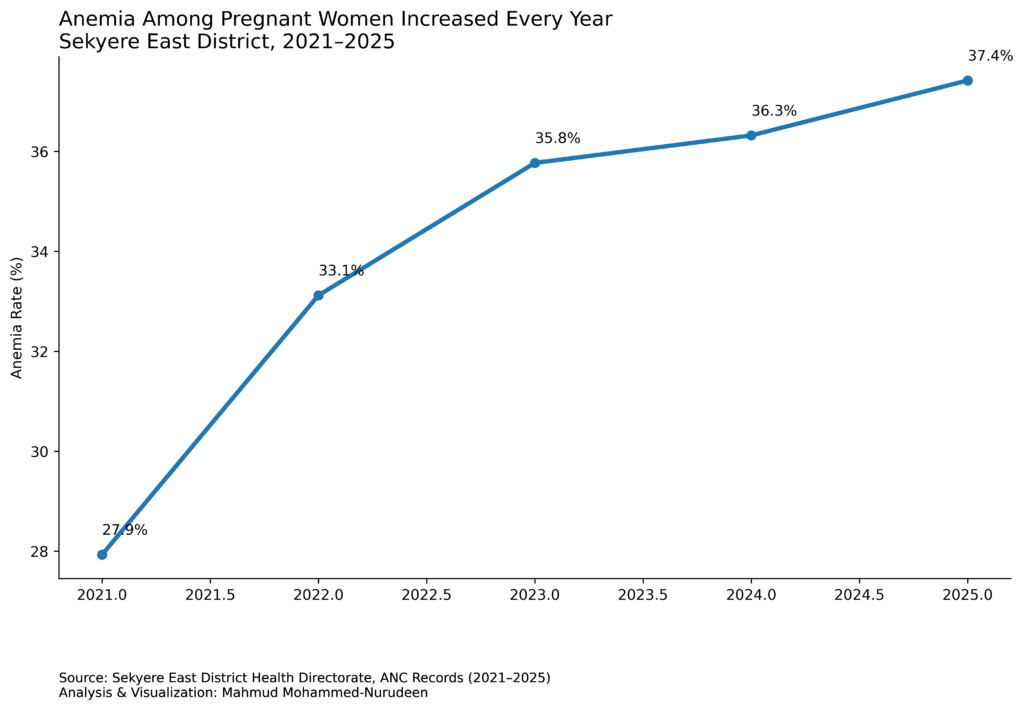
In 2025, antenatal registrations increased slightly to 1,061, but the anaemia rate climbed further to 37.42 per cent, meaning more than one in every three pregnant women attending antenatal care was anaemic.
While the proportion of women affected has risen steadily, antenatal care registrations have fallen by about one-third since 2021, raising concerns about both maternal nutrition and access to health services.
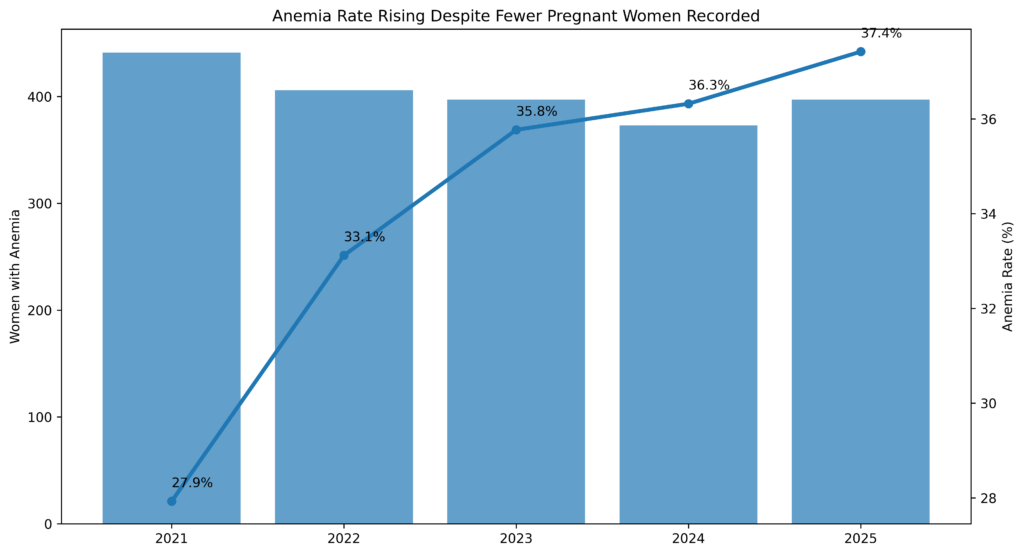
"So consistently you realized that the anaemia situation in the district is just increasing every year by year which is quite worrying," Dr. Ofori-Amoah said.
Stakeholders agree on response measures
Dr. Ofori-Amoah said discussions involving traditional leaders, district authorities and other stakeholders had focused on practical ways to reduce the condition.
"With the assembling and gathering of all stakeholders including Nananom and the District Chief Executive, we have agreed that as a people that we have to continuously engage the women to take the locally produced foods such as kontomire, turkey berry and all the local foods," he said.
He also pointed to the use of Iron III polymers as one of the interventions being adopted in some health facilities.
"What are also learning from other facilities is the introduction of iron III polymers that is given on the spot to pregnant women. The good news is that it ensured and so once we give that they will take," he said.
Despite ongoing interventions, Dr. Ofori-Amoah said some pregnant women do not take prescribed medication after leaving health facilities.
"Upon our checks, the women who comes for this routine medication for pregnant women some of them do not take it when they get home and that is quite worrying," he said.
He further expressed concern that some women do not attend antenatal care services at all. "Some women also do not attend ANC and it is disturbing," he said.
The health director urged pregnant women to seek antenatal care early and attend regularly.
"The WHO standard is that you should attend ANC not less than four plus so it can be four or more and the more you attend ANC the better for you and the fetus so that you can have a safe delivering and avoid any complications with birth including deaths," he said.
Traditional leader joins call for action
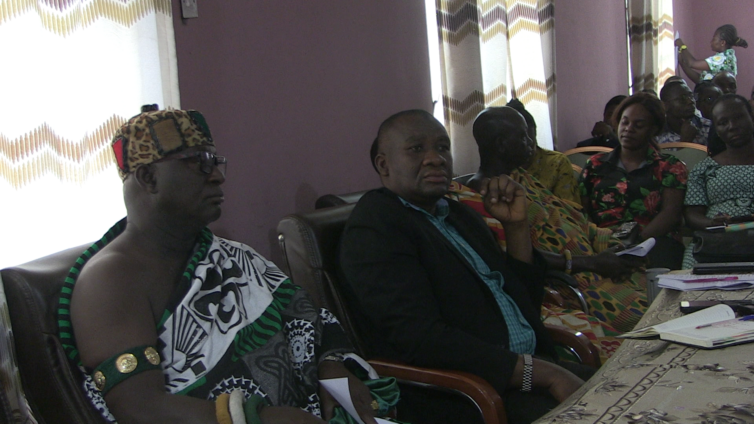
Speaking after the review meeting, Nana Kweku Adjei Juma II, Chief of Nsutem, described the gathering as an important opportunity to assess the district's health performance and identify areas requiring attention.
According to the chief, the district recorded encouraging progress in some areas, particularly antenatal attendance and family planning services.
"Especially the number of pregnant women who visited the hospital last year was very high and also family planning was high too which is good and needs to be continued this year," he said.
However, he identified anaemia among pregnant women as a major concern.
"And what didn't go way last year was anaemia that is pregnant women losses blood when they visits the hospital which results in death," he said.
Nana Juma called on families to support pregnant women by encouraging them to attend antenatal care and take prescribed medication.
"We are pleading that before we can eradicate anaemia, husbands and family members can help by asking them about taking the drugs given to them at the hospitals," he said.
He also encouraged pregnant women to consume local foods believed to support blood production.
"The food we eat such us kontomire, mushroom, and snails, those are the things that gives blood so as soon as you get pregnant start taking them," he said.
The chief warned that anaemia can have serious consequences for both mothers and babies.
"It is painful when a pregnant woman or a baby dies in the cause of delivering," he said. "Sometimes when there is anaemia the baby suffers a brain damage which affects the child when learning."
Rabies concerns raised
The annual review also highlighted concerns about rabies following the death of a child in the district.
Nana Juma said a 12-year-old child died after being bitten by a dog.
"We also spoke about rabies, a 12 year old child was bitten by a dog which resulted in his death and the video was very sad," he said.
He urged dog owners to vaccinate their animals to prevent similar incidents.
"We should make sure that everyone who is having a dog in the district should vaccinate his or her dog," he said.
The chief said community leaders would continue to engage residents on both anaemia prevention and rabies control.
"When Nananom sits we will talk about it with our people to improve our health in the community," he said.
Health officials and community leaders expressed hope that increased awareness, regular antenatal attendance and stronger community support would help reduce anaemia cases in the district in the coming year.
Latest Stories
-
Elevate Africa confirms presidents, vice presidents and ministers for 2026 Annual Convening in Accra
16 minutes -
Keta MP commissions 60-seater kindergarten facility to replace unsafe structure
21 minutes -
Salomey Awiti-Baffoe’s lawyers welcome GH¢100,000 bail after earlier rejection
22 minutes -
Domestic tourism and its impact on the local economy
31 minutes -
Top-Up Pharmacy wins Community Pharmacy Chain of the Year at 2026 PSGH Pharma Excellence Awards
31 minutes -
Nigeria military aircraft with 32 on board crashes
34 minutes -
Black Stars need a coach who can inspire players to perform – Ignatius Osei Fosu
35 minutes -
Revenue collector crushed to death on Kasoa-Winneba highway
39 minutes -
GPL Week 5: Stephen Amankona, 8 other outstanding players win NASCO awards
40 minutes -
NPP’s new leadership team has experience to deliver – Dr Asah-Asante
41 minutes -
Mahama committed to developing Volta Region – Chief of Staff
42 minutes -
NPP’s new leadership offers no renewal after ‘micro minority’ defeat – NDC’s Abeiku Hayford
44 minutes -
Blackstar Experience to hold fashion show and summit in November
44 minutes -
Prof Mike Oquaye backs Kojo Bamba’s call for stronger ballot protection
54 minutes -
If police won’t protect you, you’ll protect yourself – Prof Mike Oquaye backs Kojo Bamba’s election
54 minutes