


Audio By Carbonatix
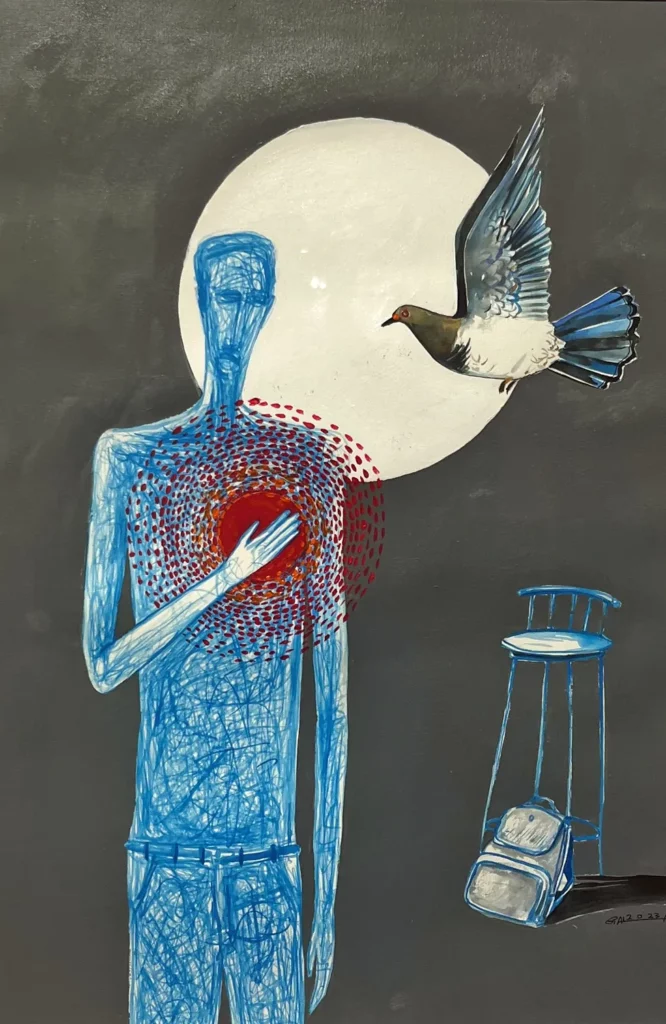
Artist Galal Yousif managed to flee Sudan when conflict erupted earlier this year with only a few belongings stuffed into a small backpack. The turmoil and bag, in which he had crammed his passport, two pairs of jeans, five shirts and a car key, is depicted in his painting Man With a Heavy Heart.
He first created the work as a mural in Addis Ababa, the capital of Ethiopia, which he reached after a harrowing journey in June.
Having now found temporary refuge in Kenya, he has recreated it on canvas - a striking image of a man with a hand over his heart, surrounded by large circular red dots resembling gunshot wounds.
A moon shines behind his head and lying on the ground is the backpack - symbolising all that Sudanese people have lost in the eight-month conflict. He had initially packed his car key thinking he would be back home soon.
"I paint my pain," he tells me in his home-cum-studio in Kenya's capital, Nairobi.
As an artist, he says his mission is to turn his personal experience into a collective visual narrative, offering a powerful glimpse into the "many people lost" in Sudan and the heavy toil of a "useless war".
The conflict began in April when two generals in the ruling junta fell out - pitting the army against the formidable paramilitary group known as the Rapid Support Forces (RSF). The fighting has since forced around seven million people from their homes, the UN says.
Yousif heard the first signs of war while working late toward the end of Ramadan in his studio near the presidential palace in Sudan's capital.
In the early hours of 15 April, he noticed troops massing nearby. Sensing something was about to happen, he decided to drive back to his family's home in the north of Khartoum - reaching there just before dawn after which the fighting started.
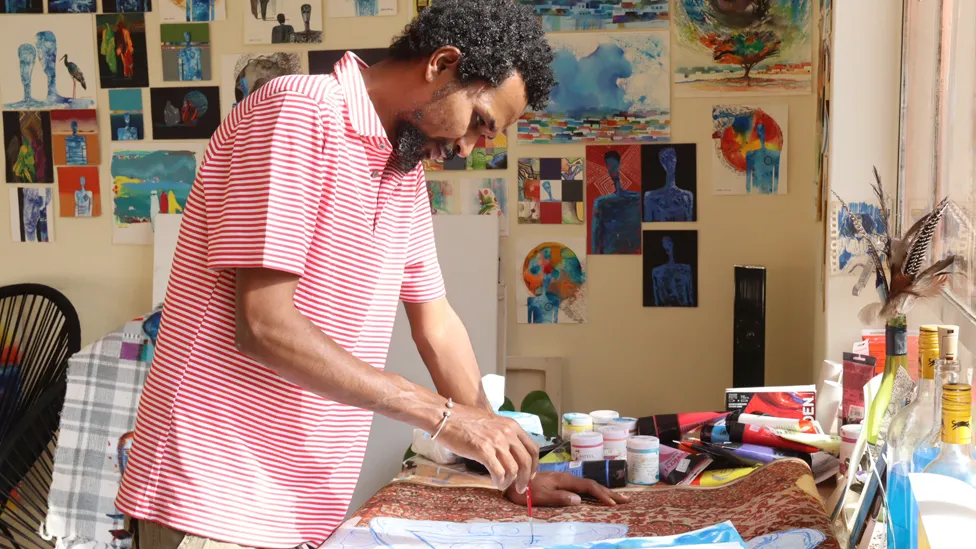
"Chaotic days" followed, he says, as there was no water, electricity and little food - and he struggled to care for his elderly aunt and uncle and other relatives.
Every night he heard the sounds of planes and gunfire and could see large plumes of smoke descending over the city - prompting him to take the decision to leave.
He hoped it was a temporary move - managing to get bus tickets for all the family to head to their ancestral home in the city of Rufa'ah - around 150km (93 miles) south-east of Khartoum.
As the situation deteriorated and with his relatives too frail to travel further, Yousif realised that as a well-established artist he could do more to support them if he headed to Nairobi. So he set off with his backpack on public transport to Metemma, a town on the border with Ethiopia where thousands of people were heading.
A month later he managed to get a flight from Addis Ababa to Nairobi where he has found a community of other Sudanese artists who had also fled the once-thriving art scene in Khartoum.
According to Khartoum art curator Rahiem Shadad, around 35 of these artists are now in the Kenyan capital, including other big names like Bakri Moaz, Yasir Algari and Hani Khalil Jawdat. Others have settled in Cairo.
Mr Shadad, who owns Khartoum's Downtown Gallery, representing many esteemed contemporary artists, tells the BBC his art space now lies in ruins.
A vast amount of artwork, including at least 165 framed paintings and 300 other pieces belonging to 60 artists, has also been lost, he says.
In recent months, the curator, who is also in Nairobi, has spearheaded numerous exhibitions of Sudanese art in the city.
He recently set up The Rest, a space for those in exile to live and work, with support from Nairobi's GoDown Arts Centre.
Despite this warm welcome by Kenya's art community, life is difficult for the Sudanese artists because of issues around asylum, lack of documents and their lack of substantial incomes.
"Some of these artists came with just $100 [£80] in their pockets," Mr Shadad says.
Many of them are also deeply traumatised by their experience and losing their entire catalogue.
"Emotionally and spiritually, I am not OK," artist Tibian Bahari tells me about not being able to return to Sudan where her father and sister still live.
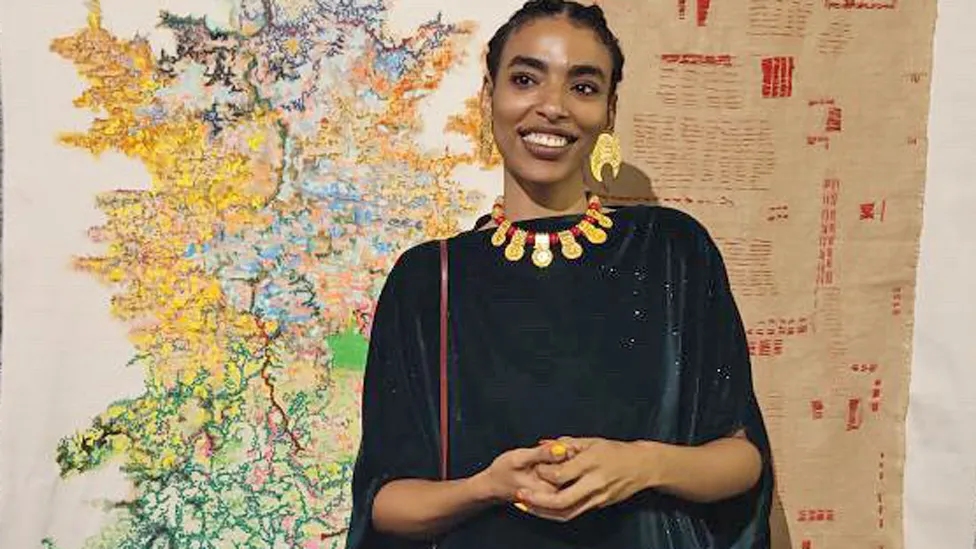
Her aim is to keep Sudan - a "sacred and magical land" - alive through her work, which currently centres around depicting the country's topography.
This determination comes down to her clothing.
"I always wear my jalabiya every morning," she says, referring to the ankle-length, loose-fitting robe with wide long sleeves worn by both men and women in Sudan.
She feels a deep sense of "responsibility" to share "truthfully" her journey and map out the art of displacement and especially keep a space for Sudan's women artists.
Many artists were part of the civilian protest movement that prompted the overthrow of Sudan's long-time leader Omar al-Bashir in 2019. Afterwards, the army initially entered into a power-sharing arrangement with civilian groups, before seizing power and the decent into war.
These artists feel their dreams have been crushed by the conflict - and that the world has forgotten them in the wake of the conflict in Gaza.
In the last week, fighting has escalated. Yousif's family has been under attack by the RSF in Rufa'ah.
Before the phone lines went down, he heard that his family, including his aunt, uncle and some of his siblings, had been forced out of their home by the RSF. They had managed to seek shelter at his grandmother's house in city centre.
"For the second time, my family has lost our home, first in Khartoum and now in Rufa'ah," he says, describing a city under siege.
"Nobody can go out," he says, adding that they are virtually prisoners unable to move around or flee.
Like his painting, Yousif feels his heart continues to bleed.
Latest Stories
-
Knights and Ladies of Marshall group backs Catholic Bishops’ stance on anti-LGBTQ+
22 minutes -
Bright Simons writes: All the Filla in the Ibrahim Mahama/E&P – Gold Fields Saga
46 minutes -
Monetise Idiocy In Ghana
53 minutes -
The Ghanaian prophet and the mysterious death of his scottish wife Charmain Speirs
2 hours -
Nearly 400 sentenced in Nigeria for links to militant Islamists
2 hours -
Ghana’s recovery supported by gold strength despite global oil price pressures – Standard Bank Research
2 hours -
Methodist Church hails Mfantsipim@150; calls for “fresh consecration” to excellence
2 hours -
‘Excellence is our inheritance’ – Nana Sam Brew-Butler hails Mfantsipim’s 150-year reign in leadership
3 hours -
Kwaku Azar writes: A-G vs OSP
3 hours -
Mfantsipim–Adisadel rivalry built excellence, not division – Sam Jonah
3 hours -
Vice President launches Mfantsipim’s 150 years of shaping Ghana’s greatest mind
3 hours -
I assure Otumfuo, Mahama will join him to commission KNUST Teaching Hospital by end of this year – Haruna Iddrisu
4 hours -
Barcelona dominate derby to extend La Liga lead
4 hours -
Gov’t to roll out free special education for persons with disabilities from July 1 – Education Minister
4 hours -
Importers and Exporters Association declares full support for Publican AI port system
5 hours