

Audio By Carbonatix
The Supreme Court has agreed to hear arguments on whether the Trump administration's sweeping global tariffs are legal.
On Tuesday, it said it would review lower court decisions that found the president did not have the legal authority to enact the tariffs, which were brought in through an emergency economic powers act.
The justices said they would hear arguments in the case in the first week of November - an expedited timeline.
It will amount to the biggest test of Donald Trump's presidential authority and his signature economic policy, potentially forcing the US to refund billions in tariffs.
The Supreme Court's conservative majority has so far been amenable to temporarily reinstating Trump's policies, and to his requests for emergency orders. But this case will mark the court's first assessment of the legal basis for one of his administration's most far-reaching policies.
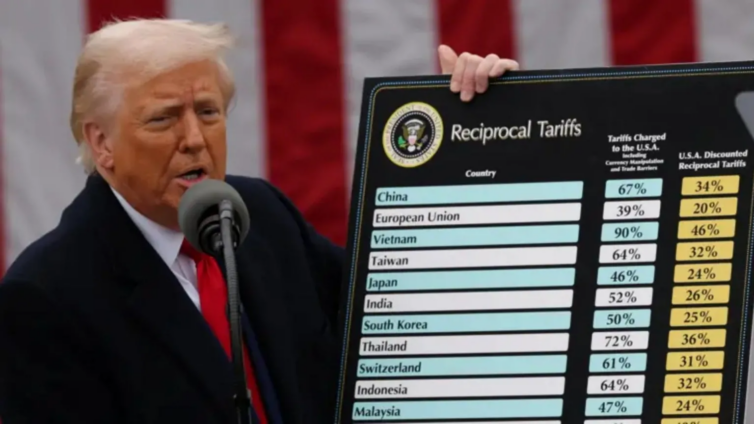
Trump had invoked the International Emergency Economic Powers Act (IEEPA) to impose levies ranging from 10% to 50% on dozens of trading partners. He has also used the emergency law to slap tariffs on China, Mexico and Canada.
Those tariffs have remained in place as the litigation proceeds, even though a federal appeals court ruled last month that Trump exceeded his authority. The power to impose taxes and tariffs continues to belong to Congress, the court ruled.
Trump had criticised the appeals court and its ruling on Truth Social, saying: "If allowed to stand, this Decision would literally destroy the United States of America."
The initial tariff challenge was brought by a group of small businesses and a dozen states, on the basis that Trump's invocation of IEEPA to impose the tariffs was unlawful.
The 1977 law states that a president can pull a number of economic levers "to deal with any unusual and extraordinary threat, which has its source in whole or substantial part outside the United States, to the national security, foreign policy or economy".
While Trump is not the first to invoke it, he is the first president to attempt to leverage the statute to impose broad-based tariffs. When he unveiled his global tariffs, Trump argued that a trade imbalance was harmful to US national security, and was therefore a national emergency.
If the Supreme Court sides with lower courts and finds that Trump's IEEPA tariffs are illegal, questions will remain over whether the US will have to pay back billions of dollars that have been gathered by import taxes on products. Trade deals currently already negotiated with countries including the UK and Japan, as well as deals currently being negotiated, could also be thrown into chaos.
Shortly after the Supreme Court announcement, Trump said on Truth Social that his administration and India were "continuing negotiations" on trade.
"I feel certain that there will be no difficulty in coming to a successful conclusion," he said.
The Trump administration has other mechanisms to impose tariffs beyond IEEPA, though they are more limited in scope.
The president used a different law to enact his tariffs on steel, aluminium and cars. Those levies are not directly affected by this case.
Latest Stories
-
Baffour Awuah ready to cooperate fully with EOCO investigation – Bosome Freho MP
18 minutes -
How a Ghanaian technology is helping fish farmers detect hidden threats before fish die
27 minutes -
AI tool helps Ghanaian farmers identify crop threats from field observations
32 minutes -
NEIP: Designing a Ghana Startup Agency that builds enterprises, not programmes
39 minutes -
Breast cancer diagnosis is not a life sentence – Gender Minister urges early treatment
41 minutes -
‘How does a bad settlement translate into criminality?’ – Atta Akyea questions EOCO
46 minutes -
Foreign Affairs Ministry launches ‘ECOWAS for All’ campaign to boost public awareness
54 minutes -
Baffour Awuah’s EOCO questioning centred on SIC matter – Bosome Freho MP
57 minutes -
Kwaku Bonsam appeals to Mahama, Ablakwa to facilitate his US travel for skin graft; says he’ll fund it
1 hour -
Baffour Awuah arrested after surrendering to EOCO
1 hour -
Baffour Awuah cooperating with investigators after surrender and arrest – EOCO
2 hours -
Destruction of aspirants’ posters breaches democracy—Ashanti NPP Communications Director
2 hours -
BNI investigates Ampofo Ankrah over alleged $623,000 World Cup visa scheme
2 hours -
GoldBod’s $1.87bn boost strengthens Ghana’s path beyond IMF support – Institute of Fiscal Policy Research
2 hours -
NPP National Delegates Conference: Police announce road closures, diversions around Baba Yara Stadium
2 hours