

Audio By Carbonatix
Lack of teachers in one of Ghana’s hardest-to-reach districts, Afram Plains North, is greatly affecting projected education outcomes.
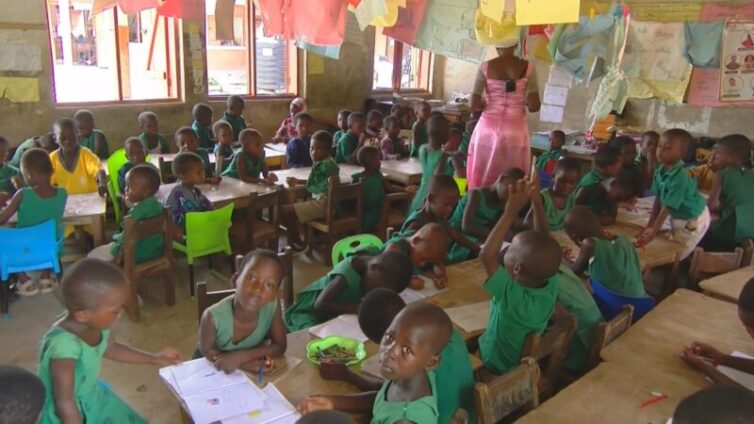
Two to three classes at the lower and upper primaries have to be combined for one teacher.
The overwhelming numbers and resultant congestion are creating anxiety among educators who fear they may not be able to deliver their best under these circumstances.
Poor road access routes to the schools are compounding the woes of teachers who sometimes have to cross floods to school.

In a phone-recorded video, a headteacher is seen lamenting the risky nature of the roads and floods they have to use to school daily.
“I am from Oguapesika…I am going to teach…As you can see, we can only cross the flooded road with the help of a rope tied to trees at both ends of the road. It's my turn….all these people here are also waiting to cross. It is not easy for us…I am a headteacher, Oguapesika..We need you to come and help us," he said.

Kwahu Afram Plains is the largest of all thirty-three districts in the Eastern Region. More than half of the one hundred and nine public basic schools in the district are located in island communities.
Access to these schools, particularly for teachers, remains a major setback to numerous interventions aimed at improving educational outcomes.
The pontoon is the only safe means of crossing the Volta Lake, which runs through a significant number of the 54 communities in the Afram Plains District. In the absence of the pontoon, travelers to and from these island communities have no option but to hire a boat, which comes at a high cost. Using the boats is life-threatening due to the absence of life jackets and unpredictable weather conditions.

These challenges, coupled with poor teacher motivation, are discouraging teachers posted there from reporting to their posts. Schoolchildren bear the brunt of their absence in the classroom. Solomon Akurugu Azubilla, the District Education Director, said the teacher deficit problem in the region is troubling.
“As we speak we lack teachers. We need about over 400 teachers to augment our staff so that teaching and learning can take place because if you visit some of our schools you have as low as one teacher teaching from class one to P6 – it’s a very big mountain to climb’’.

Edward Williams has been teaching for eight years. It’s been one year since he was posted to the Donkorkrom EP Primary.
Recounting his experience he said “The first time coming here, it was very interesting – in fact coming to the town itself, you would realise that you would have to travel long distances, here in the district… Apart from the accessibility, when you come to our classrooms, we have very large numbers. Students about 40-60 with one teacher handling them. Sometimes class control becomes a headache” he lamented.
Edward is one among several colleagues posted to this deprived community but is determined to stay despite the circumstances.
My curiosity, however, is where the others are. Edward revealed that “the problem is from the top … because, the experience we’ve had, sometimes you’ll get a call from your own colleagues that “I’ve been posted to Afram Plains” – but before you would realised, they have gone to change it. Last two years for instance, just a teacher was posted to the district”.

The impact of the lack of teachers is evident in the classrooms. Madam Janet Dafuor has been handling the KG1 and KG2 pupils at Donkorkrom Primary School in one class. She has been doing this for one year.
She fears she might lose her voice and even intends to retire this September due to the work overload.

She told JoyNews Emefa Atiamoah-Eli in a husky voice, “now my voice has changed because of the shouting and nowadays I fall sick always … because of that my children want me to stop teaching.”
Edward and others dread the impact of the teacher deficit on educational outcomes. He laments that despite their investments as teachers, the outcomes might not give an actual reflection of their efforts due to the existing challenge.

“If I have a class of about 50 and I have to have time for all of them – you know, we are human, you get tired. But if we have enough teachers we’ll have the time to cater to the needs of each learner.”
He warned that “if you don’t care, we will ride along and leave behind few learners who cannot move with the same pace as we are moving and nothing will be achieved.”

But how has the district been holding up, particularly in island communities where there are no teachers?
The implementation of the Communities of Excellence Programme has helped introduce community Teaching Assistants. That’s according to the project implementers.

“In communities in Afram Plains, 74 CTAs (Community Teaching Assistants) have been employed to come to the schools and help out the teacher to bridge the teacher shortage and the communities themselves have come together to mobilise funds like two to three hundred Ghana cedis a month to be part of the education system informally” – the UNICEF’s Education Specialist in charge of the Communities of Excellence Programme in Afram Plains North, Tillman Guenther explained.

Beyond the support of the Community Teaching Assistants, District Education Director Solomon Akurugu Azubilla appeals for a reshaping of the roads among other improvements to enhance access and make the teachers feel at home when posted to Afram Plains.
“The road network is another contributing factor which we are appealing to authorities, if you can get the road done, - because the teachers, when they are posted, even from Amanfrom - immediately they alight from the pontoon and they see the type of road there, it discourages them to want to come to Donkorkrom.

"And our friends, our children also on the islands. We are also appealing for life jackets for them. We’re appealing for boats to transport students who cannot cross the river by themselves particularly when it rains”.
The teacher-effect on education in Afram Plains cannot be underrated. This effect will however be fully felt only when the right numbers are in place to meet the demand.
That’s the only time the district will no longer lament the teacher deficit challenge. The question remains: how long will the district and school children wait for that relief?
Latest Stories
-
Landfilling waste management creates no value, it’s an economic waste
20 minutes -
Photos: Speaker Bagbin Commissions MPs constituency office under parliamentary decentralisation programme
35 minutes -
Black Stars technical advisor Winfried Schäfer sacked as GFA shakes up backroom staff
40 minutes -
Wenchi water project almost complete, critical to gov’t agenda – GWL MD
56 minutes -
Anti-LGBTQ+ bill not part of government’s legislative agenda – Inusah Fuseini
58 minutes -
Anti-LGBTQ Bill: Forget the rumour mongers, I’m a man of action, and will pass the bill – Speaker
2 hours -
Women and children among those killed in Sudanese army shelling of wedding celebration
2 hours -
President Mahama is not sincere with Ghanaians on LGBTQ bill matter – Hassan Tampuli
2 hours -
Gov’t to establish Prison Industrial Hub to equip inmates with income-generating skills – Prison Service boss
2 hours -
Alhassan Tampuli donates cement, roofing sheets to support storm victims in Gushegu
2 hours -
Alhassan Tampuli appeals for urgent support for storm victims in Gushegu
2 hours -
The hypocrisy must stop; pass Anti-LGBTQ+ Bill now – Alhassan Tampuli to Mahama
3 hours -
Imprisonment should be rehabilitative, not punitive – Ghana Prisons boss at UNGA
3 hours -
Ga Adangbe traditional priests petition Mahama over McDan aviation licence revocation
3 hours -
Anti-LGBTQ Bill: NDC’s arrogance is worrying – Hassan Tampuli
3 hours