

Audio By Carbonatix
By Isaac Kofi Agyei | JoyNews Research
If the TGMA is purely a figures award, then Black Sherif is likely to be crowned Artiste of the Year. I’m not the one saying it, but that is what the figures are screaming ; provided it all boils down to numbers.
There are years when the TGMA shortlist tells a quiet story, and there are years when it explodes onto every timeline, every airwave, every street-corner debate from Tema to Tamale. This is the second kind of year. Tonight, the 27th edition of the Telecel Ghana Music Awards lands at the Grand Arena of the Accra International Conference Centre, and the conversation around it has been running hot for nearly two months.
What follows is a category-by-category analysis of who walks home with what when the envelopes open. Each prediction blends two streams of evidence. The first is the hard data: streaming numbers, chart positions, nomination volume, and the cold arithmetic of public-vote history. The second is the softer signal: what online discourse is saying, what music editorial outlets have already gone on record predicting, what veteran industry voices have offered in interviews, and what the broader sentiment heat-map looks like across Accra's entertainment programming. The win probabilities attached to each nominee in each category are estimates based on the synthesis of both streams. They sum to roughly 100% within each category and represent relative likelihood, not certainty.
Settle in. There is a lot to get through before the lights go up tonight.
Artiste of the Year
This is the night-ender, the category every other prediction circles around. Six names, three real cases, and a level of pre-show debate that has spilled into nearly every entertainment platform in the country.
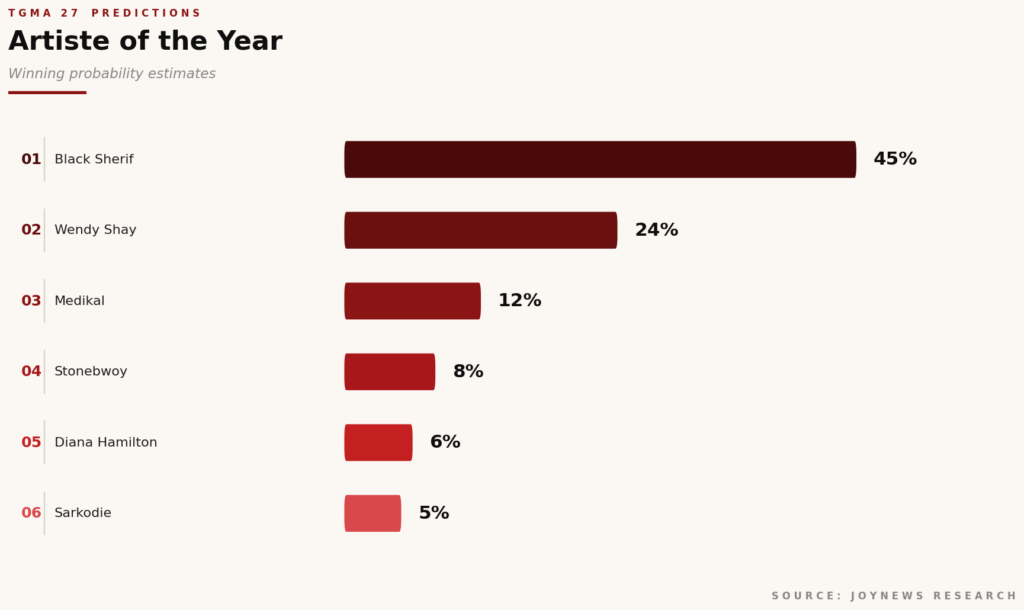
Then there is Wendy Shay, and she is the reason this category is genuinely contested. In January she walked into Lagos and walked out with the All Africa Music Awards Best Female Artiste in West Africa, beating a field that included some of the most established female voices on the continent. Seven TGMA nominations on the night. Senior figures in the hiplife scene have publicly campaigned for her case in recent broadcast interviews, and at least one of her fellow nominees has gone on record saying her year deserves louder recognition. The historical math gives her case real edge: only two women have ever won this category in TGMA history. A third would be a story. Voters know that. Probability sits at 24%, the highest of any of the alternatives.
Medikal carries a different kind of case. The numbers are not the loudest in the field, but the fan-mobilisation network is. Disturbation 2 kept him in continuous public view through the year, and Shoulder with Shatta Wale and Beeztrap KOTM became the kind of TikTok moment that votes itself into things. Industry voices have, in interviews, openly flagged that fanbase strength matters in publicly weighted categories, and his is among the deepest in Ghanaian music. The streaming and editorial weight trail Black Sherif, but the floor of his support is real. Probability lands at 12%.
Stonebwoy sits at 8%. He won this category in 2024, and the historical pattern since 2018 has shown clear genre rotation rather than back-to-back wins. Torcher has earned strong critical reception, but the heaviest streaming and editorial weight has migrated elsewhere this cycle. Still, he is a two-time winner with a near-decade of staying power, and writing him off entirely would be unwise.
Diana Hamilton at 6%. She broke the gospel ceiling in this category in 2021, and her presence on the shortlist signals continued mainstream recognition for gospel music. Gospel voting blocs are well-organised in TGMA voting, which keeps her in the conversation. The headwind is the same one that catches Stonebwoy: a recent prior win in the category cuts against her this cycle.
Sarkodie rounds out at 5%. He is the most decorated TGMA artiste in history and a two-time winner of this category, but his last Artiste of the Year win was 2012. Fourteen years of nominations have not produced a third. The pattern in recent editions has favoured artistes with current-year dominance over legacy nominees, and that pattern looks intact heading into the night.
Album or EP of the Year
The stakes in this category jumped higher in April when Guinness Ghana attached a GH¢100,000 cash prize, plus a music video budget and business mentorship, to the winner. Six projects, one trophy, and a debate that online discourse described as leading to blows.
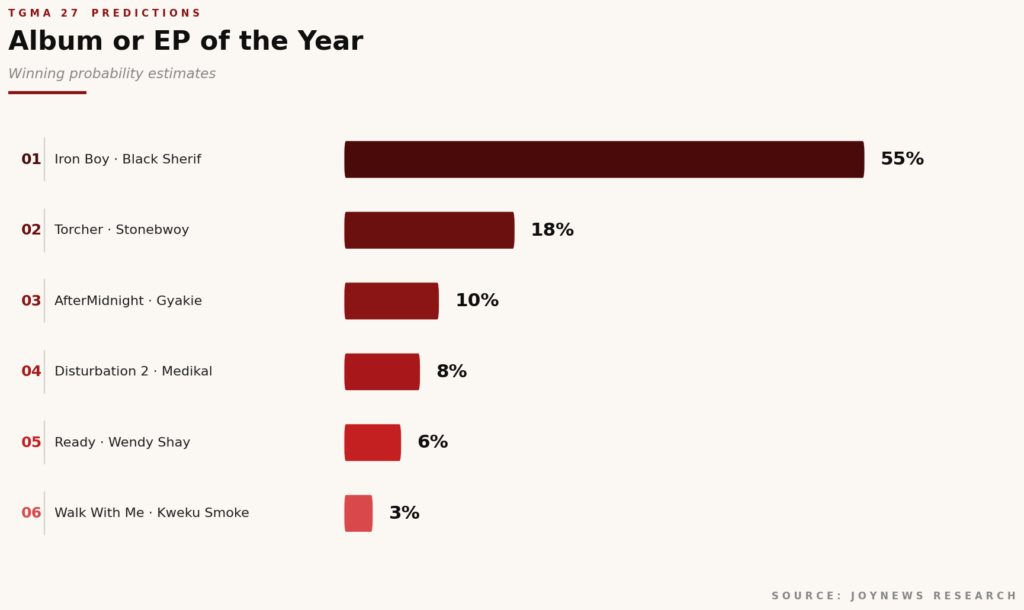
Iron Boy by Black Sherif is the case to beat. Billboard World Albums entry. UK Top Debut Albums debut at number six. Apple Music Ghana number one for twenty-one weeks. Music editorial outlets have already filed their predictions, and they have all landed in the same place. The probability sits at 55%.
Torcher by Stonebwoy is the most credible alternative at 18%. Stonebwoy has historically over-performed in album-of-the-year voting, and the EP has earned strong critical respect across editorial coverage. If there is an upset, this is where the upset comes from.
AfterMidnight by Gyakie at 10%. The vocal craft on the project has earned consistent praise from music critics, and her streaming presence in select international markets is real. The headwind is commercial reach within Ghana, where the project has been quieter than the leaders.
Disturbation 2 by Medikal at 8%. The album-as-cohesive-statement criteria favoured by board voters tends to weight craft over hit-song accumulation, which works against this nomination despite the strength of its lead singles.
Ready by Wendy Shay at 6%. Anchors her seven-nomination spread for the night and aligns with her broader case across the ceremony. Critical reception was more divided than for the leading projects.
Walk With Me by Kweku Smoke at 3%. A respected project that has earned him broader critical recognition this cycle, but lacks the cross-category nomination spread of the front-runners.
Most Popular Song of the Year
This is the pure-vote category, and pure votes mean drama. No board panel adjustments. No genre weighting. Whichever song's fanbase organises hardest takes it home.
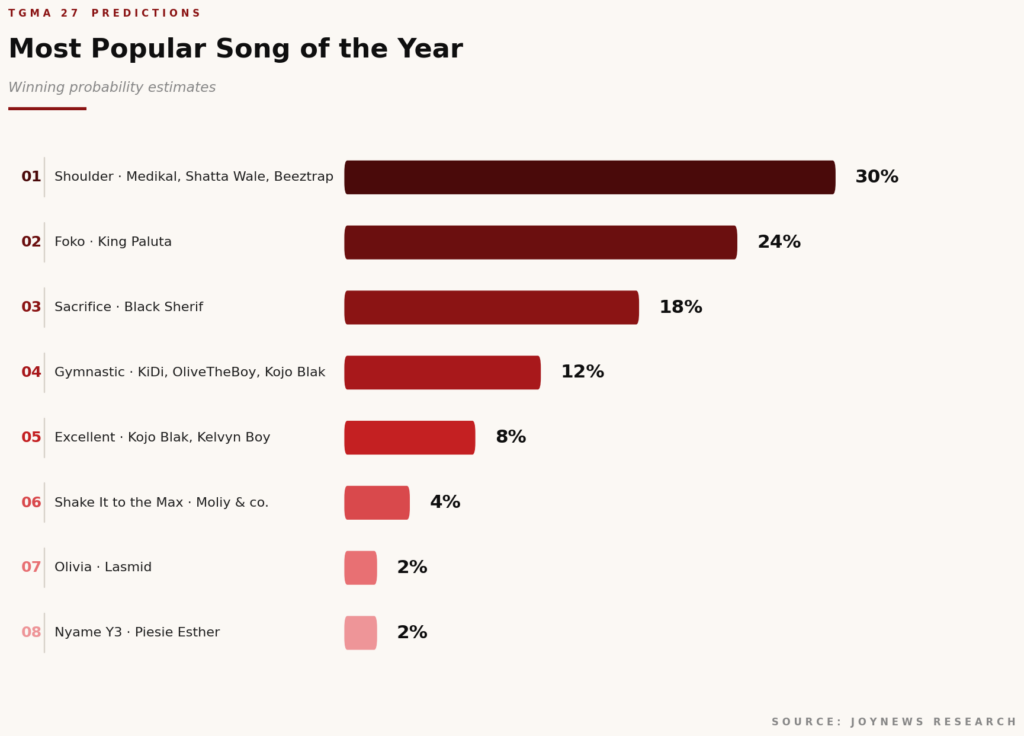
Shoulder by Medikal featuring Shatta Wale and Beeztrap KOTM is the projected leader at 30%. The combined fanbases of three high-mobilisation acts converge on a single record, and the song's TikTok afterlife through 2025 was inescapable. Online voter turnout for songs with this kind of cross-fanbase ownership has historically been the strongest in the field.
Foko by King Paluta at 24%. The defining highlife crossover record of the year, and Ashanti region voter turnout for his releases has been consistently strong. This is the song that has dominated lorry stations, drinking spots, and morning radio across the highlife-belt regions for months.
Sacrifice by Black Sherif at 18%. Topped Apple Music Ghana for an extended run, anchors his nine-nomination night, and carries the kind of cultural weight that sometimes shifts public-vote outcomes when sentiment converges on a single artiste.
Gymnastic by KiDi featuring OliveTheBoy and Kojo Blak at 12%. Three-act collaboration, energy, and sustained presence on dance-content platforms.
Excellent by Kojo Blak featuring Kelvyn Boy at 8%. The breakout collaboration of 2025 has strong radio and streaming numbers, though slightly quieter on social-media virality metrics than the leaders.
Shake It to the Max by Moliy and the international featured cast at 4%. Strong international footprint, but Ghanaian public-vote categories typically reward records with deeper local saturation.
Olivia by Lasmid at 2%, and Nyame Y3 by Piesie Esther at 2%. Both are credible nominations with steady year-round presence. Neither carries the viral spike or the fanbase mobilisation engine of the leaders.
Best New Artiste of the Year
This is the cleanest call on the entire scorecard.
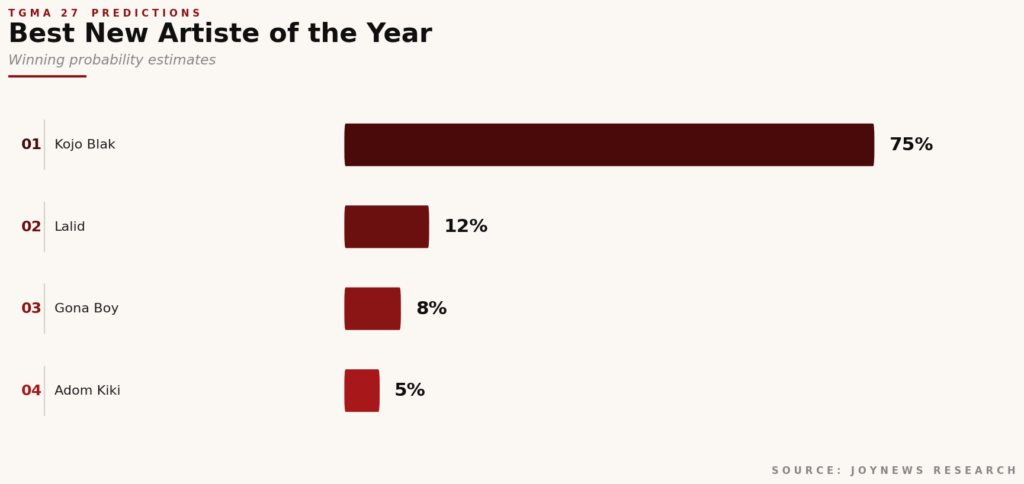
Kojo Blak has somehow accumulated seven total nominations as a debutant. Best Afrobeats or Afropop Artiste. Collaboration of the Year. Best Afrobeats Song. Most Popular Song. Best Hiplife Song. The cross-category spread is unprecedented for a Best New Artiste contender. The pattern set in recent editions, where the new artiste with the broadest overall recognition takes the category, points exactly here. Probability 75%.
Lalid at 12%. Matter generated genuine fan-driven momentum and his Best HipHop Song nomination signals real board recognition. The most credible alternative.
Gona Boy at 8%. Same Timbs has earned credible streaming numbers and his presence in Best HipHop Song reflects the underground-rap voting bloc taking him seriously.
Adom Kiki at 5%. A solid year of releases without the cross-category visibility of the others.
Best Hiplife or Hip-Hop Artiste of the Year
Black Sherif won this category in 2024 and enters this edition with stronger numbers than the year he won. Where Dem Boys and Sacrifice have performed well across streaming and radio, his nine-nomination night signals broad board favour, and the rap-purist segments of online discourse have stopped really debating this one. Probability 55%.
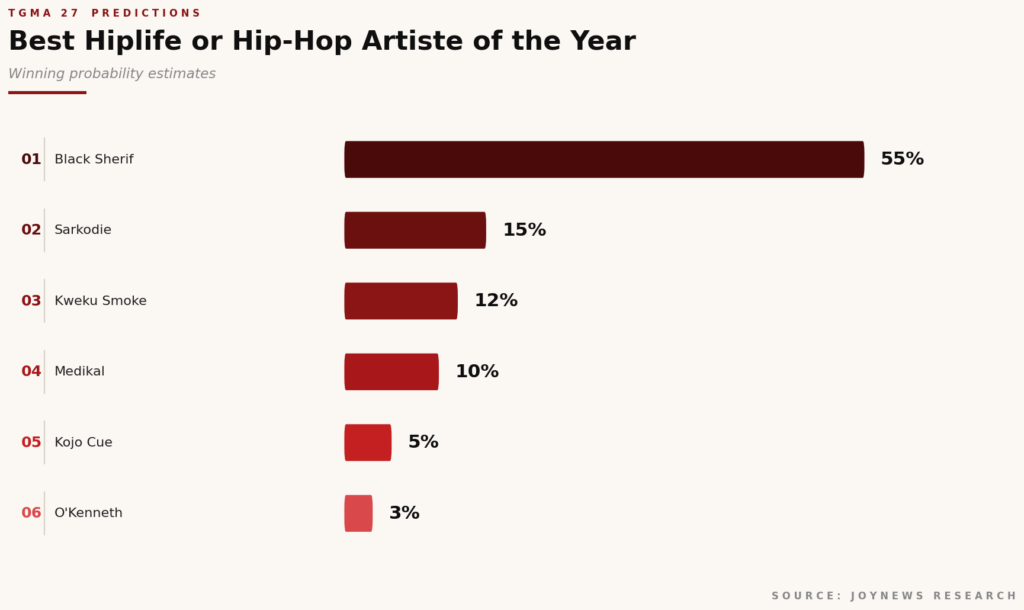
Sarkodie at 15%. Violence with Kweku Smoke kept him in the rap conversation, and his career standing in this category remains immense. The headwind is the steady migration of voter sentiment toward newer-generation artistes.
Kweku Smoke at 12%. Walk With Me has earned him real critical credibility this cycle, and his Sarkodie collaboration adds industry-voter weight.
Medikal at 10%. Welcome to America is a focused rap moment within his broader pop catalogue. His best chance in this category in several editions, but his profile this cycle skews more pop-rap than purist.
Kojo Cue at 5%. Abebrese is critically respected and his songwriting nomination adds depth to his case.
O'Kenneth at 3%. Balacianga has underground credibility but lacks the mainstream radio penetration of the leaders.
Best Highlife Artiste of the Year
This is one of the most genuinely competitive categories on the night, and the pre-show debate has been intense.
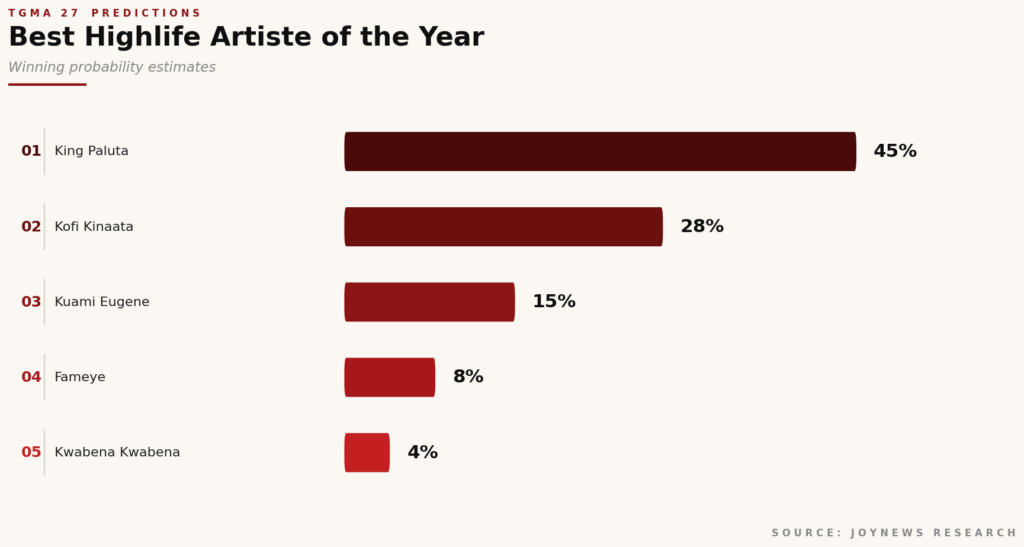
King Paluta at 45%. The 2024 sweep (Best New Artiste, Best Hiplife Song) set the trajectory, and Foko has been one of the most-played highlife records of the year. His public-vote engine across the highlife belt is the strongest in the field.
Kofi Kinaata at 28%. The category's traditional craft pick whose It Is Finished is vintage Kinaata storytelling. He has won the songwriting category multiple times and remains the choice of voters who weight lyrical depth over pure radio dominance.
Kuami Eugene at 15%. Won this category at a recent edition and Do Better has kept him relevant. Strong industry standing, even if his year did not generate the viral spike that defined the leaders.
Fameye at 8%. Habit with Medikal added pop-rap crossover to his catalogue, which broadens his reach but slightly diffuses his pure highlife identity.
Kwabena Kwabena at 4%. A respected veteran whose Aso Remix carries collaboration weight, but his solo highlife output this year was lighter than the leaders.
Songwriter of the Year
A category that has, for years, looked more settled than almost any other.
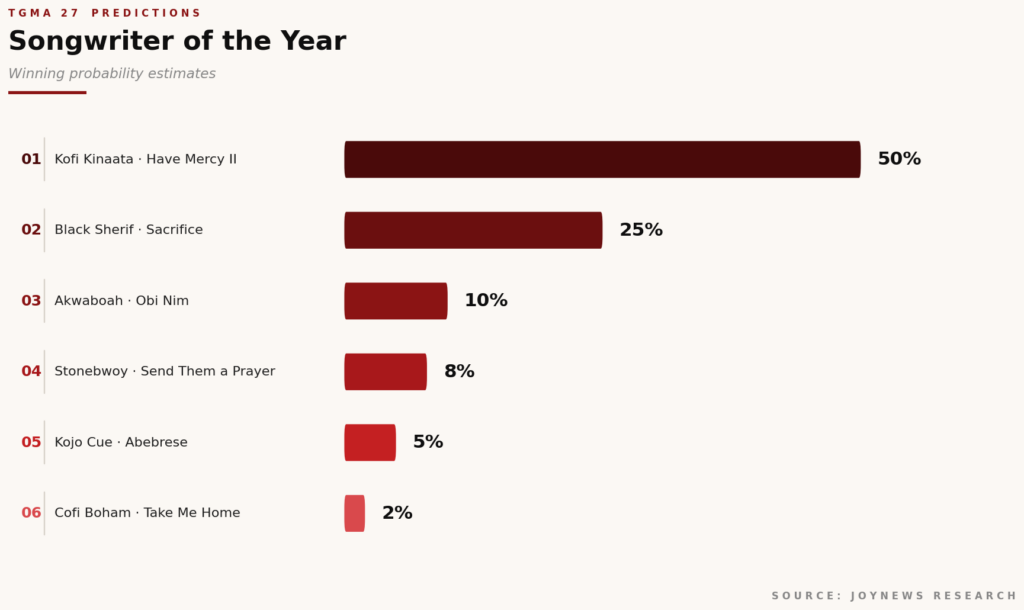
Kofi Kinaata at 50%. He won this category at the 26th edition, his fifth Songwriter trophy across editions. Voters in this category have consistently rewarded his Fante-language storytelling and structural craft, and Have Mercy II is unmistakably him at full creative range.
Black Sherif at 25%. Sacrifice represents the strongest alternative if voters choose to mark the cultural impact of the song. Editorial coverage has consistently praised the writing on the track, and a sweep year for him could include this.
Akwaboah at 10%. Obi Nim is a quietly accomplished writing entry from one of Ghana's most respected songwriters.
Stonebwoy at 8%. Send Them a Prayer carries his consistent songwriting profile, though songwriter awards have historically gone to artistes with a sharper lyrical-craft identity.
Kojo Cue at 5%. Abebrese is technically strong, but his profile in this category is below the leading contenders.
Cofi Boham at 2%. Take Me Home is a respected nomination that adds depth to the field.
Best Music Video of the Year
Sacrifice directed by Meekah Jagun at 35%. Editorial reviews have widely cited it as one of the most cinematically realised Ghanaian music videos of the cycle. The visual language anchors itself in Black Sherif's broader artistic identity in a way few of the competing entries match.
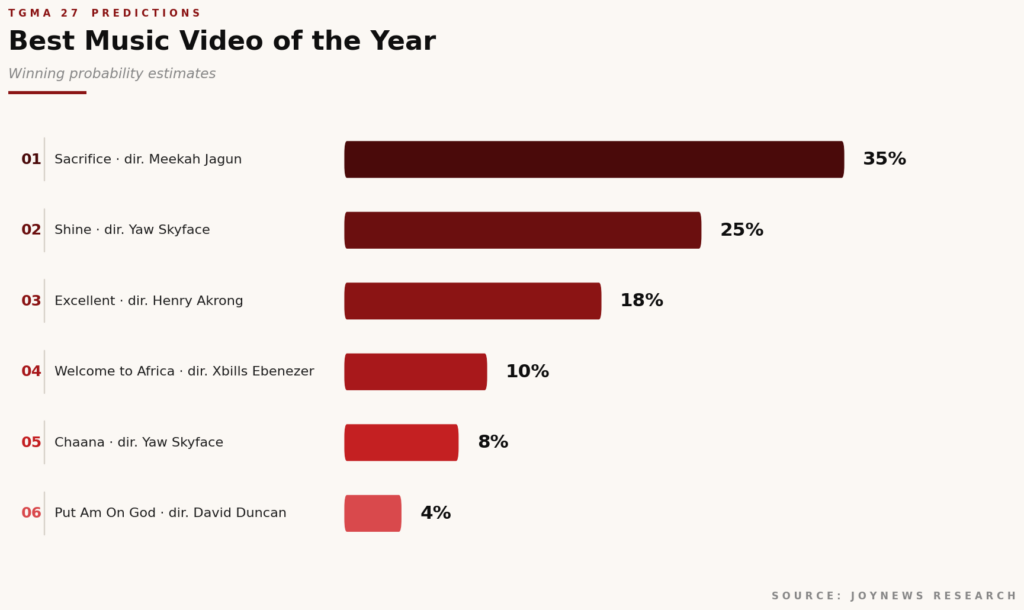
Shine directed by Yaw Skyface at 25%. Stonebwoy's video team has historical board favour in this category, and Yaw Skyface is double-nominated this year, which speaks to how busy his year was.
Excellent directed by Henry Akrong at 18%. The breakout commercial video of 2025 with strong direction credentials behind it.
Welcome to Africa directed by Xbills Ebenezer at 10%. A high-production-value Medikal video with broad pan-African visual references.
Chaana directed by Yaw Skyface at 8%. Yaw Skyface's second nomination, which fragments his vote share with Shine.
Put Am On God directed by David Duncan at 4%. Solid direction with a more intimate scale than the leading contenders.
Best Rap Performance of the Year
A pure-craft category where lyrical-technical voters tend to outweigh popularity sentiment.
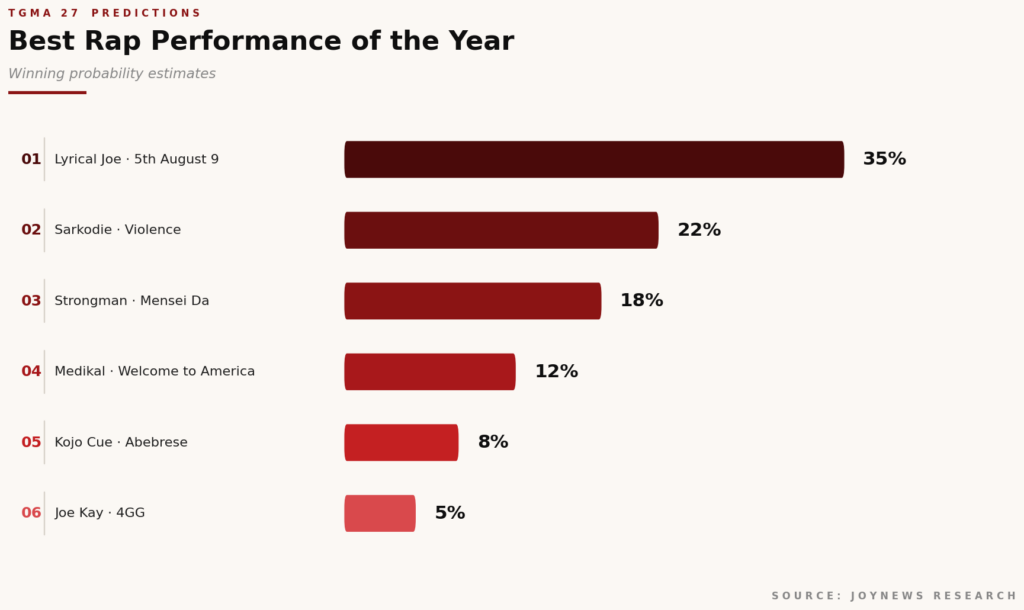
Lyrical Joe at 35%. The 5th August freestyle series has sustained annual rap-purist attention for years, and the technical-craft framing of this category aligns with his strengths better than any nominee in the field.
Sarkodie at 22%. Violence with Kweku Smoke is a credible technical entry, and writing off the most decorated rapper in TGMA history in any rap category is generally a bad idea.
Strongman at 18%. Mensei Da generated visible fan campaigning online and reflects his consistent presence in rap categories.
Medikal at 12%. Welcome to America is a focused rap moment within his broader pop catalogue.
Kojo Cue at 8%. Abebrese is technically strong, and his songwriting nomination broadens his case.
Joe Kay at 5%. 4GG (For God's Glory) brings a gospel-rap angle that broadens the field.
Best Afrobeats or Afropop Artiste of the Year
Six legitimate stars, no filler. Possibly the most stacked category on the entire ballot.
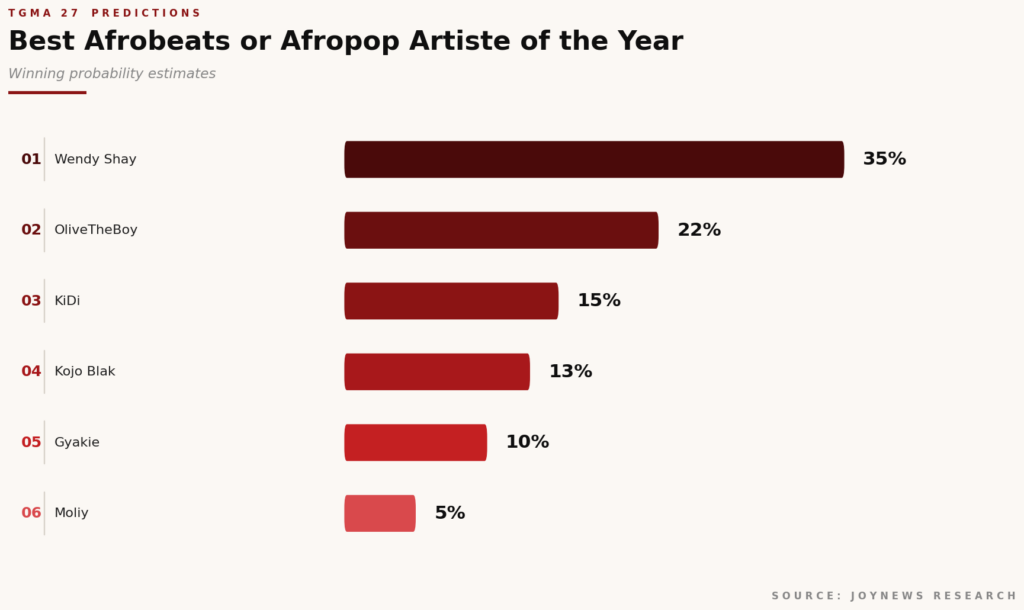
Wendy Shay at 35%. The AFRIMA win in January was a continental flex that few Ghanaian female artistes have ever pulled off, particularly while operating outside major-label structures. Seven TGMA 27 nominations. The broader sentiment campaign that has built around her case for Artiste of the Year carries naturally into this category.
OliveTheBoy at 22%. The most-featured artiste of the year. He sits on Crazy Love, Gymnastic, and Bend with Sarkodie. When you are on every hit, board voters notice.
KiDi at 15%. Gymnastic re-established his hit-making credentials with the new generation, and his prior Artiste of the Year win in 2022 still carries weight in voting rooms.
Kojo Blak at 13%. His seven-nomination night includes this category, but his stronger plays are likely Best New Artiste and Collaboration of the Year, which slightly diffuses his concentration here.
Gyakie at 10%. AfterMidnight has earned strong critical reception and her Sankofa entry in Best Afropop Song demonstrates broader recognition.
Moliy at 5%. International presence is strong but local mainstream awareness still trails the front-runners.
Best Female Vocal Performance
Cina Soul at 40%. The consistent critical favourite in this category over recent editions. Breath represents one of her most refined recordings to date, and the technical-vocal voting bloc tends to choose her when she is in the field.
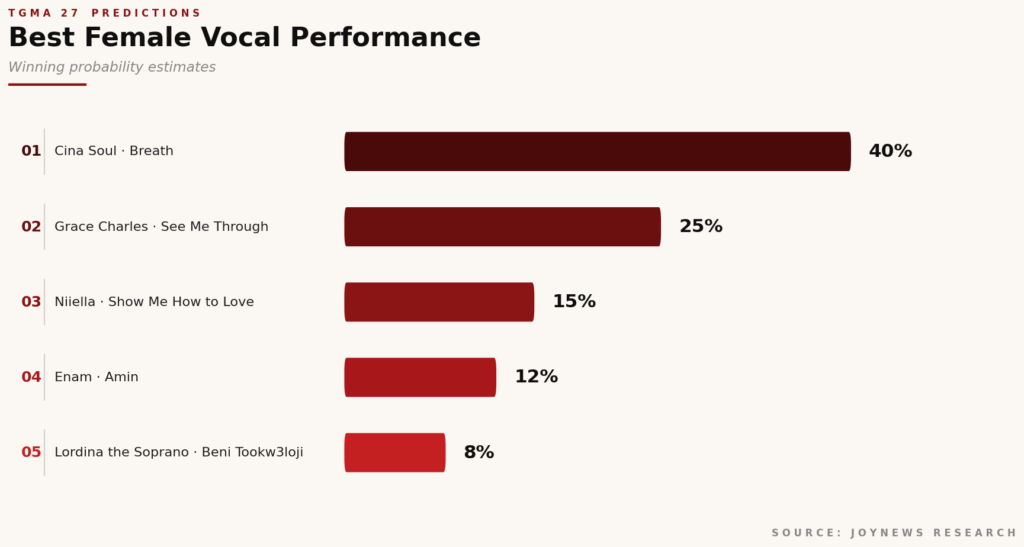
Grace Charles of Team Eternity Ghana at 25%. The gospel voting bloc is well-organised, and Team Eternity's Defe Defe winning Best Urban or Contemporary Gospel Song last year demonstrates that organisational strength carries into adjacent categories.
Niiella at 15%. Show Me How to Love is a vocally accomplished nomination from a rising vocal talent.
Enam at 12%. Amin demonstrates technical control and her separate nomination in Record of the Year shows broader recognition.
Lordina the Soprano at 8%. Beni Tookw3loji is a credible nomination but trails the leaders in cross-platform reach.
Best Male Vocal Performance
Perez Musik at 35%. By Prayer is the strongest gospel-aligned candidate this cycle, and the gospel-vocal pattern has held firm in recent editions of this category.
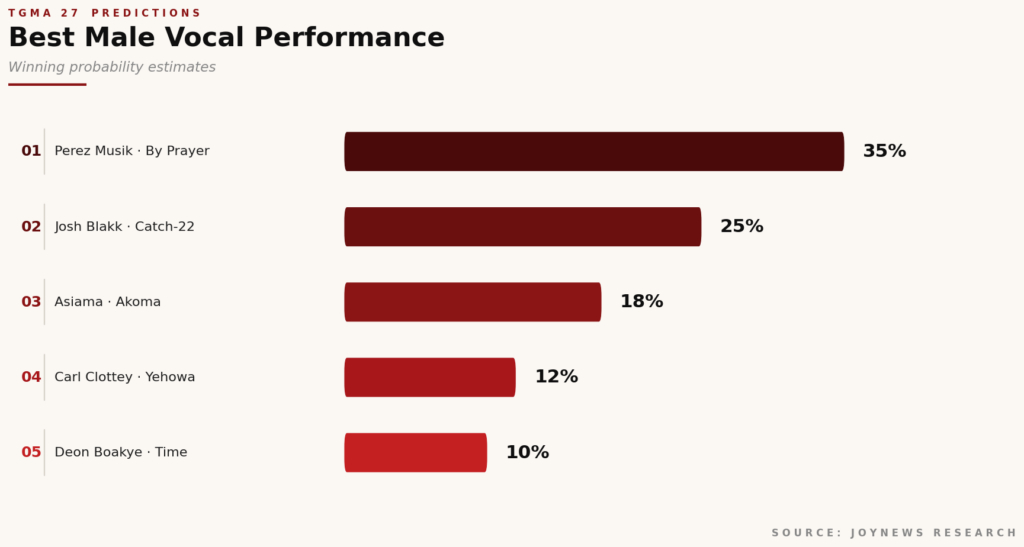
Josh Blakk at 25%. A focused recent EP signals a deliberate campaign for this honour, and Catch-22 demonstrates strong vocal range. The clearest secular alternative in the field.
Asiama at 18%. Akoma is a critically respected nomination with separate recognition in Record of the Year, which adds cross-category weight to his case.
Carl Clottey at 12%. Yehowa adds gospel depth to the field and his collaboration nomination broadens his case.
Deon Boakye at 10%. Time (Live Sessions) is a credible vocal entry, though the live-session framing may limit his perceived production polish in voting rooms.
Best Gospel Artiste of the Year
Diana Hamilton at 40%. Her Artiste of the Year nomination signals the strength of her year overall, which typically correlates with strong performance in genre-specific categories.
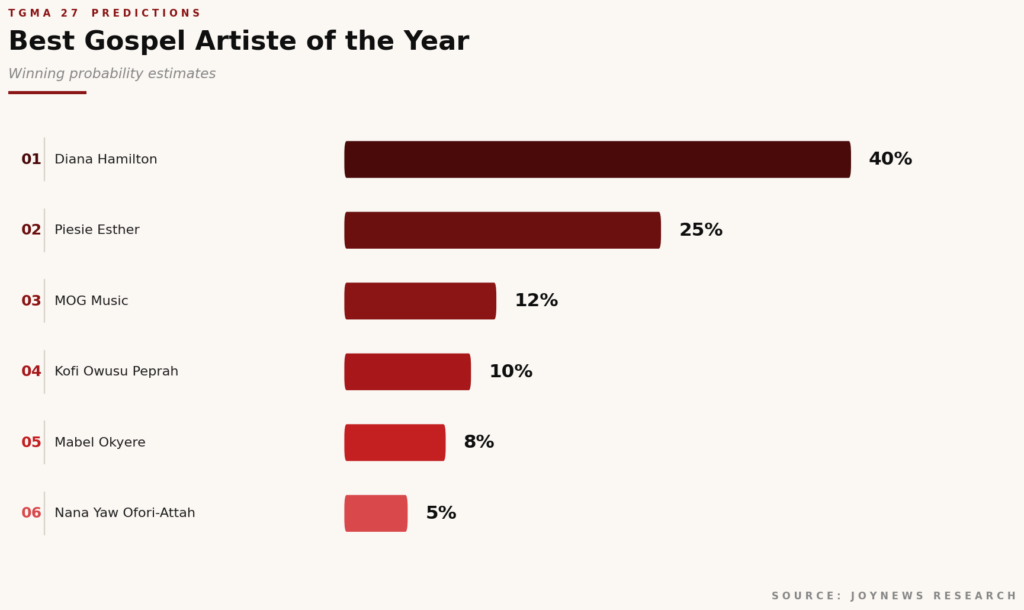
Piesie Esther at 25%. Won the category in 2023 and Nyame Ye has had remarkable staying power. The strongest alternative.
MOG Music at 12%. Strong contemporary gospel profile with consistent radio play through the year.
Kofi Owusu Peprah at 10%. Multiple nominations in gospel song categories add depth to his case.
Mabel Okyere at 8%. So Far So Good has resonated in traditional gospel circles.
Nana Yaw Ofori-Attah at 5%. A respected nomination but trails the better-known names in cross-platform reach.
Best Reggae or Dancehall Artiste of the Year
The shortest section in this report, because the math does most of the talking.
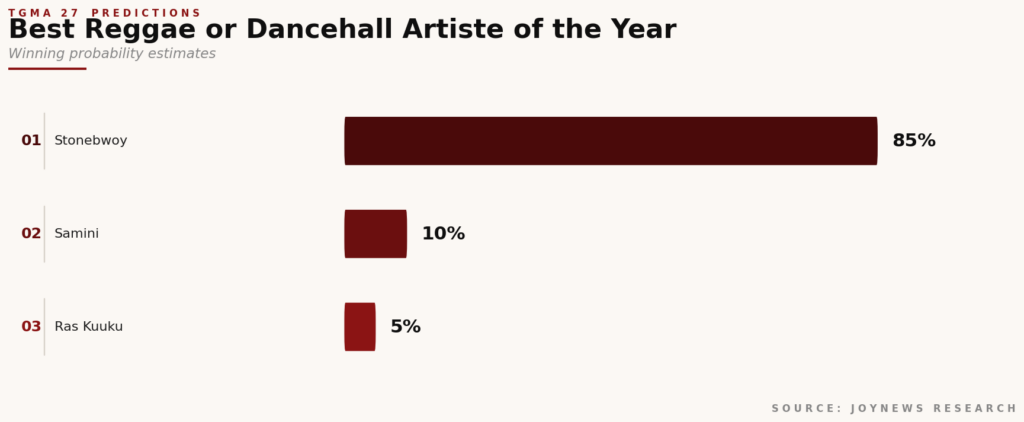
Stonebwoy at 85%. He has won this category in each of the last ten consecutive editions. Audience reach within the genre, consistency of output, and the absence of a serious dancehall challenger this cycle make the eleventh straight win the heavy base case.
Samini at 10%. Chaana with the Soweto Mass Choir is a strong project entry, and as one of the genre's senior figures, he remains the most credible alternative if anyone takes the title from Stonebwoy.
Ras Kuuku at 5%. A respected nominee whose presence reflects his sustained contribution to the genre.
Best International Collaboration
Shake It to the Max by Moliy with Shenseea, Skillibeng and Silent Addy at 40%. The broadest international footprint of any record on this list. Multiple-market chart presence, sustained international media coverage through 2025, and the kind of cross-Caribbean collaboration that puts a Ghanaian artiste in genuinely global conversation.
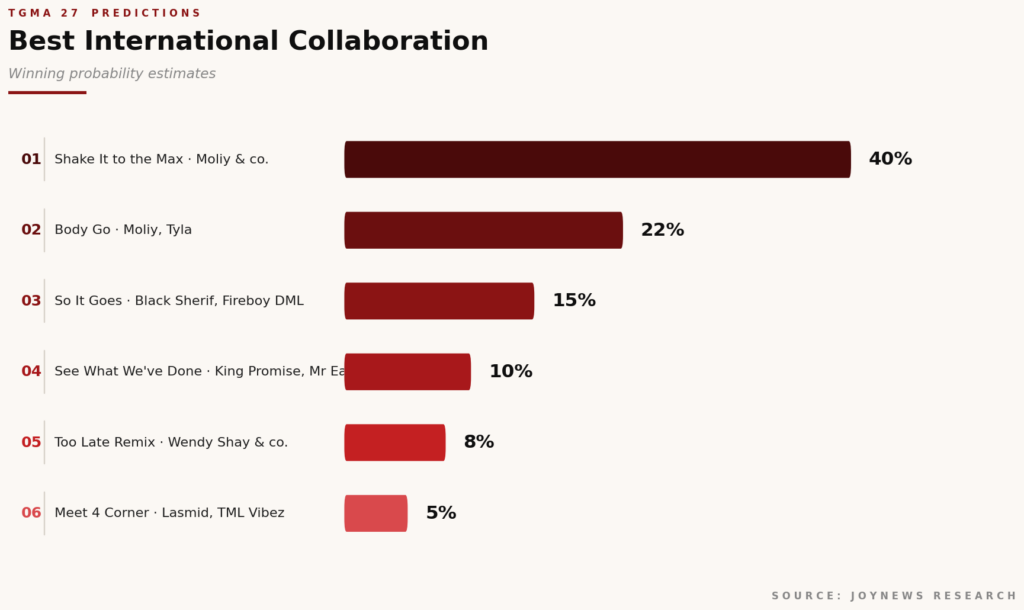
Body Go by Moliy with Tyla at 22%. Strong critical reception and Tyla's continental profile elevate this entry. A double Moliy night is plausible.
So It Goes by Black Sherif with Fireboy DML at 15%. West African crossover credentials with two of the region's strongest voices.
See What We've Done by King Promise with Mr Eazi at 10%. A polished collaboration with strong streaming numbers in select markets.
Too Late Remix by Wendy Shay with Bedjine, Phyna and Guchi at 8%. Pan-African female-led collaboration with broad reach across the continent.
Meet 4 Corner by Lasmid with TML Vibez at 5%. A credible nomination but with the lightest international footprint of the field.
Collaboration of the Year
Excellent by Kojo Blak featuring Kelvyn Boy at 35%. Widely credited with launching Kojo Blak as a household name and one of the most discussed collaborations of the year. The board often rewards collaborations that genuinely break an artiste, and this one did.
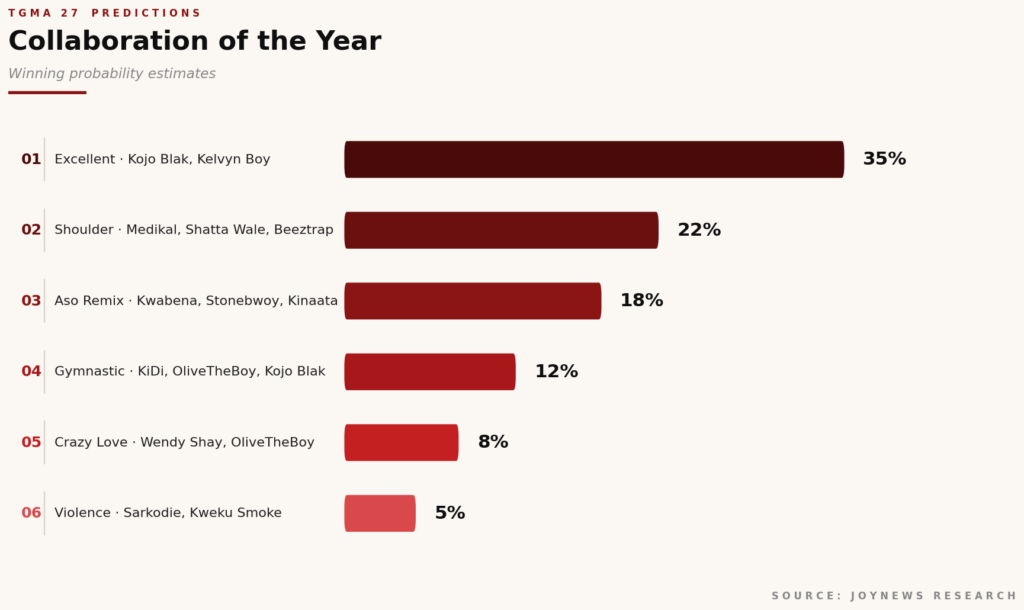
Shoulder by Medikal featuring Shatta Wale and Beeztrap KOTM at 22%. Combined fanbases create the strongest viral mobilisation case, and the song's TikTok afterlife was inescapable.
Aso Remix by Kwabena Kwabena, Stonebwoy and Kofi Kinaata at 18%. The prestige pick that pairs three established artistes on a single record.
Gymnastic by KiDi, OliveTheBoy and Kojo Blak at 12%. A three-act youth-focused collaboration with sustained streaming and dance-platform presence.
Crazy Love by Wendy Shay and OliveTheBoy at 8%. A strong commercial collaboration that has performed consistently across the year.
Violence by Sarkodie featuring Kweku Smoke at 5%. Generation-bridging rap collaboration with respected critical reception.
Best Hiplife Song
Shoulder by Medikal featuring Shatta Wale and Beeztrap KOTM at 32%. The viral hiplife crossover of the year.
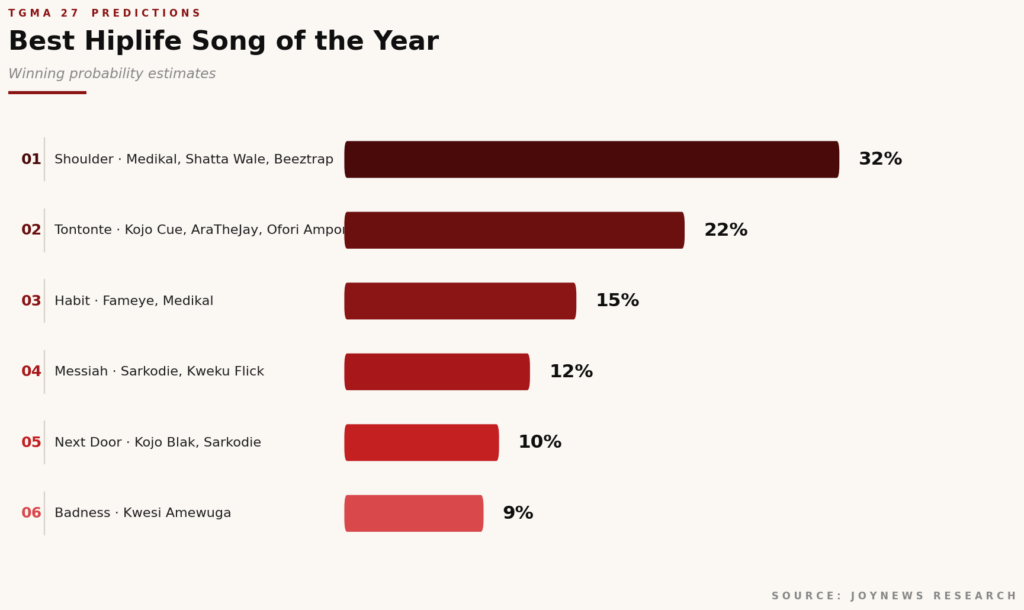
Tontonte by Kojo Cue featuring AraTheJay and Ofori Amponsah at 22%. Bridges classic and contemporary hiplife generations through Ofori Amponsah's involvement.
Habit by Fameye featuring Medikal at 15%. A radio-friendly entry with strong commercial reach.
Messiah by Sarkodie featuring Kweku Flick at 12%. A technically strong hiplife entry with the Sarkodie brand attached.
Next Door by Kojo Blak featuring Sarkodie at 10%. Broadens Kojo Blak's nomination spread without representing his strongest play.
Badness by Kwesi Amewuga at 9%. A solid nomination from an emerging name in the hiplife scene.
Best HipHop Song
Where Dem Boys by Black Sherif at 38%. The most-streamed pure hip-hop entry on the shortlist, with strong critical positioning.
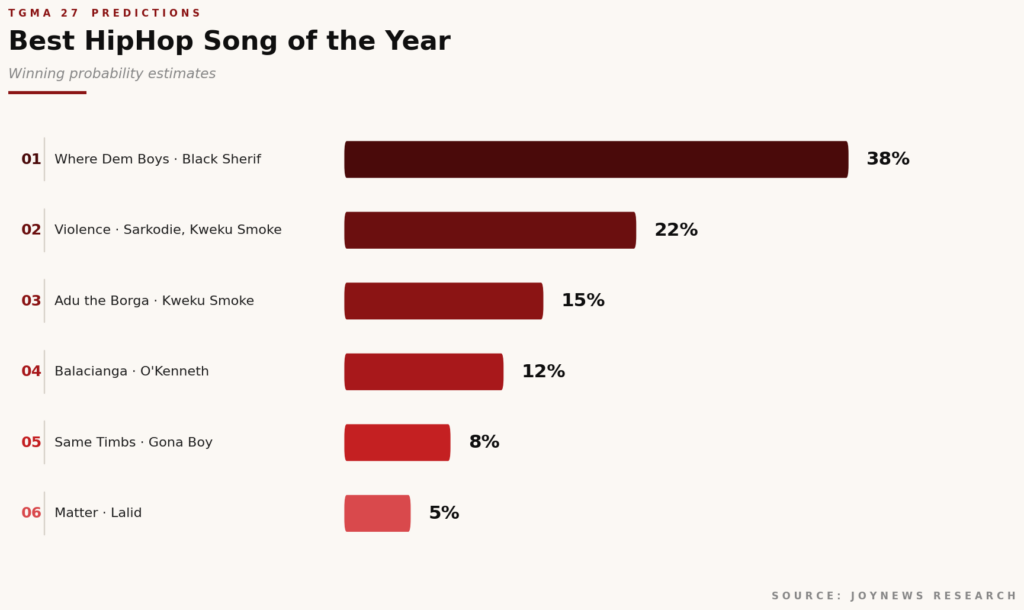
Violence by Sarkodie featuring Kweku Smoke at 22%. A rap-craft entry with two respected names attached.
Adu the Borga by Kweku Smoke at 15%. A defining track from Walk With Me with strong critical reception.
Balacianga by O'Kenneth at 12%. Underground credibility with a distinctive sonic identity.
Same Timbs by Gona Boy at 8%. A breakout entry that justified his Best New Artiste nomination.
Matter by Lalid at 5%. Generated genuine fan campaigning online but trails the leaders in cross-platform reach.
Best Highlife Song
Foko by King Paluta at 38%. The most-played highlife record of the year and a strong public-vote driver.
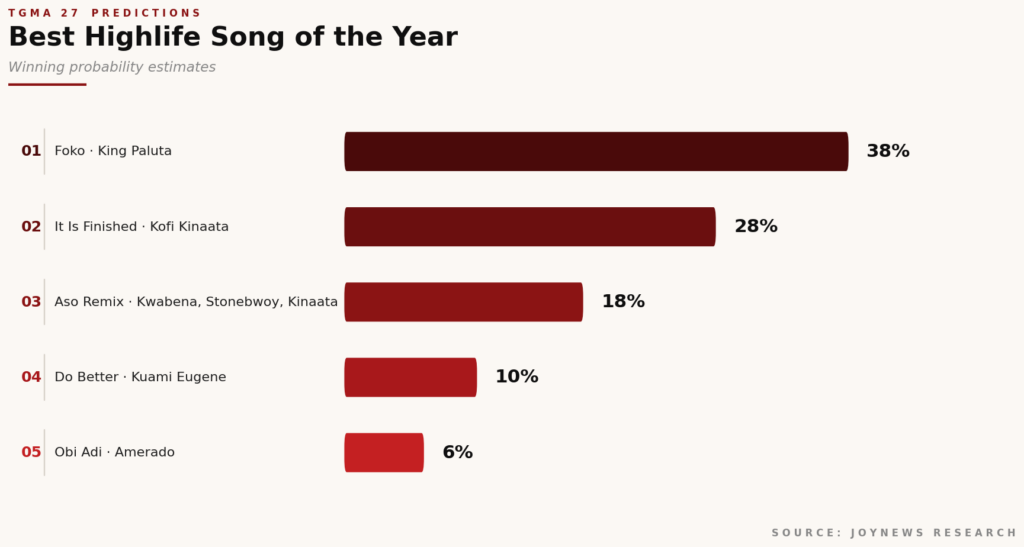
It Is Finished by Kofi Kinaata at 28%. Vintage Kinaata writing and the category's traditional craft pick.
Aso Remix by Kwabena Kwabena, Stonebwoy and Kofi Kinaata at 18%. Three-act prestige collaboration with strong board-voter appeal.
Do Better by Kuami Eugene at 10%. A polished highlife-pop entry with consistent radio presence.
Obi Adi by Amerado at 6%. A respected nomination that broadens the field.
Best Afrobeats Song
Excellent by Kojo Blak featuring Kelvyn Boy at 35%. The breakout afrobeats record of 2025 with sustained chart presence.
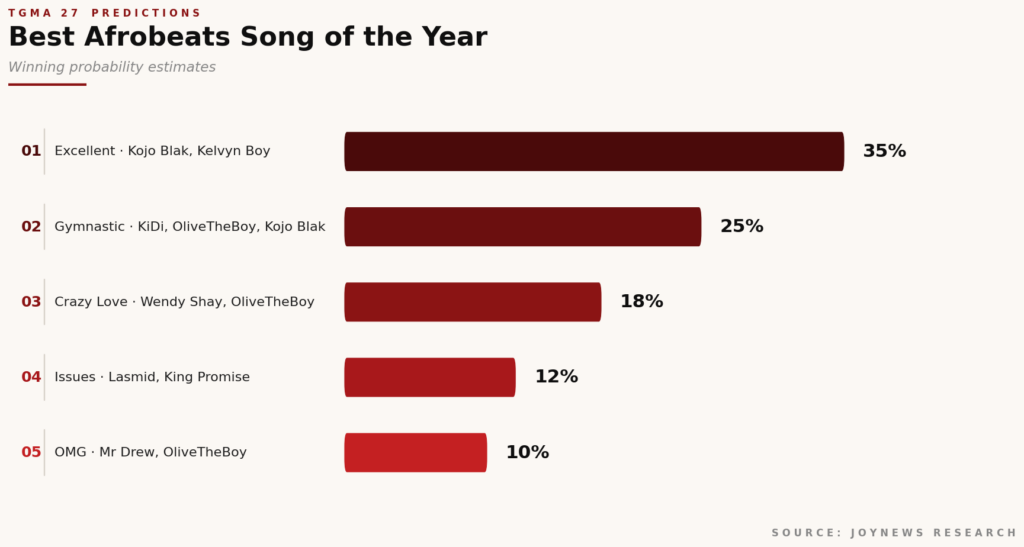
Gymnastic by KiDi, OliveTheBoy and Kojo Blak at 25%. Strong dance-platform engagement and a three-act mobilisation case.
Crazy Love by Wendy Shay and OliveTheBoy at 18%. Consistent radio play across the year.
Issues by Lasmid and King Promise at 12%. A polished collaboration between two respected voices.
OMG by Mr Drew featuring OliveTheBoy at 10%. Solid commercial performance, with OliveTheBoy's presence broadening its reach.
Best Afropop Song
Sacrifice by Black Sherif at 38%. Topped Apple Music Ghana for an extended run and carries the artiste's overall nomination weight.
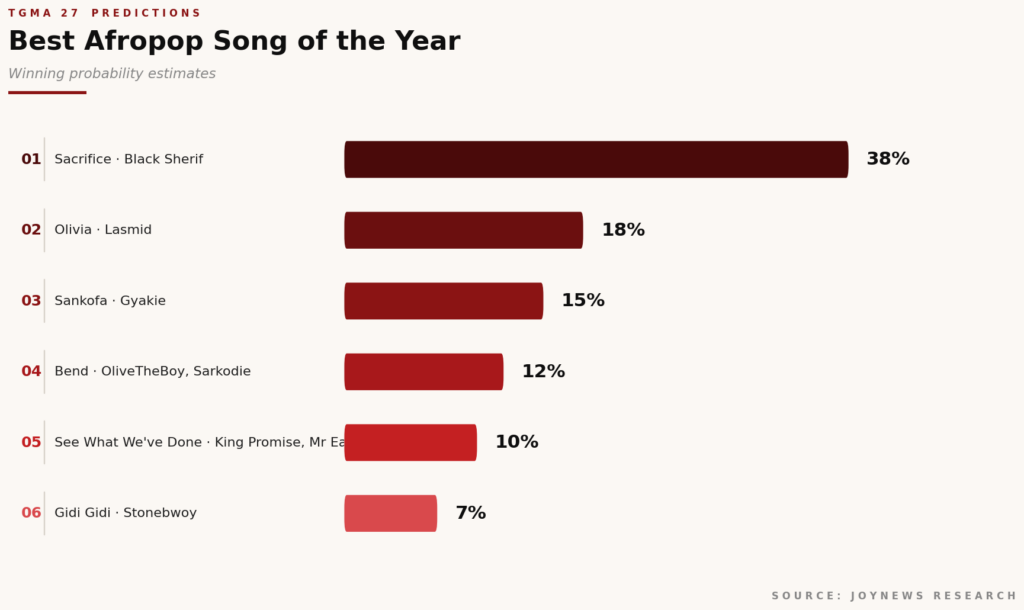
Olivia by Lasmid at 18%. Year-round radio presence and strong commercial performance.
Sankofa by Gyakie at 15%. Critically respected and demonstrates her vocal craft.
Bend by OliveTheBoy featuring Sarkodie at 12%. Strong commercial collaboration with two well-known names.
See What We've Done by King Promise featuring Mr Eazi at 10%. Polished international-leaning afropop with strong streaming.
Gidi Gidi by Stonebwoy at 7%. Broadens his nomination spread without representing his strongest play in this category.
Best Traditional Gospel Song
Nyame Ye by Piesie Esther at 30%. Strong staying power across the year with deep gospel-circle resonance.
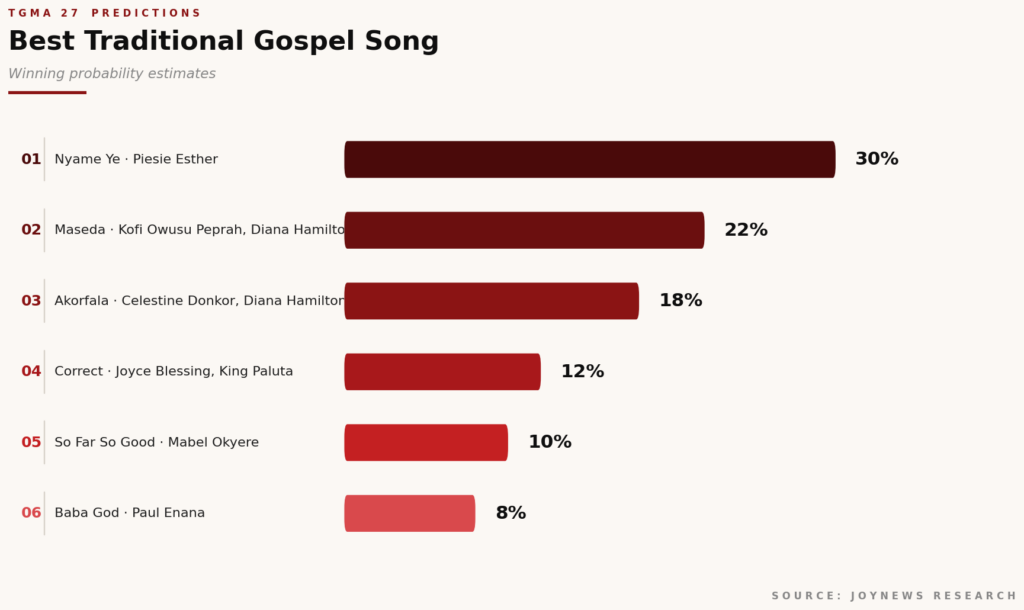
Maseda by Kofi Owusu Peprah featuring Diana Hamilton at 22%. A high-profile gospel collaboration with two respected names.
Akorfala by Celestine Donkor featuring Diana Hamilton at 18%. Adds further weight to Diana Hamilton's spread across the night.
Correct by Joyce Blessing featuring King Paluta at 12%. A genre-crossing collaboration with viral potential.
So Far So Good by Mabel Okyere at 10%. A traditional gospel cornerstone with consistent reception.
Baba God by Paul Enana at 8%. A credible nomination that broadens the field.
Best Urban or Contemporary Gospel Song
Aha Y3 by Diana Hamilton, Ntokozo Mbambo and Elder Mireku at 30%. A pan-African gospel collaboration with strong cross-market reach.
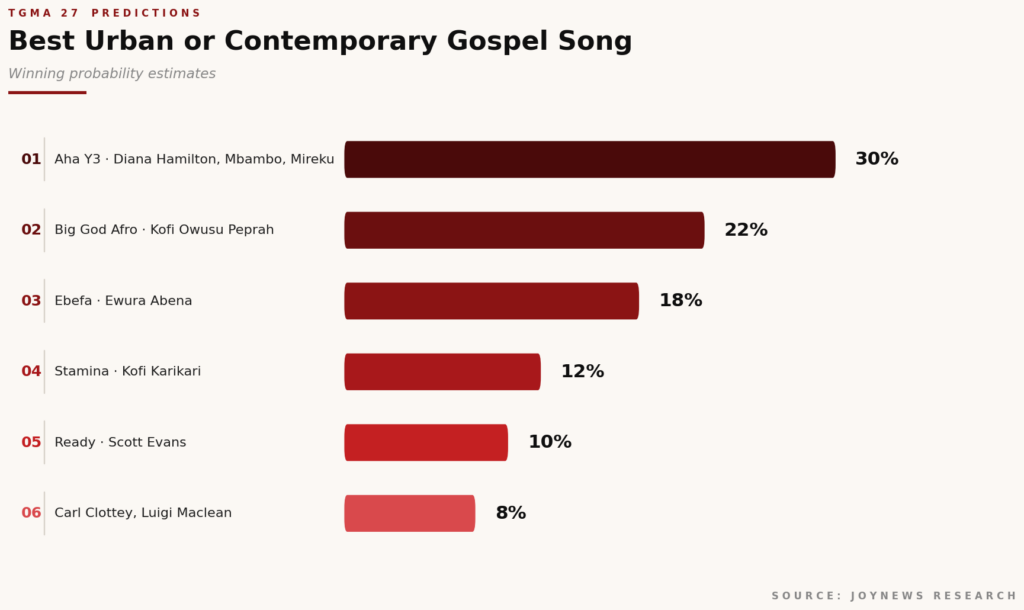
Big God Afro by Kofi Owusu Peprah at 22%. Strong contemporary gospel entry with consistent radio presence.
Ebefa by Ewura Abena at 18%. Breakout urban-gospel record of the year with strong digital streaming.
Stamina by Kofi Karikari at 12%. A vocally focused contemporary gospel entry.
Ready by Scott Evans at 10%. Solid commercial performance.
Carl Clottey featuring Luigi Maclean at 8%. A credible duo entry that adds depth to the field.
Record of the Year
Chaana by Samini featuring the Soweto Mass Choir at 25%. A high-production-value record with continental scope and strong critical reception.
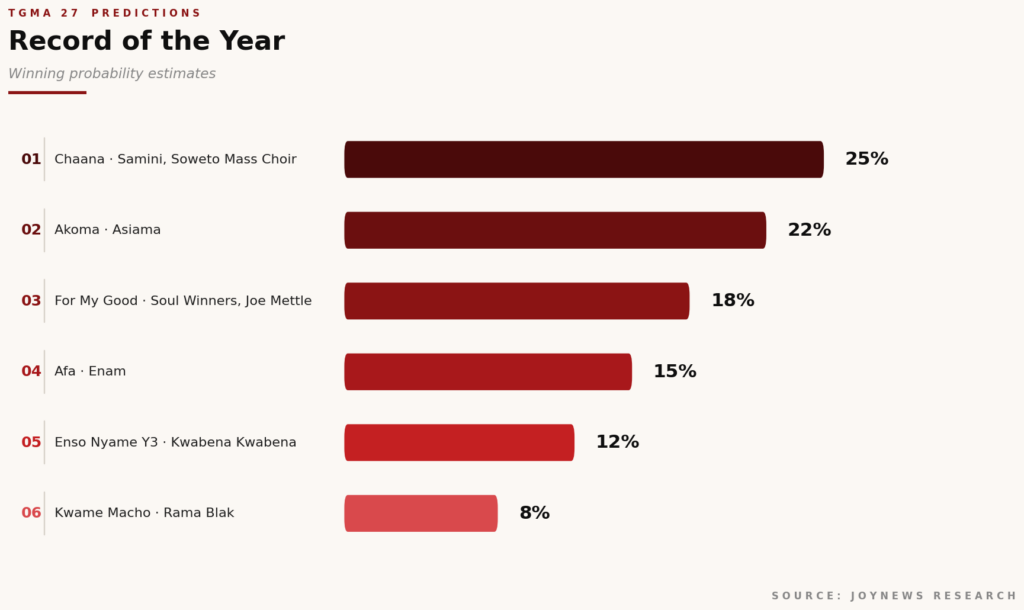
Akoma by Asiama at 22%. A vocally accomplished record produced by a respected name in the category.
For My Good by Soul Winners featuring Joe Mettle at 18%. Strong gospel collaboration with significant audience reach.
Afa by Enam at 15%. A polished record with strong vocal performance credentials.
Enso Nyame Y3 by Kwabena Kwabena at 12%. A traditional highlife entry from one of the genre's senior figures.
Kwame Macho by Rama Blak at 8%. A credible nomination that broadens the field.
Audio Engineer of the Year
Kwame Yeboah for Akoma at 30%. A musician's musician with deep production credentials. Industry voters in technical categories tend to favour engineers with respected back-catalogues, and his work on Akoma has been quietly praised across producer circles all year.
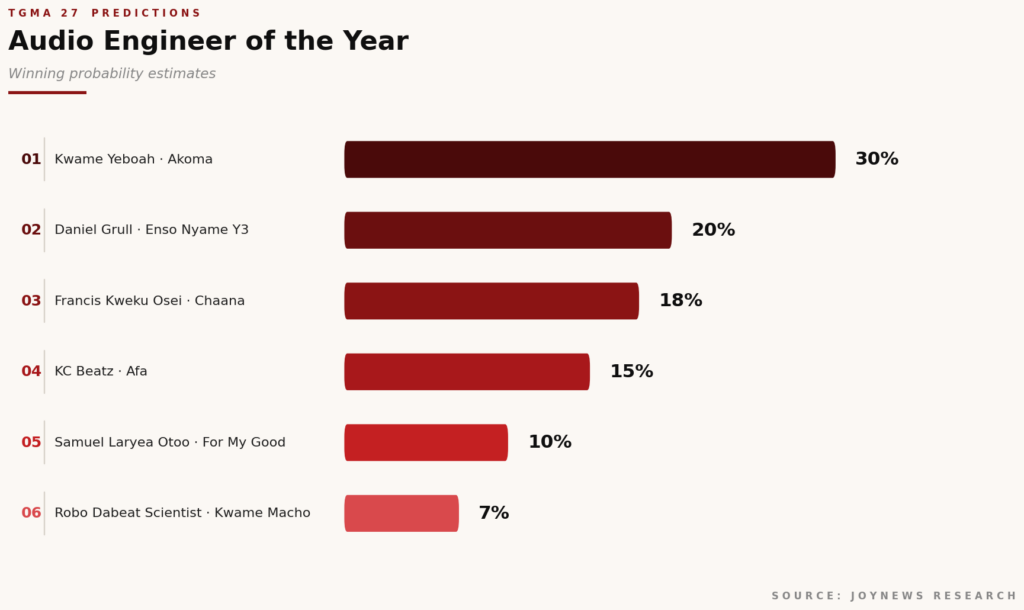
Daniel Grull for Enso Nyame Y3 at 20%. Strong technical work on a senior-artiste record with high production polish.
Francis Kweku Osei for Chaana at 18%. The continental-scale Soweto Mass Choir collaboration carries technical complexity that voters reward.
KC Beatz for Afa at 15%. A respected name in Ghanaian production with consistent presence in technical categories.
Samuel Laryea Otoo for For My Good at 10%. Strong gospel-engineering credentials.
Robo Dabeat Scientist for Kwame Macho at 7%. A solid nomination but with the lightest profile of the field.
Projected Top Winners by Volume
| Artiste | Projected Wins | Key Categories |
| Black Sherif | 4 to 5 | Artiste of the Year, Album of the Year, Best Hiplife or Hip-Hop Artiste, Best HipHop Song, Best Afropop Song, possible Best Music Video |
| King Paluta | 2 | Best Highlife Artiste, Best Highlife Song |
| Diana Hamilton | 2 | Best Gospel Artiste, Best Urban or Contemporary Gospel Song |
| Kojo Blak | 2 to 3 | Best New Artiste, Collaboration of the Year, Best Afrobeats Song |
| Stonebwoy | 1 | Best Reggae or Dancehall Artiste |
| Wendy Shay | 1 | Best Afrobeats or Afropop Artiste |
| Medikal | 1 | Most Popular Song via Shoulder |
| Kofi Kinaata | 1 | Songwriter of the Year |
| Moliy | 1 | Best International Collaboration |
| Lyrical Joe | 1 | Best Rap Performance |
| Cina Soul | 1 | Best Female Vocal Performance |
| Perez Musik | 1 | Best Male Vocal Performance |
| Piesie Esther | 1 | Best Traditional Gospel Song |
| Samini | 1 | Record of the Year via Chaana |
| Kwame Yeboah | 1 | Audio Engineer of the Year |
Tonight's TGMA looks, on balance, like a strong night for Black Sherif, with several alternative storylines that could meaningfully reshape the final tally if voters lean into different narratives. Wendy Shay's industry support and AFRIMA validation give her a genuine path to the top honour. The new generation of artistes has a clear opening to take a meaningful share of the night's hardware. The traditional categories of Songwriter, Best Highlife, and Best Reggae or Dancehall look the most settled, while public-vote categories such as Most Popular Song remain the hardest to call with high confidence.
The ceremony begins at 8:00 PM tonight at the Grand Arena. Public voting closes shortly before the broadcast. By the time the credits roll, every probability in this report will either be vindicated by the envelopes or politely embarrassed by them. That is the nature of award nights, and that is why the country watches.
Who is Isaac Kofi Agyei:
Isaac Kofi Agyei is a Data & Research Journalist/Analyst and Head of Research at JoyNews based in Accra, where he covers mostly finance, economics, banking, politics, sports & entertainment business across Ghana and West Africa, from detailed analytical reports on all key issues to debt crises to IMF programmes. He also serves as the data and research correspondent for SBM Intelligence, an Africa-focused market/security leader in strategic research, providing actionable analyses of West Africa’s socio-political and economic landscape. With his solid academic background in economics and statistics and additional training from credible institutions such as the UNDP, Afrobarometr, Ghana Statistical Service, and a host of others, Isaac has honed his skills in effective data storytelling, reporting, and analysis.
Latest Stories
-
Mohammed Fuseini in talks over Troyes move from Union SG
31 seconds -
‘Bear with the system’ – Energy Ministry says temporary power control room to be ready by September
10 minutes -
Two nationwide blackouts in a space of a month ‘cause for worry’ – Adomako-Mensah
13 minutes -
Technical challenges affecting tax payments are being resolved—GRA
17 minutes -
Ghana Premier League 2026/27: What to expect from the new season
34 minutes -
Academic who accused Jason Arday of plagiarism suspended by university
45 minutes -
Founder of collapsed Chinese property giant Evergrande sentenced to life in prison
56 minutes -
VIDEO: I don’t subscribe to Oyinbo life, Nigeria’s Elumelu schools lady for calling him by first name
58 minutes -
23rd Ghana International Book Fair launched to promote reading culture among young people
1 hour -
NSMQ 2026: Amaniampong’s ‘Onipa’ starts new mission at St. Louis with one-eighth spot
1 hour -
All you need to know about the new Road Traffic Regulations, 2026
1 hour -
FET Auto introduces full GAC vehicle lineup to Ghanaian market
2 hours -
Parliament must summon GRIDCo, Energy Minister over recurring blackouts – Adomako-Mensah
2 hours -
Temporary control room leaves Ghana’s power system vulnerable — Energy Ministry
2 hours -
Ghana’s NGOs should strengthen local government, not replace it
2 hours