

Audio By Carbonatix
The incident is the second occasion in recent months in which police resorted to using water cannons on demonstrators. Recent protests in Thailand have called for government reforms and changes to the powerful monarchy.
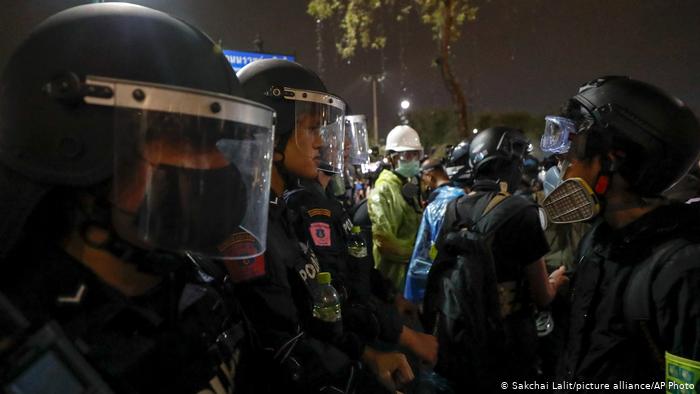
Pro-democracy protesters in Thailand were confronted with riot police and water cannons on Sunday as they attempted to deliver grievance letters to the Grand Palace in Bangkok.
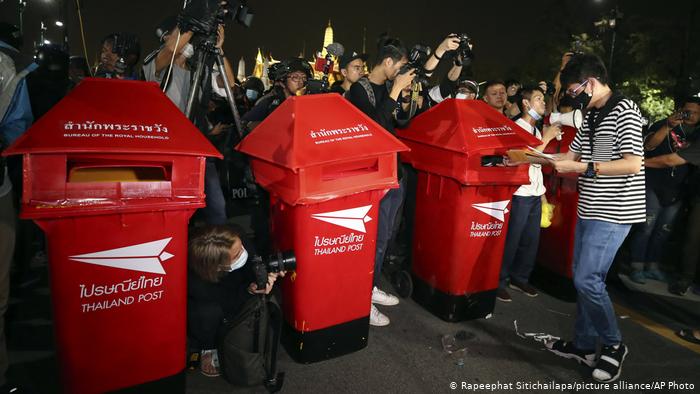
The conflict was brief, and police later allowed the demonstrators to place four red mailboxes near the palace to allow protesters to deposit their letters.
Some 7,000 protesters took to the streets on Sunday, marching from Democracy Monument in central Bangkok to the palace, authorities said.
Police had unleashed water cannons when protesters pushed aside one of several buses serving as a barricade to the palace. For protesters and one police officer were hurt during the confrontation, according to the Bangkok authority's emergency unit.
Police spokesman Kissana Phatanacharoen said the water cannons were only fired as a warning. It was only the second time police used the cannons amid months protests.
The Grand Palace in Bangkok is home to royal offices but is only used infrequently by King Maha Vajiralongkorn.
Pro-democracy protests in Thailand
The southeast Asian country has seen pro-democracy protests since July. The student-led movement has put enough pressure on the government to call for parliament to deal with at least some of their demands.
Protesters have taken to the streets on a daily basis to protest the country's monarchy and demand that Thailand's Prime Minister Prayuth Chan-ocha step down.
Protesters believe Prayuth lacks legitimacy because he came to power during an election in which the rules were set up by the military. Prayuth, a former army chief, led a 2014 coup that ousted an elected government and then headed a junta that ran the country until an election last year.
The junta also instituted a new constitution that the protesters deem to be illegitimate.
The movement's criticism of the monarchy is more controversial. A lese majeste law mandates a prison term of up to 15 years for anyone who defames the king or his close family. Public criticism was virtually unheard of until the protests.
The protesters have demanded curbs on the king's powers and called for the monarchy to be more accountable.
"When the king truly cherishes democracy, all people will find happiness," the protesters said Sunday as part of a prepared statement. "When you hear all the flattering praise from the people, you must also hear fearless criticisms and suggestions all the same."
Latest Stories
-
Demand and savings deposits decreased in August 2026, but currency outside banks increased by 4%
1 minute -
Fiscal policy implementation poses downside risk to inflation – BoG
35 minutes -
Organised Labour should seek fair adjustment, not excessive pay rise – Labour consultant
39 minutes -
BoG maintains medium-term inflation target of 8 ± 2%
46 minutes -
Sammi Awuku urges NPP Germany to unite ahead of 2028 elections
1 hour -
The Inconvenient Truth: We cannot pray for the cure while protecting the disease
2 hours -
MTN Ghana trains civil society organisations on artificial intelligence
3 hours -
GoldBod FX framework aims to make dollar supply predictable – Acheampong
3 hours -
How does a Ghanaian team make it to the BAL?
3 hours -
Ghana’s investment climate presents opportunities for industrial growth and job creation.
3 hours -
‘I paid thousands to a company for jobs that never came’
4 hours -
SSNIT intensifies informal sector enrolment drive with Techiman float
4 hours -
Ghana seeks long-term mining investments that benefit local communities – Armah-Kofi Buah
4 hours -
GHATOF demands compensation for 85 businesses affected by La Pleasure Beach demolition
4 hours -
Bono Regional Minister calls for investor education to drive economic growth
4 hours