


Audio By Carbonatix
There is something strange about the air we breathe. We cannot see it, yet it surrounds us. We cannot hold it in our hands, yet without it we would not survive for more than a few minutes. It carries heat, moisture, gases and tiny particles across cities, countries and continents. It interacts with sunlight; controls part of the Earth's energy balance and helps determine the weather we experience every day.
As a physicist, I have learned to look at the atmosphere differently. To many of us, the sky is simply the space above our heads. To physics, however, the atmosphere is not empty space. It is a dynamic physical system governed by the same fundamental principles that govern the movement of matter and energy throughout nature.
And this is where our conversation about air pollution should begin. Not with the smoke we see. Not even with the health problems we fear. But with the physics of the air itself.
THE ATMOSPHERE IS A PHYSICAL SYSTEM
The Earth's atmosphere is a thin layer of gases held around the planet by gravity. Nitrogen and oxygen make up most of it, with smaller quantities of argon, carbon dioxide, water vapour and other gases. But the atmosphere is far more than a mixture of gases. It is constantly moving.
The Sun supplies energy to the Earth. The Earth's surface absorbs part of that energy and releases energy back into the atmosphere and space. Differences in temperature create differences in pressure. Differences in pressure drive winds. Water evaporates, condenses and falls as precipitation. Heat is transported from one region to another.
In other words, the atmosphere is a giant energy and mass transfer system. The air above Accra is not necessarily the same air that was there yesterday. Air masses move. They mix. They rise and descend. They carry moisture, dust, smoke and other particles with them. That simple physical reality has an important consequence: What we release into the atmosphere does not necessarily remain where we release it.
A particle emitted in one location can be transported somewhere else by wind and atmospheric circulation. The atmosphere therefore connects us in ways that political boundaries cannot.
And then there are aerosols.

This is where my own scientific interest in atmospheric physics becomes particularly important. Suspended in the atmosphere are tiny solid and liquid particles collectively known as aerosols.
Some come from natural processes. Dust can be lifted from dry soils. Sea spray can inject salt particles into the atmosphere. Volcanic eruptions can release particles and gases. Vegetation and biological processes can also contribute particles to the atmosphere. Others are produced or influenced by human activity. Vehicle exhaust, industrial processes, construction, agricultural activities, combustion and open waste burning can all contribute to atmospheric particulate matter.
The fascinating part is that these particles are not simply passive objects floating in the sky. They interact with radiation. When sunlight encounters atmospheric particles, some of the radiation can be scattered while some can be absorbed. The nature of that interaction depends on factors including the particle's size, composition, concentration and the wavelength of the radiation. This is physics. And this physics matters to the climate.
Some aerosols can exert a cooling influence by reflecting part of incoming solar radiation back toward space. Others, particularly absorbing particles such as black carbon, can warm the atmosphere by absorbing sunlight.
Aerosols can also influence clouds because some particles provide surfaces around which water vapour can condense. So, a tiny particle that we cannot see with our eyes can participate in processes that operate on a scale much larger than itself. That is one of the things I find most fascinating about atmospheric physics.
THE INVISIBLE CAN INFLUENCE THE VISIBLE: THE ATMOSPHERE DOES NOT RECOGNISE OUR BORDERS
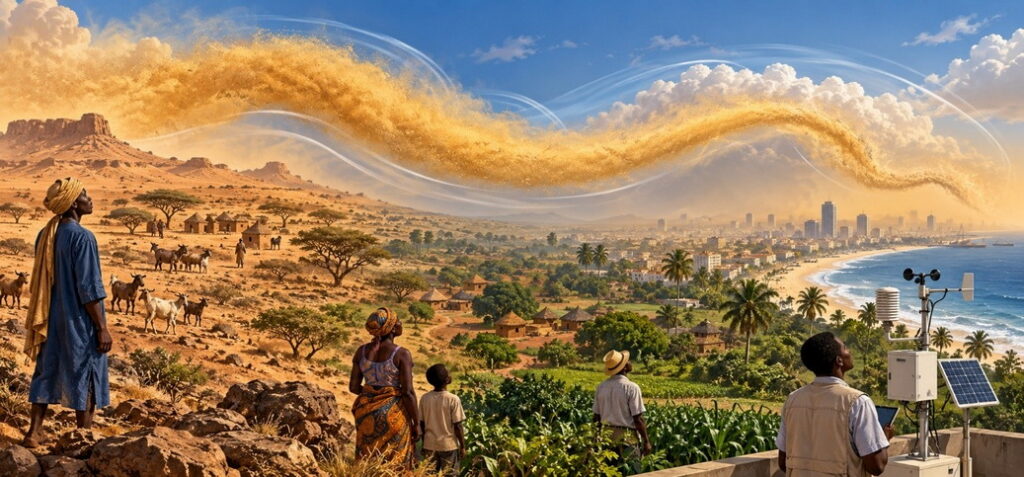
Once we understand this physics, the environmental question becomes much bigger. Ghana does not have an atmosphere separate from Burkina Faso, Mali, Niger, Nigeria or the Atlantic Ocean. The West African atmosphere is a connected system.
During the dry season, for example, mineral dust from the Sahara and Sahel can be transported southward. When that happens, the hazy conditions we experience in parts of Ghana are not necessarily caused by something that happened within the immediate community. This is why simply looking at a hazy sky and blaming the nearest source can sometimes be scientifically misleading.
We need measurements. We need atmospheric models. We need meteorological observations. We need satellite observations. And we need scientists who can bring these different sources of information together. Only then can we begin to answer the more difficult question:
- Where did the particles come from?
- Where are they going?
- What are they doing while they are in the atmosphere?
GHANA'S INVISIBLE PROBLEM
This becomes particularly important when we consider recent air-quality measurements. The 2024 World Air Quality Report estimated Ghana's population-weighted annual average PM2.5 concentration at 35.8 micrograms per cubic metre, more than seven times the World Health Organization's annual guideline of 5 micrograms per cubic metre. Accra's estimated annual average was approximately 36.3 micrograms per cubic metre.
These numbers are significant, but they need to be interpreted carefully. Air-quality monitoring coverage remains uneven, particularly across Africa. Therefore, the numbers tell us something important about measured pollution while simultaneously reminding us about what we still do not know. That distinction matters.
A lack of measurement should never be mistaken for a lack of pollution. In fact, insufficient measurement may be one of Africa's greatest environmental challenges. Africa cannot manage an atmosphere it does not adequately measure. The monitoring gap is striking.
IQAir's 2024 assessment reported roughly one air-quality monitoring station for every 3.7 million people in Africa. Compare that with the scientific infrastructure available in many wealthier parts of the world, where monitoring networks, satellite observations, atmospheric models and publicly accessible environmental databases have been developed over decades.
The problem is therefore not simply that Africa has polluted air. Africa also has a measurement problem. And that has consequences. If we do not have enough observations, we cannot confidently establish long-term trends. If we cannot establish trends, it becomes harder to determine whether air quality is improving or deteriorating. If we cannot determine the sources of pollution, it becomes harder to design targeted interventions. And if we cannot quantify the problem, it becomes easier for society to underestimate it. This is why atmospheric science is not an academic luxury. It is infrastructure.
GHANA IS NOT THE WORST, AND THAT IS PRECISELY WHY WE SHOULD PAY ATTENTION
Ghana's estimated 2024 PM2.5 concentration was lower than that of several African countries.
Chad recorded about 91.8 micrograms per cubic metre, the Democratic Republic of Congo about 58.2, Uganda 41.0, Nigeria 40.1, Rwanda 40.8 and Egypt 39.8. Ghana's figure was about 35.8. Countries such as South Africa, Ethiopia and Madagascar recorded lower annual averages in the same dataset. But these numbers should not become an African pollution league table. The more useful question is: What can Ghana learn from the different experiences of these countries?
From the Sahel, we can study dust, land degradation and atmospheric transport. From highly urbanised countries, we can study the interaction between transport, energy consumption, industry and population growth. From countries that have developed stronger monitoring networks, we can study how sustained observation improves environmental decision-making. And from countries that have reduced pollutants over time, we can study what happens when regulation, technology, monitoring and enforcement work together.
WE SHOULD STUDY THE NEGATIVE CONSEQUENCES BEFORE THEY BECOME NORMAL
There is a danger in becoming accustomed to pollution. A hazy morning eventually becomes "normal." Smoke from burning waste becomes part of the neighbourhood. Dust becomes something we simply wipe from our windows. Traffic emissions become part of everyday life. But physics does not become less real because we become accustomed to it. PM2.5 remains PM2.5 whether we see it or not.
The respiratory system does not care whether pollution has become socially normal. And the atmosphere does not stop responding because society has become accustomed to haze.
The health implications are serious. The World Health Organization (WHO) identifies air pollution as a major environmental health risk, while the State of Global Air estimates that air pollution contributed to millions of deaths globally in recent years. The consequences also extend beyond human health.
Air pollution affects visibility, ecosystems, agriculture and climate processes. Some pollutants have short atmospheric lifetimes but strong effects. Others remain in the atmosphere for much longer.
This is why the distinction between air pollution and climate change should not become an excuse to treat them as separate problems. They interact.
THE CLIMATE CONNECTION
Climate change is fundamentally a problem of energy. The Earth receives energy from the Sun and emits energy back toward space. The balance between incoming and outgoing energy determines the planet's climate.
Greenhouse gases influence the outgoing infrared radiation from the Earth. Aerosols can interact with incoming and outgoing radiation in different ways. Clouds interact with both.
The atmosphere therefore sits at the centre of a complicated exchange involving radiation, convection, evaporation, condensation, chemistry and circulation.
As a physicist, this is what makes climate science so compelling. It is not simply about “hotter temperatures but about the redistribution of energy through a complex system.”
The late NASA climate scientist James Hansen referred to the temporary cooling effect of some human-produced aerosols as a “Faustian bargain.”
The phrase captures an uncomfortable scientific reality: some forms of pollution can partially mask greenhouse warming while simultaneously damaging human health and ecosystems.
Cleaning the air can therefore produce an apparent short-term warming effect for some pollutants, even though it is essential for health and environmental protection. This is precisely why climate policy requires science rather than slogans.
Other countries are already teaching us important lessons. The rest of the world provides a useful laboratory. Some countries demonstrate what happens when pollution becomes severe. Others demonstrate what sustained monitoring, regulation, cleaner technology and public policy can achieve.
Europe is particularly instructive because air pollution has not disappeared despite relatively strong environmental regulation. The European Environment Agency's assessment of 2024 data still identified exceedances of air-quality standards in several countries, while comparison with the stricter WHO guidelines revealed a much wider problem.
Australia and New Zealand provide another useful contrast. IQAir's 2024 assessment placed both among the small number of countries whose population-weighted annual PM2.5 averages met the WHO guideline.
The lesson is not that Ghana should copy Australia or Europe. Their economies, geography, population structures and emission sources are different. The lesson is that air quality is partly a question of choices.
How do we generate electricity? How do we move people? How do we cook? How do we dispose of waste? How do we regulate industries? How do we design cities? How do we monitor emissions? And perhaps most importantly: “How much scientific information do we make available before making decisions?”
AFRICA NEEDS TO STUDY AFRICA
There is another issue that concerns me as an African scientist. Africa cannot permanently depend on measurements and models generated elsewhere to understand its own atmosphere. We need African atmospheric scientists studying African atmospheric processes. We need long-term measurements across the continent. We need stronger collaboration between universities, meteorological agencies, environmental regulators and space institutions. We need to combine ground observations with satellite measurements. We need African researchers working with atmospheric chemistry, radiation, aerosol transport, climate modelling and remote sensing.
And we need young scientists to see atmospheric science not as an abstract field but as a discipline connected to food security, health, transport, climate resilience and development.
Wangari Maathai's environmental philosophy repeatedly connected environmental protection with human wellbeing and development. Her work reminds us that environmental problems in Africa cannot be treated as luxuries reserved for wealthier societies. “Clean air is not a luxury but part of development.”
WHAT CAN GHANA DO?
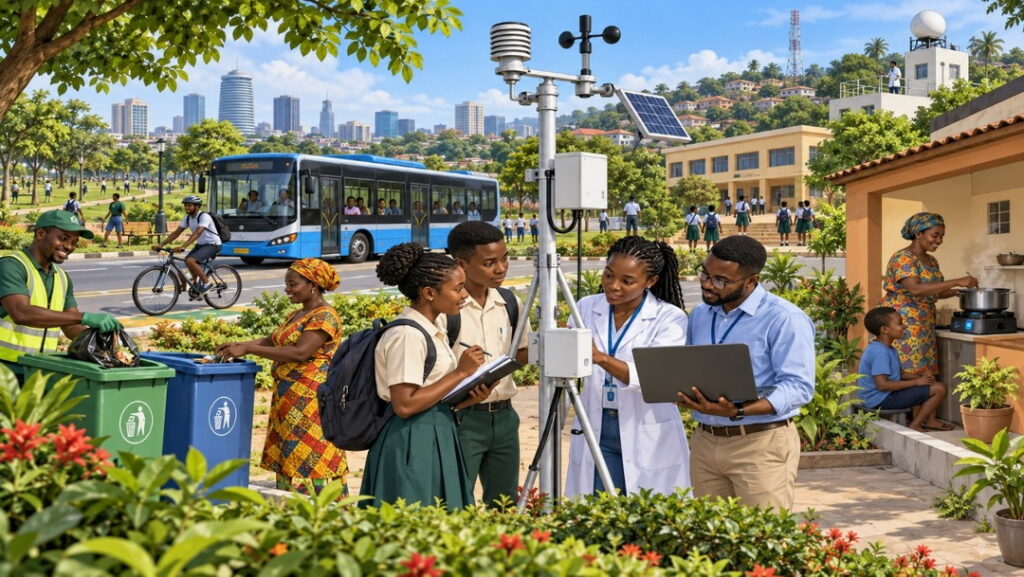
The solutions will not come from one ministry, one institution or one technology.
But several things are possible.
1. Measure more
Ghana needs a dense, reliable and continuous air-quality monitoring network. Monitoring should particularly focus on major urban centres, industrial areas, transport corridors, construction zones and communities where open burning is common.
2. Connect the measurements
Ground stations should not operate in isolation. We should combine them with satellite observations, meteorological data and atmospheric models. This would allow researchers to distinguish local pollution from regional transport and natural sources such as Saharan dust.
3. Make the data public
People should be able to know the quality of the air they are breathing. Air-quality information should become as accessible as weather information.
4. Reduce open burning
Waste does not disappear when we burn it. It is transformed into gases, particles and ash. Reducing open waste burning should therefore be treated as both a waste-management and air-quality intervention.
5. Improve transport
Cleaner public transport, better vehicle inspection, improved urban planning and reduced congestion can help reduce transport-related emissions.
6. Support cleaner household energy
Household air pollution remains a major challenge across Africa. Expanding access to cleaner cooking technologies and fuels would have immediate health benefits while also contributing to broader environmental goals.
7. Strengthen industrial enforcement
Industries need clear emission standards, reliable monitoring and consistent enforcement. Environmental regulation is most effective when compliance can be measured.
8. Invest in African atmospheric science
Perhaps this is the most important solution. We need more research funding. More monitoring stations. More atmospheric scientists. More climate physicists. More environmental data scientists. More satellite and remote-sensing specialists. And more collaboration between African institutions. Because ultimately, scientific independence is part of environmental independence.
THE AIR WE CANNOT SEE
Perhaps the greatest challenge is that we respond more quickly to environmental problems that are visible.
We see a polluted river.
We see plastic waste.
We see a forest being destroyed.
But we cannot see PM2.5.
We cannot see carbon dioxide.
We cannot see the radiation being absorbed or scattered by atmospheric particles.
We cannot see the complex circulation transporting dust across borders.
Yet these invisible processes are shaping the world we live in.
The atmosphere may appear empty.
Physics tells us otherwise.
It is a constantly moving system of matter and energy, connecting the ground beneath our feet to the space above us and connecting one country to another.
That is why Ghana needs to start taking its atmosphere seriously. Not because every hazy day means a disaster. Not because every particle in the air is produced by human activity. But because we cannot responsibly manage an environment, we do not adequately understand. The question is therefore not simply whether Ghana has polluted air.
The deeper question is whether we are willing to measure it, understand it and act on what the measurements tell us. For me, as a physicist, that is where the conversation begins. The air may be invisible. The physics is not. And neither are the consequences.
About the Author

Petras Anaab Ali (MPhil) also known as Sumaila Ali or Coach Ali (The Supreme Tactician), holds a BSc and MPhil in Physics from the University of Ghana, also reading a certificate program in Biblical Studies from Heritage Bible Institute. His academic interests lie at the intersection of cosmology, quantum theory, philosophy of science, and Christian theology, with a focus on exploring the origin, structure, and destiny of the universe.
He works with Ghana’s Environmental Protection Authority (EPA) as a Programme Officer (P.O), contributing to environmental regulation and sustainability efforts. Beyond his scientific career, he is also a Sports Analyst, Sports Researcher, Sports Writer, and Sports Commentator with Radio Univers and Legon Today. Petras brings a balanced and insightful perspective to discussions on science and faith, communicating complex ideas with clarity for both academic and general audiences.
Some of his publications are:
Entropy and Eschatology: From Creation to Collapse – Why the Laws of Physics and the Witness of Scripture Converge on a Finite, Contingent Cosmos
The Big Bang Theory: A Scientific Beginning, not a Denial of God
The Uncertainty of Precision: How VAR Mirrors the Heisenberg Uncertainty Principle in Football
Martin Koopman, the missing piece in Hearts’ rainbow puzzle?
While the World Looks to the Moon, Africa Looks Away – And that Must Change
Latest Stories
-
Meet Dr Hazel and Nhyira: Mother and daughter called to the Ghana Bar last Friday
6 seconds -
Black Star Fashion Week: Can Ghana turn the runway into a tourism attraction?
53 seconds -
Ghana sends 61 health workers to Grenada under Labour Export Programme
13 minutes -
Central banks should avoid reacting too strongly to headline inflation – IMF
20 minutes -
Kumasi: One injured, shops destroyed in Atasemanso fire in Kumasi
33 minutes -
Global economy proving resilient, growth projected at 3.1% in 2026 – IMF
37 minutes -
NDC targets all 6 parliamentary seats in Ahafo Region for 2028
40 minutes -
Ghana targets thousands of overseas nursing jobs under Labour Export Programme
42 minutes -
Pius Hadzide explains why Sports Ministry always attracts scandals
43 minutes -
APL says GoldBod terminated US$1bn Goldstream deal over failure to meet obligations
48 minutes -
Daily Insight for CEOs: Making better decisions under pressure
49 minutes -
Weta rice farmers seek urgent support after floods destroy crops
49 minutes -
Mahama commits GH¢200m in 2027 Budget to complete Police Hospital expansion
53 minutes -
Standard Chartered Bank delivers strong returns and sustainable shareholder value
1 hour -
Akufo-Addo’s role in the artificial cedi stability is indisputable — Facts do not bend to political convenience
1 hour