

Audio By Carbonatix
Former United Nations Senior Governance Advisor, Professor Baffour Agyeman-Duah, has described the current threshold for petitioning the removal of the Chief Justice as "woefully inadequate," calling for urgent reforms to protect the country's democracy.
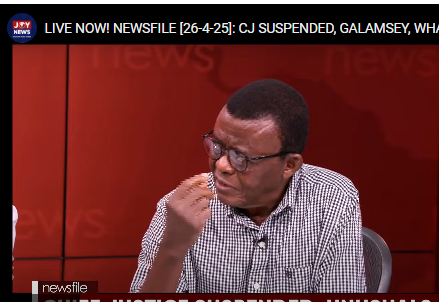
Speaking on Newsfile on JoyNews on Saturday, April 26, during a discussion on the suspension of the Chief Justice, Prof Agyeman-Duah welcomed the timing of the issue.
"For me, I am happy that this thing has happened at the time that a committee has been set up to review the constitution. I think the threshold for petitioning to getting the removal of EC, the Chief Justice is woefully inadequate. Because these are some of the issues we need to deal with to bring some clarity," he said.
He criticised the existing procedure for the removal of the Chief Justice, comparing it to the more rigorous process required for the President and ministers.
"For the President and even his ministers, it has to go to Parliament for two-thirds majority to accept before anything can be done. In this case, individuals submit a petition and then the Chief Justice is obliged to respond to each of them. Then the process is now ongoing," he explained.
Prof Agyeman-Duah questioned the fairness and strength of this system.
"I think it is not a proper process to manage a problem having to do with a Chief Justice. Maybe my conception of a Chief Justice might be a little bit exaggerated, but if I consider the fact that Chief Justice, President, and the Speaker are the three centres of our democracy, then I have to be more careful looking at the principle of separation of powers. That is my concern," he stated.
Although he stressed that the President had not committed any wrongdoing, he argued that the constitutional provisions need urgent revision. "The whole process as we have it today in the Constitution has to be reviewed so that we can streamline and raise the bar," he urged.
Drawing lessons from other jurisdictions, Prof Agyeman-Duah noted that elsewhere, a petition must often be supported by a certain number of signatures to show serious and widespread disapproval.
"It will show the gravity and the widespread support for that particular movement," he explained.
He stressed the need for Ghana to adopt a higher standard.
"So I think we need to raise the bar for petitioning and petitions being accepted by the President when the Chief Justice does something wrong," he said.
Latest Stories
-
Interest payments to average a high 20% of government revenue over next 4 years
1 hour -
Strategy of accumulating foreign reserves, gold carries high fiscal cost – S&P Global
1 hour -
Weak institutional arrangements, high debt servicing constrain Ghana’s rating – S&P
1 hour -
Bond market: Turnover declined by 28% to GH¢1.56bn
2 hours -
Volta Region National Public Speaking contest advances drug prevention conversation
2 hours -
New health training facility at Ampoma-Jema to address admission shortfalls, but Minister flags missing amenities
2 hours -
Black Challenge unveiled with sights set on Amputee World Cup glory
3 hours -
Pay striking teachers before expressway spending, Dr Kingsley Agyemang tells government
3 hours -
Customs intercepts assault rifle, two pistols and 610 rounds of ammunition at Tema Port
4 hours -
PKO boxers secure wins at Odwira Festival
4 hours -
South Tongu Records Rise in Teenage Pregnancy
4 hours -
Cabinet threw out US health compact faster than anything I’ve seen – Mahama
4 hours -
MoFA urges Finance Ministry to reverse World Bank food programme withdrawal over GH¢643m commitments
4 hours -
NAGRAT demands signed timelines before calling off strike
5 hours -
National Investment Quiz: West Africa SHS, St. Louis SHS advance to semi-finals
5 hours