

Audio By Carbonatix
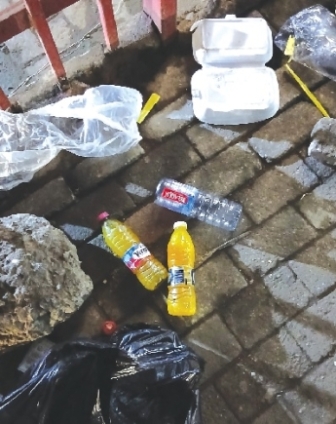
A Community Health Consultant has warned that the practice of some traders, particularly women, at the Accra Central Market, urinating into plastic water bottles and storing them at their spots until the end of the day is a serious health risk.
Others pour the urine into nearby drains or on pavements — a habit that has become disturbingly common despite rising concerns about communicable diseases.
The consultant, who is the Head of the Department of Community Health at the University of Ghana Medical School, Professor Benedict N.L. Calys-Tagoe said that such practices could expose traders and customers to diseases.
In an interview with The Mirror in Accra last Wednesday, Professor Calys-Tagoe said communicable diseases such as typhoid could be transmitted if infected urine came into contact with food, water or even the hands of traders.
He explained that containers used to store urine could serve as breeding grounds for disease-causing organisms.

“When urine is stored for long periods, it becomes a good medium for the growth of microorganisms. Although urine itself is generally not hazardous, it can pose health risks under such conditions,” he said.
“If urine leaks onto their hands and they don’t wash them properly, microorganisms can easily be transferred to food or water, creating a route for disease transmission,” he explained.
Professor Calys-Tagoe, who is also an epidemiologist and consultant public health physician, added that decomposing urine releases ammonia gas, which causes the strong odour associated with urinals and can irritate the eyes and respiratory tract, sometimes leading to coughing.
These, he said, are some of the indirect effects of improper urine disposal.
Professor Calys-Tagoe stressed the need for continuous engagement and education for traders, many of whom may not be aware of the health implications of their actions.
“Beyond education, we must provide adequate places of convenience in markets. If traders have to walk about 200 metres to find a urinal, it becomes easier for them to use bottles instead,” he observed.
Market observations
During visits to the Accra Central Market, The Mirror found some of such bottles filled with urine under tables and on pavements in areas such as the Okaishie Drug Lane, CMB and Kingsway.
Environmental effects
Professor Calys-Tagoe warned that abandoned urine bottles could contribute to eutrophication — the process by which nutrients such as those in urine enter water bodies, causing excessive algae growth.
“When urine enters drains and eventually streams, it can disrupt aquatic ecosystems, killing fish and reducing the availability of seafood for human consumption,” he explained.
He also cautioned that traces of antibiotics or medication in urine could contaminate water bodies, further harming aquatic life.
Public concerns
Some customers expressed worry about the practice.
“A trader can be urinating behind her table while transacting business,” said Osei Akoto.
Another shopper, Evelyn Ntiamoah, added that some traders reused empty water bottles as urine containers instead of visiting public urinals.
Other customers described the practice as lazy, noting that public toilets and urinals were often located within a short walking distance.
Market queen’s reaction
The CMB Market Queen, Naa Kwanuwa, confirmed the practice and condemned it as unacceptable.
“The women are just being lazy. I’ve warned them several times, but they keep doing it and apologising later,” she said.
She urged traders to prioritise hygiene and called on the media to help raise awareness.
“It costs only GH¢1 to use a urinal and GH¢5 for the toilet. There’s no excuse for such behaviour,” she added.
Latest Stories
-
Trump says he is considering firing US ambassador to Greece
3 hours -
Man City bananas ‘brought fun back’, says Varadi
4 hours -
Meta releases Muse Wonder AI models to challenge Anthropic and OpenAI
4 hours -
Daily Insight for CEOs: The CEO as Chief Decision Maker
4 hours -
Burnham had formal meeting with Man City chair while mayor
4 hours -
Is Ghana producing too many lawyers? What is the best lawyer-to-citizen ratio?
4 hours -
NDC sinking Ghana’s democracy with Emelia Agbenyo’s appointment – Miracles Aboagye
4 hours -
Seedorf back in football as Corinthians head coach
4 hours -
Hincapié and Zubimendi injured in post-match training session
4 hours -
Fridges in French supermarkets hit by cyberattack
5 hours -
Qantas flight grounded after bedbug outbreak
5 hours -
Reality Zone with Vicky Wireko: International Day of the Girl, shaping today’s girl for tomorrow’s future – ZONTA Clubs lead the way
5 hours -
Global health must be led by countries, not designed for them – Mintah Akandoh
6 hours -
Mahama honoured at 2026 World Health Summit in Berlin for global health leadership
6 hours -
Breast cancer is not a death sentence – Besease Kontire Obaapanin, Magmina Foundation lead awareness campaign
6 hours