

Audio By Carbonatix
Every time Donald Trump has mentioned his plan to levy massive tariffs on imports into the US, there has been a widespread assumption that they will be delayed, watered down or rolled back.
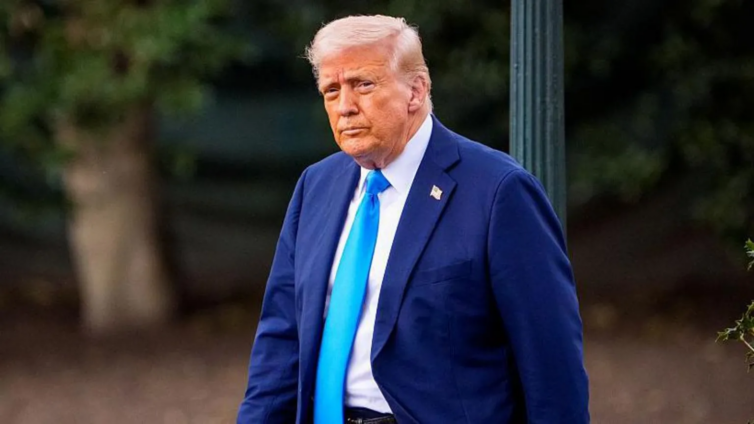
Today, he will reveal in the White House Rose Garden not just how serious he is about "the most beautiful word in the dictionary", but effectively call time on decades of economic globalisation.
And it is still possible that he will do this by launching the equivalent of a salvo of ballistic missiles into the global trading system, with a universal tariff on all imports into the USA.
The option of a 20% universal tariff is the only way to get to some of the massive revenues of trillions of dollars claimed by some of his advisers.
In recent days, President Trump has been adamant that the tariffs will be "reciprocal" and the US will be "nicer" to its trade partners.
That doesn't rule out wide-scale imposition of tariffs at 10 or 20%, if, for example, the US deems that Value Added Taxes are tariffs.
It is possible that countries could be very broadly bracketed into different levels of a basically universal tariff. As one G7 negotiator told me at the weekend, "it all comes down to President Trump".
A system such as this, with equivalent global retaliation, would see the UK economy shrinking by 1%, enough to wipe out growth and lead to pressure for tax rises or spending cuts.
The total cost around the world could, according to an Aston University Business School study, be $1.4 trillion (£1.1tn), as trade is diverted, and prices rise.
In industry, there is some expectation that the European Union will target US tech companies. There could be quite the contrast should the UK choose not just to hold back on retaliation, but offer a significant tax cut to US big tech.
Trade wars are hard to win, and easy for everyone to lose.
A universal tariff of 20%, or its equivalent, would be a historic hit to the global trading system, on a par with the infamous Smoot-Hawley tariffs nearly a century ago.
There is something bigger here, however. As the Vice President, JD Vance said in a speech last month, globalisation has failed in the eyes of this administration because the idea was that "rich countries would move further up the value chain, while the poor countries made the simpler things".
As that has not panned out, especially in the case of China, the US is moving away from this world.
If the US overplays its hand in alienating its allies today, China will be waiting. The hit to US business in Europe, for example, could be offset by cheaper electronics, clothes, and toys from the East arriving in the UK and lowering prices, diverted from the US market.
What starts later today is designed not just to reshape America, and trade, but the way the world itself has been run.
Latest Stories
-
Ampofo Ankrah did not collect World Cup visa money – Lawyer
8 minutes -
Baffour Awuah to spend night in EOCO custody – Atta Akyea
10 minutes -
Torgbiga Wenya III opposes proposed elevation of 36 Anlo chiefs to Paramount status
17 minutes -
The strengthening El Niño and what it could mean for Ghana
21 minutes -
Baffour Awuah formally charged with money laundering, loss of public funds – Lawyer
22 minutes -
Drone flight over EOCO building could attract 30-year jail term – Security consultant
30 minutes -
Flying drone over EOCO premises is strictly prohibited – Security consultant
30 minutes -
SIC file was surrendered to client, EOCO has no reason to search Manhyia South MP’s firm – Atta Akyea
31 minutes -
EOCO search of Baffour Awuah’s law firm raises confidentiality concerns – Atta Akyea
32 minutes -
“I will never ignore an invitation from EOCO if I had received one” — Manhyia MP
34 minutes -
Baffour Awuah ready to cooperate fully with EOCO investigation – Bosome Freho MP
57 minutes -
How a Ghanaian technology is helping fish farmers detect hidden threats before fish die
1 hour -
AI tool helps Ghanaian farmers identify crop threats from field observations
1 hour -
NEIP: Designing a Ghana Startup Agency that builds enterprises, not programmes
1 hour -
Breast cancer diagnosis is not a life sentence – Gender Minister urges early treatment
1 hour