


Audio By Carbonatix
US President Donald Trump says he will hit movies made in foreign countries with 100% tariffs,as he ramps up trade disputes with nations around the world.
Trump said he was authorising the US Department of Commerce and Trade Representative to start the process to impose the levy because America's movie industry was dying "a very fast death".
He blamed a "concerted effort" by other countries that offer incentives to attract filmmakers and studios, which he described as a "National Security threat".
His remarks could spell a "knock-out blow" to the industry, one union warned, where filmmakers have for years left Hollywood for destinations like the UK and Canada in search of lower costs.
Trump said on his Truth Social platform: "It is, in addition to everything else, messaging and propaganda!"
"WE WANT MOVIES MADE IN AMERICA, AGAIN!"
US Commerce Secretary Howard Lutnick responded to the latest announcement, saying "We're on it".
But the details of the move are unclear. Trump's statement did not say whether the tariff would apply to American production companies producing films abroad.
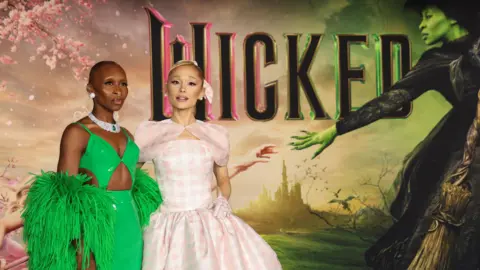
Several recent major movies produced by US studios were shot outside America, including Deadpool & Wolverine, Wicked and Gladiator II.
It was also unclear if the tariffs would apply to films on streaming services, like Netflix, as well as those shown at cinemas, or how they would be calculated.
The founder of European cinema chain Vue, Timothy Richards, questioned how Trump would define a US film.
Speaking to BBC Radio 4's Today programme, he said: "Is it where the money comes from? The script, the director, the talent, where it was shot?"
Mr Richards said the cost of shooting in southern California had grown significantly over the last few decades, prompting production to move elsewhere.
"But it's not just the actual financing itself," he added.
"One of reasons UK has done so well is we have some of the most highly experienced and skilled film and production crew in the world.
"The devil will be in the details."
Meanwhile, UK media union Bectu warned the tariffs could "deal a knock-out blow" to the industry as it recovered from the pandemic and a "recent slowdown".
Union chief Philippa Childs told the BBC: "The government must move swiftly to defend this vital sector, and support the freelancers who power it, as a matter of essential national economic interest."
The UK's Department for Culture, Media & Sport, industry body the British Film Institute and the Motion Picture Association, which represents the five major US film studios, did not immediately respond to BBC requests for comment.
The governments of Australia and New Zealand have spoken out in support of their countries' film industries.
"Nobody should be under any doubt that we will be standing up unequivocally for the rights of the Australian screen industry," Australia's home affairs minister Tony Burke said.
New Zealand's Prime Minister Christopher Luxon told a news conference that his government was awaiting further details of the proposed tariffs.
"But we'll be obviously a great advocate, great champion of that sector and that industry," he added.
Since returning to the White House in January, Trump has imposed tariffs on countries around the world.
He argues tariffs will boost US manufacturers and protect jobs - but the global economy has been thrown into chaos as a result, and prices on goods around the world are expected to rise.
Ahead of his inauguration, Trump appointed three film stars - Jon Voight, Mel Gibson and Sylvester Stallone - to be special ambassadors tasked with promoting business opportunities in Hollywood, which he described as a "great but very troubled place".
"They will serve as Special Envoys to me for the purpose of bringing Hollywood, which has lost much business over the last four years to Foreign Countries, BACK - BIGGER, BETTER, AND STRONGER THAN EVER BEFORE!" Trump wrote at the time.
The US remains a major film production hub globally despite challenges, according to movie industry research firm ProdPro.
Its most recent annual report shows the country saw $14.54bn (£10.94bn) of production spending last year. That was down by 26% since 2022, though.
Countries that have attracted an increase in spending over the same period include Australia, New Zealand, Canada and the UK, according to the report.
Even before this most recent announcement, the US movie industry had been impacted by the fallout from Trump's trade policies.
In April, China said it was reducing its quota of American films allowed into the country.
"The wrong action of the US government to abuse tariffs on China will inevitably further reduce the domestic audience's favourability towards American films," the China Film Administration said.
"We will follow the market rules, respect the audience's choice, and moderately reduce the number of American films imported."
Latest Stories
-
Don’t let speed of information become your judgement – CJ tells new lawyers
23 minutes -
World Cup visa scandal: People have leveraged public office to facilitate fraud – Senyo Hosi
28 minutes -
Glut! Farmers count losses as prices crash, customers happy
1 hour -
GSA postpones auction of unserviceable vehicles
1 hour -
Man charged with attempted murder after stabbing
1 hour -
World Cup visa scandal: Senyo Hosi says issue goes beyond calls for Sports Minister’s resignation
1 hour -
Yaw Ampofo Ankrah hasn’t taken or received any money to facilitate visas – Lawyer insists
1 hour -
World Cup visa scandal: Senyo Hosi urges focus on constitutional accountability
1 hour -
La Beach demolition: Senyo Hosi condemns lack of consultation
2 hours -
Russian glide bomb attack on Zaporizhzhia kills at least 15 people
2 hours -
Jinapor warns underperforming energy sector CEOs of consequences, says no protection for failure
2 hours -
Fire destroys head of tipper truck on Lower Volta Bridge
2 hours -
Palmer signs new Chelsea contract until 2034
2 hours -
World Cup visa scandal: Mahama will act on corruption allegations – Abass Nurudeen
2 hours -
Abass Nurudeen accuses Minority of ‘scandal scavenging’ over World Cup visa controversy
2 hours