

Audio By Carbonatix
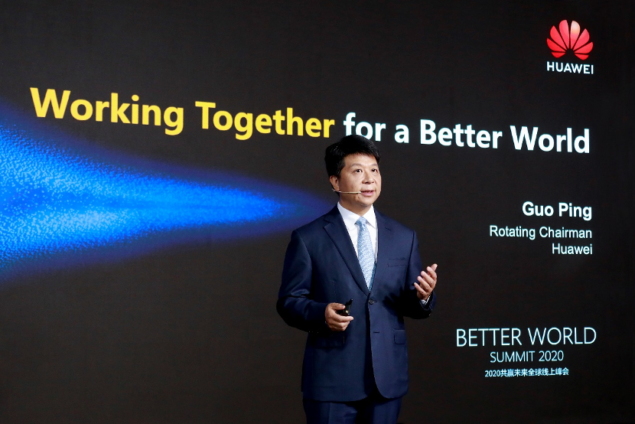
Huawei's Rotating Chairman Guo Ping has elaborated on how synergy across five major tech domains will help unlock the full potential of 5G to drive commercial success.
On the opening day of the online Better World Summit, guest speakers from China Telecom, Etisalat, MTN, GSMA, and 3GPP/ETSI were also joined by several thousand online attendees from more than 80 countries.
They explored how information and communications technology (ICT) can power new economic growth both now and in a post-pandemic world.
Working together to fight the pandemic with technology
The pandemic has reshaped how we live and work, and has dealt a heavy blow to the world economy. Fortunately, ICT offers a concrete set of tools to aid in the fight against COVID-19 on multiple fronts.
"As an ICT company, it's our responsibility to use the technology we have to help contain and defeat this pandemic," said Guo. "Together with our partners and customers, including carriers and enterprises of all types, we can use technological solutions to effect a positive impact on our communities."
"By drawing on our experience in early hotspots, we have developed nine scenario-based solutions that use ICT technology to help combat the pandemic. Whether it's hospital network deployment, remote consultation, online education, or restarting governments and businesses, we've been sharing our experience and capabilities to help control the spread of the virus and reopen economies."
Unlocking the full potential of 5G: Synergy across five major tech domains
There are already more than 90 million 5G users worldwide. "As global 5G deployment begins to wrap up, we need to strengthen our focus on industry applications," Guo said. "This will help us unleash the full potential of 5G."
The business case for 5G is not just better connectivity. When technologies like 5G, computing, cloud, and AI come together, they reinforce each other and create numerous opportunities across five major tech domains: connectivity, AI, cloud, computing, and industry applications.
"Huawei has in-depth strengths in each of these domains," Guo continued. "We can mix and match them to create scenario-based solutions that meet the unique needs of our customers and partners. This is key to unlocking the full potential of 5G and driving commercial success."
For 5G to succeed commercially, the entire industry needs to work together. Vertical industry applications can be replicated at scale only when unified industry standards and a collaborative ecosystem are in place. "Moving forward, Huawei will double down on efforts to equip our partners with the capabilities they need," Guo said. "We will promote joint innovation, and drive growth for everyone in the value chain."
Balancing short-term and long-term goals: Precise deployment for maximum value
Guo said, "Given the current economic environment, carriers need to focus on both short-term and long-term goals. More precise deployment is how they can maximize the value of their networks." Huawei has three suggestions for this.
- First, carriers should prioritize user experience and spend money where it's needed most to maximize the value of existing networks.
- Second, carriers should make the most of existing 4G and FTTx networks, and integrate them with new 5G networks through holistic coordination and precise planning.
- Third, 5G deployment plans should prioritize hotspots and key industry applications.
Day 1 speakers
Liu Guiqing, Executive Vice President and Executive Director of China Telecom, shared the carrier's strategy and applications for driving digital transformation across industries through convergence of cloud and networks.
Hatem Bamatraf, CTO of Etisalat International, presented Etisalat's experience using ICT to fight the pandemic and drive economic recovery.
Bernice Samuels, Executive: Group Marketing of MTN, explored how MTN will speed up their digital transformation process to extend the benefits of a modern connected life to everyone in the post-pandemic era.
Alex Sinclair, CTO of GSMA, shared insights into how ICT can enable new economic development.
Adrian Scrase, head of 3GPP MCC and CTO of ETSI, emphasized that an open, transparent, equal, and impartial environment for industry collaboration is crucial for setting unified standards and promoting shared success worldwide.
Latest Stories
-
US, Iran fail to reach peace agreement after marathon talks in Pakistan
1 minute -
Port crises loom as 11,000 drivers threaten four-day strike
38 minutes -
A source of excellence across generations – Vice President Opoku-Agyemang lauds Mfantsipim
2 hours -
(Photos) Mfantsipim School launches historic 150th anniversary
3 hours -
Knights and Ladies of Marshall group backs Catholic Bishops’ stance on anti-LGBTQ+
4 hours -
Bright Simons writes: All the Filla in the Ibrahim Mahama/E&P – Gold Fields Saga
4 hours -
Monetise Idiocy In Ghana
4 hours -
ECG kicks off Phase Two of transformer upgrades at Lashibi; brief outages expected
5 hours -
The Ghanaian prophet and the mysterious death of his scottish wife Charmain Speirs
5 hours -
Nearly 400 sentenced in Nigeria for links to militant Islamists
5 hours -
Ghana’s recovery supported by gold strength despite global oil price pressures – Standard Bank Research
5 hours -
Methodist Church hails Mfantsipim@150; calls for “fresh consecration” to excellence
6 hours -
‘Excellence is our inheritance’ – Nana Sam Brew-Butler hails Mfantsipim’s 150-year reign in leadership
6 hours -
Kwaku Azar writes: A-G vs OSP
6 hours -
Mfantsipim–Adisadel rivalry built excellence, not division – Sam Jonah
6 hours