

Audio By Carbonatix
The President of the Ghana Institution of Engineers (GhIE), Ing. Ludwig Annang Hesse, has said Accra has reached a point where "upstream treatment" remains the only viable option for addressing the recurring flooding problems.
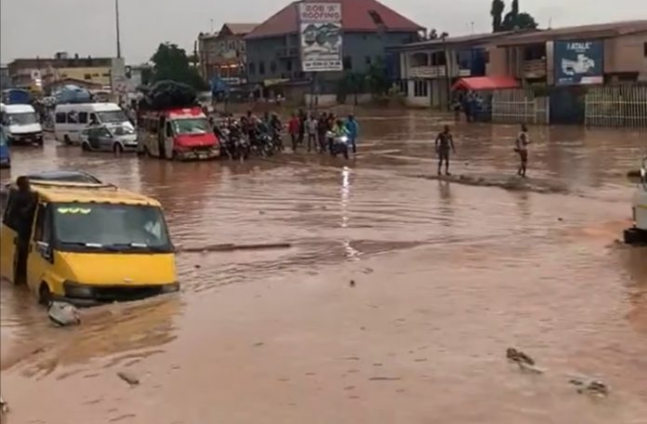
Speaking on Joy FM's Super Morning Show on Thursday, June 4, Ing. Hesse said that years of unchecked development, poor waste management, and the destruction of natural water retention areas have left the city vulnerable to annual flooding.
According to him, efforts focused on expanding drains and other downstream infrastructure have failed to solve the problem because the natural systems that once held and slowed floodwaters have been severely compromised.
"All the water retention areas in Accra have been compromised. So, we've brought this on ourselves," he said.
He explained that the problem has been worsened by the condition of many drainage channels, which are clogged with waste and unable to effectively carry stormwater.
"The channels that we have downstream, that are now under capacity, are filled with silt, are filled with rubbish, are filled with polythene bags," he said.
The President of the Ghana Institution of Engineers said previous flood mitigation efforts have focused largely on what engineers describe as downstream solutions, including the expansion of drainage infrastructure.
"Previously, all the solutions that we've tried ourselves are what we call downstream solutions. We keep expanding the drainage systems, we keep putting money in, and we expand them," he said.
However, he said that those investments have produced limited results because water retention areas, wetlands, and overflow zones that naturally absorb excess water continue to disappear.
"Because we are compromising the sumps, the water-holding places and the overflows, we've lost the plot when it comes to downstream treatment," he said.
As a result, Ing. Hesse believes attention must now shift towards upstream treatment, which involves holding rainwater closer to where it falls before allowing it to flow gradually into drainage systems.
"Now, we have to go to upstream treatment," he said.
"Upstream treatment, the only option for us left, is that each of us in our own houses, we have to hold the rainwater that falls in our house for some time so we can let it go after the floods."
He said that retaining water at the household and property level offers the best chance of reducing pressure on Accra's overwhelmed drainage network.
"This is the only option that we are left with to solve the drainage problems in Accra, to mitigate, to minimise," he said.
According to him, government policies will be needed to ensure that future developments contribute to flood prevention rather than worsen the problem.
"We have to insist that anybody who is developing any new building site will create retention areas on its properties so that it doesn't add to the existing runoff," he explained.
Ing. Hesse also called on owners of existing buildings to modify their properties to temporarily store rainwater and release it gradually after heavy rainfall.
"Those of us who have built already, we have to start a programme of retrofitting our houses to be able to retain the water that falls in our houses or on our premises for some time and let it out gradually after the rainstorms so that we can mitigate the flooding downstream," he said.
While acknowledging that implementing such measures would be challenging, he said the country has little choice if it hopes to reduce the impact of flooding in the future.
"This is the option left for us. It's the most difficult of the options left, but this is what we are left with," he said.
"And this is what we have to start working towards as a nation, as a country, as a people."
When asked how long it would take for such interventions to produce results, Ing. Hesse said it was difficult to provide a timeline without detailed technical studies.
"I don't know. Actually, I'm not a storm management expert. I'm speaking as the president of the institution, and I'm speaking on advice," he clarified.
He explained that specialists in hydrology and hydraulic engineering would need to conduct detailed assessments before authorities can determine the scale of interventions required and the timeframe for implementation.
"These things have to be modelled. If we want to do these things, then we need to engage hydrological engineers and hydraulic engineers to do the analysis and the modelling," he said.
According to him, comprehensive studies will be necessary to understand the extent of the flooding challenge and identify the most effective solutions.
"This will have to be a detailed study where the proper analysis can be made, the proper models can be built, so that we can see the extent to which we have the problem and the rate at which we have to put in these interventions to mitigate the problems," he added.
Latest Stories
-
Tiptoe Lane’s tech takeover: The story behind Ghana’s booming informal phone market
45 minutes -
Abanga vows to use social media to counter NDC messaging ahead of 2028 elections
47 minutes -
Okai Mintah seeks Sabah Zita Benson’s support for NDC National Youth Organiser bid
1 hour -
Okai Mintah vows to strengthen NDC campaign machinery ahead of 2028
1 hour -
Mother of four and Jasikan teacher among new Telecel M’ahitti Promo winners
1 hour -
International Youth Shakers Conclave 2026 set to bring global young leaders to London
1 hour -
Gov’t is committed to addressing teachers’ conditions of service, deprived-area allowance – Education Minister
1 hour -
GoldBod’s structure encouraging galamsey – Afenyo-Markin
1 hour -
Tullow starts selling Jubilee, TEN crude to Ghanaian refineries
1 hour -
Local Government Service authorises rationalisation, redistribution of staff
1 hour -
PURC assures consumers of working to ensure quality services in Northern Region
1 hour -
Ghana develops US$4.28bn water financing framework
2 hours -
Christian Council calls for protection of mission schools’ religious identity
2 hours -
Mahama holds discussions with India’s External Affairs Minister
2 hours -
Even when you cough, they come after you — Abanga accuses Mahama govt of criminalising free speech
2 hours