

Audio By Carbonatix
US funding cuts will lead to an additional 2,000 new HIV infections each day and over six million further deaths over the next four years, the UNAids chief has warned.
It would mark a stark reversal in the global fight against HIV, which has seen the number of deaths from the disease decrease from more than two million in 2004 to 600,000 in 2023, the most recent year for which figures are available.
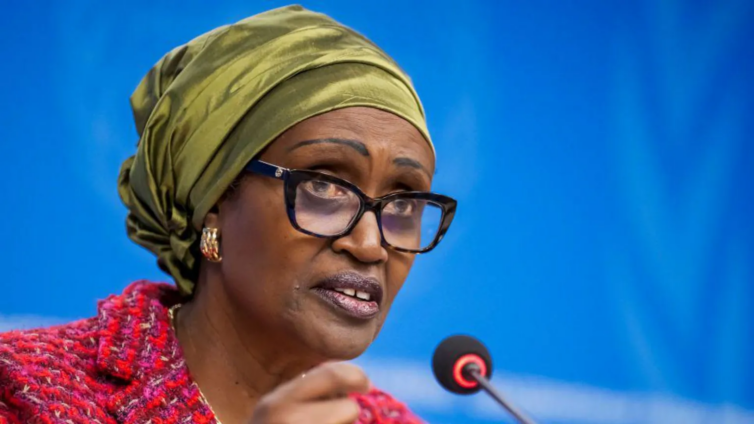
UNAids Executive Director Winnie Byanyima said the US government's decision to pause foreign aid - which included funding for HIV programmes - was already having devastating consequences.
She called on the US to reverse the cuts immediately, warning women and girls were being hit particularly hard.
US President Donald Trump announced the pause on foreign aid, for an initial 90 days, on his first day in office in January as part of a review into government spending. The majority of the US Agency for International Development's (USAID) programmes have since been terminated.
Many US-financed HIV treatment and prevention programmes received stop work orders, leading to the closure of mother and baby clinics in Africa, and severe shortages of life saving anti-retroviral (ARV) medicines.
Ms Byanyima said she feared a return to the 1990s, when HIV medication was scarcely available in poorer countries, and infections and deaths soared.
The US has for years been the single biggest funder of HIV treatment and prevention, and Ms Byanima thanked Washington for its generosity and humanity.
She added it was "reasonable" for the US "to want to reduce its funding - over time", but said the "sudden withdrawal of lifesaving support [was] having a devastating impact".
There has been no sign that Washington is listening to appeals to change course.
Traditional aid donors in Europe also plan funding cuts, and UNAids - the joint UN agency which combats HIV - has not indicated that other countries might step in to fill the gap left by the US.
Speaking in Geneva on Monday, Ms Byanyima described the case of Juliana, a young woman in Kenya living with HIV. She worked for a US-funded programme that supported new mothers to access treatment to ensure their babies did not develop the disease.
With the programme suspended, Ms Byanyima said Juliana was not only out of work but, because she was still breastfeeding her youngest child, she also feared losing the treatment she needed.
Previously, the World Health Organization (WHO) said eight countries - Nigeria, Kenya, Lesotho, South Sudan, Burkina Faso, Mali, Haiti and Ukraine - could soon run out of HIV drugs after the US funding pause.
WHO chief Tedros Adhanom Ghebreyesus warned that disruption to HIV programmes "could undo 20 years of progress".
In February, South Africa's leading Aids lobby group, the Treatment Action Campaign (TAC), warned the country could see a return to when HIV patients struggled to access necessary services for their treatment.
"We can't afford to die, we can't afford to go back to those years where we were suffering with access to services, especially for people living with HIV treatment," said TAC chair Sibongile Tshabalala.
Ms Byanyima also proposed a deal to the Trump administration, offering an opportunity to market a new US-developed ARV to millions of people.
Lenacapavir, made by US company Gilead, is given by injection every six months, with UNAids believing 10 million people could benefit from it.
The profits and jobs resulting from such a deal would be hugely beneficial to the US, Ms Byanyima added.
UNAids is one of a number of UN agencies facing funding cuts.
The UN Refugee Agency has suggested it may have to lose 6,000 jobs, while Unicef has warned that progress to reduce child mortality is threatened, and the World Food Programme has had to cut rations in famine threatened regions.
Latest Stories
-
I have supported highway authority financially to fix roads in my constituency – A Plus
54 minutes -
US, Iran fail to reach peace agreement after marathon talks in Pakistan
1 hour -
ECG kicks off Phase Two of transformer upgrades at Lashibi; brief outages expected
2 hours -
Port crises loom as 11,000 drivers threaten four-day strike
3 hours -
A source of excellence across generations – Vice President Opoku-Agyemang lauds Mfantsipim
4 hours -
(Photos) Mfantsipim School launches historic 150th anniversary
4 hours -
Knights and Ladies of Marshall group backs Catholic Bishops’ stance on anti-LGBTQ+
5 hours -
Bright Simons writes: All the Filla in the Ibrahim Mahama/E&P – Gold Fields Saga
5 hours -
Monetise Idiocy In Ghana
5 hours -
The Ghanaian prophet and the mysterious death of his scottish wife Charmain Speirs
6 hours -
Nearly 400 sentenced in Nigeria for links to militant Islamists
7 hours -
Ghana’s recovery supported by gold strength despite global oil price pressures – Standard Bank Research
7 hours -
Methodist Church hails Mfantsipim@150; calls for “fresh consecration” to excellence
7 hours -
‘Excellence is our inheritance’ – Nana Sam Brew-Butler hails Mfantsipim’s 150-year reign in leadership
7 hours -
Kwaku Azar writes: A-G vs OSP
7 hours