

Audio By Carbonatix
Direct talks between the US and Iran are set to begin in Switzerland despite the Iranian military saying it has closed the Strait of Hormuz again over Israel's attacks on southern Lebanon.
Iran also cited a breach of its agreement with the US to end the war as a reason for the closure. However, the US military has said "traffic continues to flow" in the strait.
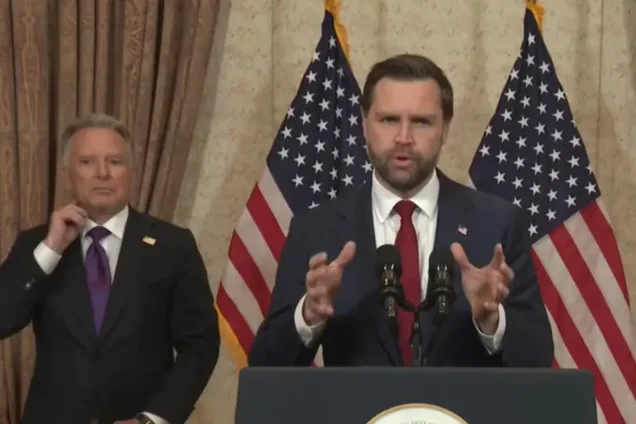
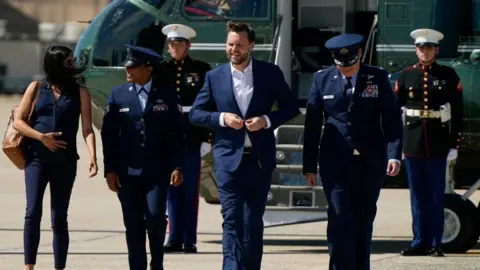
US Vice-President JD Vance arrived in Switzerland early on Sunday morning. The new round of negotiations is expected to start later in the day.
An Iranian delegation including parliamentary speaker Mohammad Bagher Ghalibaf and Foreign Minister Abbas Araghchi arrived late on Saturday.
Officials from the US and Iran will be joined at the talks by Pakistan's Prime Minister Shehbaz Sharif and the head of the country's armed forces, Field Marshal Asim Munir.
Pakistan has acted as a mediator throughout the war, and hosted a previous round of negotiations between the US and Iran.
"Pakistan will continue to support the implementation of the understandings between Iran and the United States," the Pakistan Ministry of Foreign Affairs said in a statement ahead of the talks.
Vance said he hoped to make progress "on the nuclear issue" and on the "Lebanon ceasefire issue".
Speaking to the press before he boarded his flight, he was asked about clashes between Israel and Hezbollah and Israeli air strikes in southern Lebanon and said: "Things are actually getting better there, and things are slowing down a little bit."
"It's going to be something we're just going to have to continuously manage to ensure that Israel and Lebanon are both safe and secure. That's fundamentally the goal of this, to make the whole region safe and secure," he said.
Iran's foreign ministry spokesman Esmail Baghaei said his country would be "demanding that the other side fulfil its commitments".
Earlier this week the US and Iranian presidents signed an initial agreement aiming to end the war, including in Lebanon, with immediate effect. It includes a commitment to further talks to reach a final deal over the next 60 days.
Complicating matters are the ongoing clashes between Israel and Hezbollah, the Iran-backed militia based in the southern suburbs of Lebanon's capital Beirut.
On Saturday, at least 47 people were killed in Lebanon following a series of Israeli air strikes, the country's health ministry has said.
The Israel Defense Forces (IDF) said it had struck 80 targets linked to Hezbollah and killed "dozens" of its members.
The IDF says four of its soldiers were also killed.
Israel and Hezbollah have continued to exchange fire since the deal was announced between the US and Iran, but on Friday afternoon an immediate ceasefire between the two was confirmed.
Prior to the agreement, Israel had said it had no intention of withdrawing its forces from Lebanon and had insisted that its conflict with Hezbollah was separate from the war on Iran.
Hezbollah said Israeli attacks in Lebanon were an attempt to "sabotage" the broader US-Iran deal.
The US government has criticised Israel's ongoing operations in Lebanon, which was drawn into the war when Hezbollah launched rockets into Israel in retaliation for US-Israeli strikes that killed Iran's supreme leader.
BBC sees destroyed villages in Israeli-occupied southern Lebanon
Iran's Islamic Revolution Guard Corps (IRGC) said Israeli strikes on Lebanon violated ceasefire comm
itments and the Strait of Hormuz, which had been reopened after the US and Iran reached a deal to end the war, had been closed.
Justifying its announcement that it was closing the strait, the Iranian military accused the US of violating the US-Iran deal by not implementing the first clause of their 14-point memorandum of understanding, which agrees to "the immediate and permanent termination of military operations on all fronts, including in Lebanon".
However, after Iran's statement, US Central Command (Centcom) spokesperson Tim Hawkins said "traffic continues to flow". He said US forces were "monitoring the situation to ensure this remains the case", adding that "Iran does not control the Strait of Hormuz".
Centcom said 55 merchant ships transited the strait on Saturday with more than 17 million barrels of oil for global markets.
Tracking data monitored by BBC Verify suggested that at least five tankers passed through the strait on Saturday while several vessels appeared to have made U-turns in the area.
Iran effectively blocked the Strait of Hormuz after the US and Israel attacked the country on 28 February - sending shockwaves through global energy markets.
The strait is deep enough for the world's biggest crude oil tankers, and is used by major Middle Eastern oil and liquefied natural gas producers, as well as their customers.
In 2025, about 20 million barrels of oil and oil products passed through the strait per day, according to estimates from the US Energy Information Administration. That is nearly $600bn (£447bn) worth of energy trade per year.
Latest Stories
-
Education Ministry welcomes suspension of teachers’ strike
7 minutes -
Vice Chancellors Ghana appeal to striking university administrators to resume work
22 minutes -
KNUST postpones 2026/2027 academic year reopening indefinitely amid GAUA strike
26 minutes -
Fire destroys mattress showroom at Sokoban in Kumasi
46 minutes -
ECOM-SMS Ghana launches ‘Agriculture Our Future Clubs’ to address threat of ageing farmer population
49 minutes -
Nicholas Atsu Kumi
50 minutes -
Cherif Sarr: Economic participation needs more pathways, not one prescribed route
51 minutes -
Cyber Security Authority: Ghana led Operation Blackout, not FBI
56 minutes -
GH¢800,000 goods destroyed as fire engulfs Kia Rhino truck on Apedwa-Kibi Road
1 hour -
Chief Justice calls for supportive workplaces to address mental health stigma
1 hour -
NVI CEO defends GH¢13m spending on training, workshops and conferences
1 hour -
Ghana targets first locally manufactured vaccine by 2027
2 hours -
Teachers suspend strike after reaching agreement with government
2 hours -
Council of State describes talks with striking teachers as fruitful
2 hours -
Adjaye Associates opens new Accra studio with public space for cultural exchange
2 hours