

Audio By Carbonatix
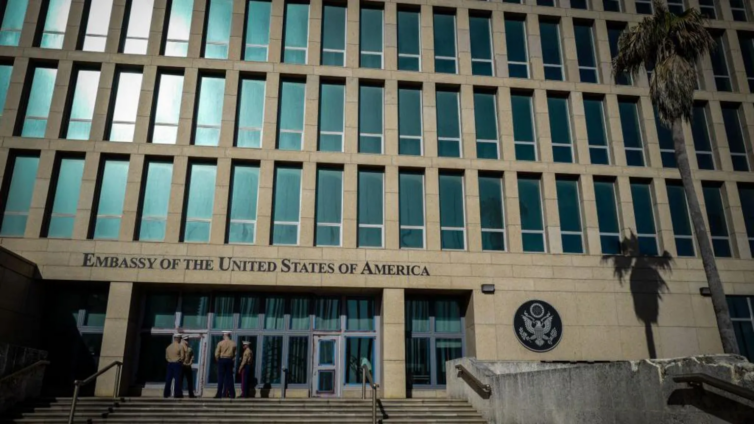
The US government has paid nearly $3m (£2.2m) in compensation to victims of so-called Havana Syndrome, a mysterious neurological condition reported by spies, diplomats and their families.
The payments are the first to be made to US agency staff in relation to the illness, reports of which began emerging a decade ago among CIA officers working in the Cuban capital.
Since then, American staff based elsewhere, including China, have reported "anomalous health incidents".
Sufferers have described symptoms such as hearing a low hum, clicks, squeals and "grinding metal" while others reported intense pressure on the skull, dizziness and nausea.
The US Department of Defence said it would continue to prioritise "the care of affected personnel" as it announced the compensation, paid out under the Havana Act which was signed into law in 2021.
There has been widespread speculation for many years over what - and who - is responsible for Havana Syndrome.
Some have claimed the illness is caused by microwaves, prompting further speculation that a foreign power may have used some kind of sonar weapon to attack US overseas staff and their dependants.
"My brain is broken," former CIA analyst Erika Stith told CBS News in 2022.
"We got this as a result of serving our country. And we deserve to be taken care of," she said.
Last year, most US intelligence agencies and departments surmised that it was "very unlikely" that a foreign actor used "a novel weapon or prototype device to harm" US personnel and their families.
Although a small component of the US intelligence community did not completely dismiss the theory.
The report, by the National Intelligence Council, said none of the agencies or departments it spoke to "call[ed] into question the experiences or suffering" of US workers and their families.
The community believed that they "experienced genuine, sometimes painful and traumatic, physical symptoms and sensory phenomena and honestly and sincerely reported those events as possible anomalous health incidents".
What is Havana Syndrome?
Havana Syndrome was first publicly reported in 2016, when US diplomats in Cuba reported getting sick and hearing piercing sounds at night.
Other cases have been reported around the world, from Washington to China.
It was these reports that sparked speculation of an attack by a foreign power using a mystery sonic weapon.
In 2017, the US government pulled more than half of its staff from its embassy in Havana after employees and their families reported dizziness, nausea and difficulty concentrating.
Canada's government also heard of similar symptoms from its embassy employees in Cuba, leading to a sharp reduction in its personnel in Havana in 2019.
While Havana Syndrome cases began to emerge around a decade ago, some claim the illness has been around for much longer, spanning the Cold War years.
Latest Stories
-
Mr President, Ghana was mentioned at the UN; why aren’t we talking about it?
46 minutes -
Accra to convene Africa’s regulators and markets on tokenisation at AVAS 2026
49 minutes -
The Paradox of Plenty — When every smartphone becomes a newsroom
1 hour -
GTA sensitises taxi drivers in ‘Know Ghana’ tourism campaign
3 hours -
Archbishop Agyinasare calls for responsible speech amid growing social media abuse
3 hours -
‘It will be inexcusable for gov’t not to honour payment of teachers’ arrears by 30th October’ – Haruna Iddrisu
3 hours -
Forbes’ World’s Best Employers 2026: No Ghanaian firm ranked among 900 companies
3 hours -
Electronic processing of teachers’ data: ‘The decision is the Controller’s’ – GES boss
3 hours -
Teachers’ Strike: Haruna Iddrisu questions paper-based processing of promoted teachers’ data
3 hours -
Savannah Region: Kunfusi bridge collapses again, leaving nearly 4,000 residents cut off
3 hours -
Teachers’ strike: GES targets Monday deadline to submit promotion data to Controller
3 hours -
Inflation to average 11.3% in 2027 – Fitch Solutions
4 hours -
‘I didn’t campaign for NDC to come and do this nonsense’ – Kpebu on EOCO’s conduct
4 hours -
Fitch Solutions maintains policy rate forecast of 14% by December 2026
4 hours -
Diaspora Nasara Caucus congratulates Mohammed Ali Suraj, new NPP executives
6 hours