

Audio By Carbonatix
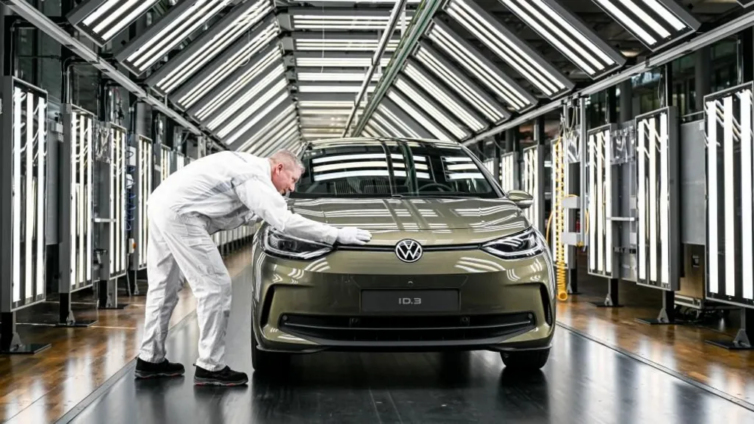
The board of German car giant Volkswagen has approved a plan to cut another 50,000 jobs as part of the biggest restructuring in the group's almost nine-decade history.
It brings the total number of roles the carmaker plans to shed by 2030 to 100,000, after announcing in March that it would cut 50,000 roles.
The group - which includes Audi, Porsche, Skoda as well as the VW brand - is also considering the future of four of its German plants.
The move is a "strong signal" for the future of the firm, which is "taking responsibility for our entire workforce", VW's chief executive Oliver Blume said in a statement on Thursday.
Blume said in July that the firm was looking to make the additional cuts.
Shares in the company were up by around 7% in Frankfurt on Friday morning.
The Golf-maker has been hit by a drop in profits due to falling sales and fierce competition, especially from Chinese brands.
The firm also said that by 2035 it would cut the number of models it produces by 50% and reduce the complexity of its offering by 75%.
VW will also prioritise the "most compelling vehicles" and make more of each model, which will help lower costs, it said.
A "fundamental adjustment of the global workforce capability is necessary" to safeguard the competitiveness of the company, which faces shifting demand and technological change.
It added "a group-wide workforce adjustment of approximately 50,000 positions - including management roles - will be necessary."
The company is also weighing options for operations in Emden, Zwickau, Hanover and Neckarsulm, where it has said production capacity exceeds demand.
"Alternative uses for these plants are being assessed," it said.
As of 2025, VW employed more than 660,000 people worldwide. Its brands also include Seat, Bentley and Lamborghini.
Christianne Benner - the president of Europe's largest industrial union IG Metall and deputy chair of VW's Supervisory Board - said the carmaker had "fought hard for good solutions" to address a "crisis situation".
VW's profits have fallen sharply in recent years, hit by falling sales in China, which was once one of its biggest markets.
Sales have also fallen in the US, partly due to the impact of tariffs on car imports that were introduced by President Donald Trump's administration.
Chinese carmakers have been expanding aggressively as they roll out new technologies while benefiting from lower production costs than their rivals.
In recent years, firms such as BYD have seen their sales rise sharply in markets including the UK, European Union and South East Asia.
Latest Stories
-
Rule of law must be protected – GBA condemns EOCO action against Baffour Awuah
36 minutes -
950,000 barrels of Sankofa crude head to TOR as GNPC deepens domestic refining
48 minutes -
Scales of deception removed – Annoh-Dompreh attacks new cocoa price
60 minutes -
Young Positivist Writes : My Experience with GCLP
2 hours -
Strong Day 1 turnout sets tone for Day 2 of Republic Bank-JoyNews Habitat Fair Clinic
3 hours -
Ghana Army warns new soldiers against social media misuse, uniform abuse
3 hours -
AMA calls for science-led action to tackle environmental health risks in Accra
3 hours -
NPP Canada Organizer BigMo urges Diaspora to support Kodua Frimpong
4 hours -
He entered at eight. He is now 16: Ghana’s children growing up in prayer camps
7 hours -
‘Development must not always begin from Accra’ — Anwelle Foundation launched in Jirapa
7 hours -
PKO trio eye victories at Odwira Festival
10 hours -
346 Ghana Navy recruits pass out after 26 weeks of intensive training
10 hours -
Livestream: Newsfile to discusses EOCO-MP arrest, drug trafficking, speech arrests and $235m water debt
10 hours -
JoyNews gets results as listeners raise GH¢40,000 to help 17-year-old student with cerebral palsy attend SHS
11 hours -
Vice President calls for stronger local pharmaceutical production to reduce medicine imports
11 hours