

Audio By Carbonatix
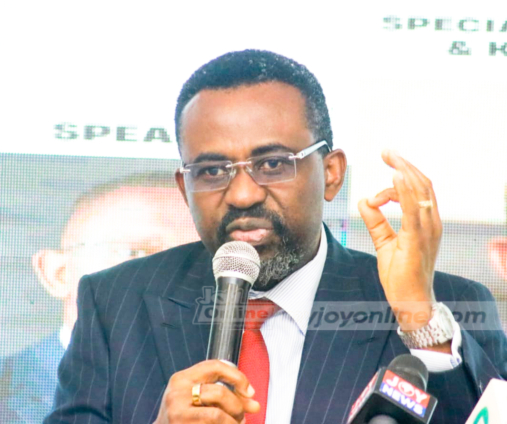
Bank of Ghana Governor, Dr Johnson Asiama, has warned that fintechs could become a major source of financial instability if left unregulated.
Speaking in Washington, D.C., at the ongoing IMF/World Bank Spring Meetings on October 16, he said central banks must act early to prevent new technologies from triggering crises in the financial system.
“For example, fintechs. We did not have fintechs those days, but I believe that if not handled properly, fintechs, for example, that area could be an area where a risk could emerge going forward,” he said.
According to the Governor, the Bank of Ghana is already taking steps to strengthen supervision of the digital finance space.
“We are, you know, looking at that industry well. We are mending the legislation there as well,” he noted, stressing the need for proactive regulation to safeguard financial stability.
Dr Asiama explained that his broader vision for the central bank is “ready and able to adapt” to emerging global financial risks.
“It is critical today. It could be something else tomorrow. It could be anything. Who knows, but we should have the manpower, we should have that agility, we should have the balance sheet to be able to contend with any of these risks as they emerge in the future.”
The Governor, who has been in office for eight months, said his mandate remains to achieve price and financial stability.
He acknowledged progress but noted that deep-seated structural issues like dollarisation remain a concern.
“You know, I’ve seen this for many years. I started central banking some 30 years ago. The phenomenon has been there, and so we are tackling it. What can we do to make the local currency the sole legal tender?”
Dr Asiama said efforts to promote confidence in the cedi will culminate in a national celebration later this month.
“On the 28th of this month, we are having a celebration. We call it the Cedi at 60. The local currency will be 60 years old this year, and we want that to mark a new beginning,” he said.
He emphasised that wider use of the cedi in domestic transactions will strengthen monetary policy and improve economic resilience.
“When we use the local currency in all transactions, that enhances the efficiency of monetary policy,” he said.
Dr Asiama concluded that his goal is to build a central bank that is not only stable but also agile in the face of evolving challenges.
“What I want to see is a central bank that is ready and able to adapt,” he said.
Latest Stories
-
Ghana ranked joint 6th in 2026 Absa Africa Financial Markets Index
39 minutes -
Demand and savings deposits decreased in August 2026, but currency outside banks increased by 4%
1 hour -
Fiscal policy implementation poses downside risk to inflation – BoG
2 hours -
Organised Labour should seek fair adjustment, not excessive pay rise – Labour consultant
2 hours -
BoG maintains medium-term inflation target of 8 ± 2%
2 hours -
Sammi Awuku urges NPP Germany to unite ahead of 2028 elections
3 hours -
The Inconvenient Truth: We cannot pray for the cure while protecting the disease
3 hours -
MTN Ghana trains civil society organisations on artificial intelligence
4 hours -
GoldBod FX framework aims to make dollar supply predictable – Acheampong
4 hours -
How does a Ghanaian team make it to the BAL?
4 hours -
Ghana’s investment climate presents opportunities for industrial growth and job creation.
4 hours -
‘I paid thousands to a company for jobs that never came’
5 hours -
SSNIT intensifies informal sector enrolment drive with Techiman float
5 hours -
Ghana seeks long-term mining investments that benefit local communities – Armah-Kofi Buah
5 hours -
GHATOF demands compensation for 85 businesses affected by La Pleasure Beach demolition
5 hours