


Audio By Carbonatix
It is 9 a.m. on a Monday, and the finance director has news: the product launch is moving forward by two weeks. She has run the numbers. Across the table, the head of people and culture raises a concern. His teams are already stretched, he says, and two engineers are close to burnout.
The finance director hears complication and repeats the deadline, a little louder. The head of people hears a wall and stops talking. The meeting ends on time, apparently aligned, but by lunchtime the real conversation has moved to the corridors. The CFO and CPCO have quietly started to believe the other has a character problem.
The scene is a composite, but I see versions of it often in my work with leadership teams across the corporate ecosystem. The people involved are rarely poor communicators. In that moment, both were speaking from a nervous system under pressure.
It is a natural human phenomenon that communication skills fail under stress when emotions and the autonomic nervous system are dysregulated.
In Gallup’s 2025 State of the Global Workplace report, 47 per cent of employees in sub-Saharan Africa said they had experienced stress the previous day, a new high for the region, and falling manager engagement cost the global economy an estimated US$438 billion in lost productivity in 2024.
Most leadership programmes respond with more communication skills. They are useful, but they become hard to reach under stress. Research by the Yale neuroscientist Amy Arnsten shows that even mild, uncontrollable stress can impair the prefrontal cortex, the part of the brain we rely on for judgement, and shift control towards faster, more reflexive responses. The skill is still there; we simply have less access to it in a difficult moment.
In Neuro-Emotional Intelligence Training (NEIT), the approach I use with executive teams, we look at two things together: the natural gift a person brings to a conversation and the state of their nervous system- three brains (head, heart, gut, and pelvic intelligence) and the environment.
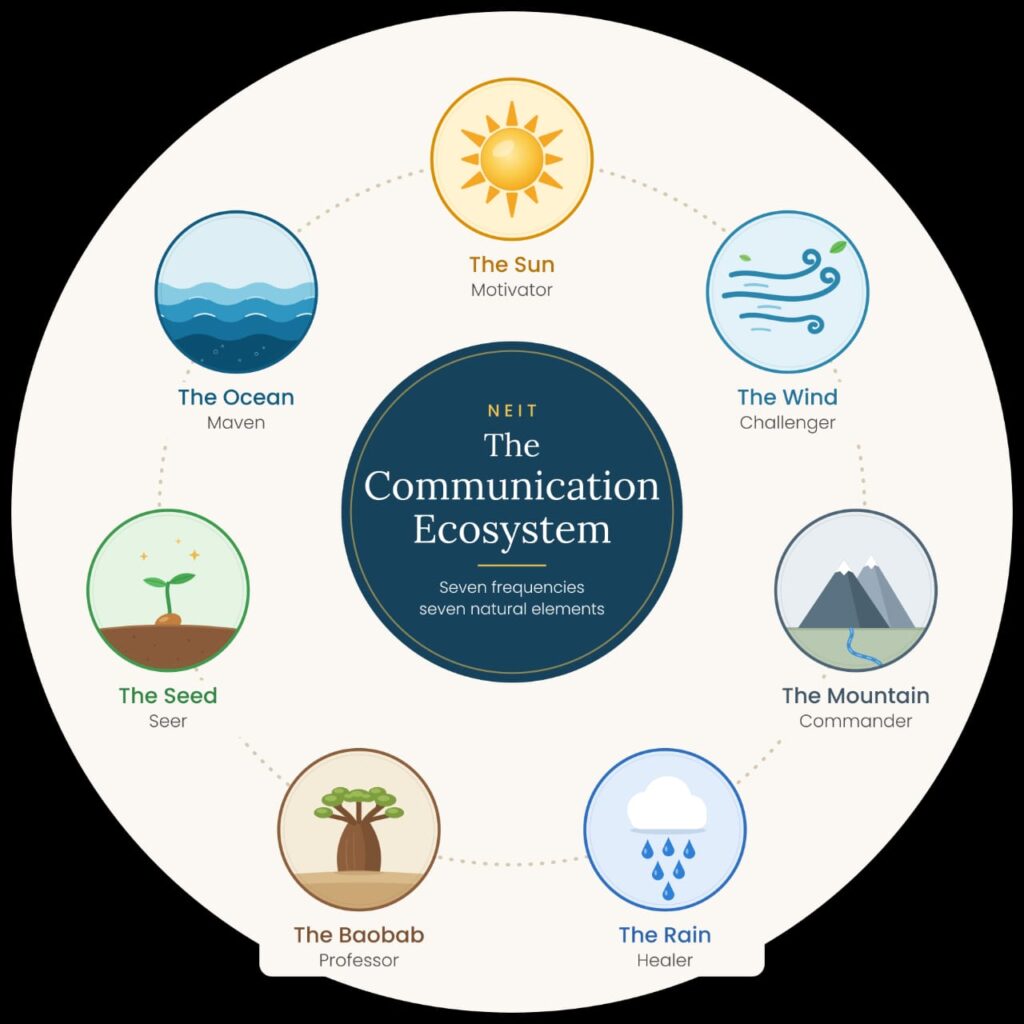
For the "gift", I am referencing the framework from Erwin McManus's seven communication “frequencies”.
The Motivator lifts energy, and the Challenger pushes people to stretch. The Commander gives direction, the Healer helps people feel accepted, and the Professor brings knowledge. The Seer notices possibilities, while the Maven imagines new ways of doing things. Most of us rely on two or three of these. In our training, each has a metaphorical image from nature: the Sun, Wind, Mountain, Rain, Baobab, Seed and Ocean. The baobab, which survives the dry season by storing water, stands for the Professor who gathers, holds and shares knowledge.
For the state, I draw on the Autonomics model developed by Hearth Science, which describes three broad states. In safety, our strengths are fully available. In danger, the body moves into fight or flight. Adrenaline and noradrenaline rise within seconds, and a strength can turn into pressure. The Commander becomes forceful, the Challenger confrontational, and the Motivator starts seeking approval. I call this the hot shadow. When the threat feels overwhelming, the body can shut down(ground) instead. In this cold shadow, the Healer withdraws, the Professor retreats into facts and process, and the Seer stops seeing what is possible.
Stress stretched and compounded over months becomes "burnout," the cold shadow.
The World Health Organisation describes burnout as the result of chronic workplace stress that has not been managed successfully, marked by exhaustion, mental distance from the job, and reduced effectiveness.
In practice, it often looks like a cold shadow that has become a way of working. The manager who used to challenge ideas starts nodding them through. By the time a team notices, good people have often gone quiet.
Teams that lack neuro-emotional intelligence mistake a stress response for a personality problem and label it as such.
Let's go back to the Monday scenario. The finance director was a Commander running hot, and the head of people was a Healer who had gone cold. As one pushed harder, the other withdrew further, and each reaction fed the other. A meta-analysis of 74 studies of this demand-withdraw pattern, mostly in close relationships, links it to poorer communication and lower satisfaction.
In organisations, we tend to label the pattern before we understand it. “She is difficult.” “He never listens.” “She is too emotional.” They rarely help anyone change what is happening. A more useful conversation starts when we separate the person from the pattern. Saying “I think we are both running hot” gives both people room to look at what is happening without defending who they are. That is neuro-psychophysiological safety in practice. Harvard professor Amy Edmondson describes this as a climate in which people can speak up without fear of punishment or humiliation.
I am careful about the evidence. The seven frequencies are a reflective language rather than a validated personality test, but the stress science beneath them is firm. Putting feelings into words, for example, reduces activity in the brain’s alarm system.
When someone goes quiet, telling them to “calm down” rarely helps, because the two states need different responses; if you are running hot, slow the body first: lengthen your exhale, name what you are feeling, and notice your feet on the floor. If you have shut down, bring yourself back gently: look around the room, move a little and find a warm voice before you speak. Ninety seconds is often enough to create space between the feeling and the response.
Cortisol from a tense exchange typically peaks 20 to 30 minutes later, so we often carry one bruising meeting into the next. The effect spreads between people too through entrainment and electromagnetism. In one study, support from a close friend reduced people’s stress-hormone response to a public-speaking test. Leaders don't need to be the calmest person in the room all the time, but they do need to notice what they bring into it.
In an embodied practice, start your next team meeting with a 90-second balanced breathing exercise, then ask each person to describe their internal weather in one word, such as sunny, stormy, foggy, or still. It takes a minute and lets people acknowledge their state before the agenda takes over.
Before your next difficult conversation, check your state before you check your talking points. Then look at the patterns in your team. A team without enough Rain may struggle to admit what is not working; one without Wind may become too comfortable, and one without a Mountain may lose direction. You rarely need to change how anyone communicates; more often, you need to intentionally and attentionally bring in (entrain) what is missing.
Above all, go first, as it is termed "leadership by example". If you want honesty, make room for it, and if you want people to pause before reacting, let them see you do it. The more authority you hold, the more weight your statement carries.
We spend a great deal of time on what leaders should say. The more important question may be who we are becoming while we say it.
Good leaders will sometimes communicate badly. They lose patience, become defensive, withdraw, speak too quickly or listen too little. That is part of being human. What distinguishes the best of them is how quickly they notice, and how reliably they find their way back.
About the Author: Scofray Nana Yaw Yeboah, MCC ACTC FInstCM
He is Africa's foremost neuroscience-informed Ontological Executive Coach, Ghana's first Master Certified Coach (MCC) and Advanced Certified Team Coach (ACTC), Ghana’s first ICF 3-level Mentor Coach, Founder of Neuro-Emotional Intelligence Training, Professional Corporate Trainer, and Professional Certified mBIT Master Coach & Trainer. He currently serves as President of the Ghana Chapter of ICF, a Fellow of the Institute of Commercial Management (UK), and lead consultant for Zoweh Global Consult, with 20 years of combined experience and over 4,000 coaching hours.
Latest Stories
-
Empower community radio stations to strengthen public engagement – Former Sports Minister
7 seconds -
MP for La Dade-Kotopon calls for Ga language programmes in schools and on radio
23 seconds -
Families welcome guilty verdict over Mali crash that killed 116
54 seconds -
Until we see concrete action, we will stay home – Striking teachers
3 minutes -
Studio 7 Clinic & Med Spa marks 10 years with ‘Beyond the Mirror’ event
8 minutes -
Haruna Iddrisu outlines roadmap on teachers’ strike, sets timelines for allowances and promotion arrears
15 minutes -
8% fare hike: Lack of coins forcing some fares to be rounded up – GRTCC
16 minutes -
TikTok to pay $100m and limit daily child usage in Alabama settlement
17 minutes -
Fair Wages and Salaries Commission to meet teacher unions October 6 as strike continues
20 minutes -
GPL 2026/27: Hearts of Oak victory ‘helpful’ ahead of Kotoko game – Karela United coach
23 minutes -
Mahama explains Ghana’s rejection of US health compact over medical records, FDA concerns
31 minutes -
Suspect in murder of phone dealer allegedly sold his iPhone 12 for GH¢100
33 minutes -
Sarkodie, Omar Sterling, Medikal, others named in Lawyer Bobby Banson’s Greatest Ghanaian Rappers list
34 minutes -
Private cars, taxis, trotros, okadas barred from Ayalolo lanes during peak hours
36 minutes -
Teacher unions reject government plea, vow to stay home until salaries reflect on payslips
49 minutes