

Audio By Carbonatix
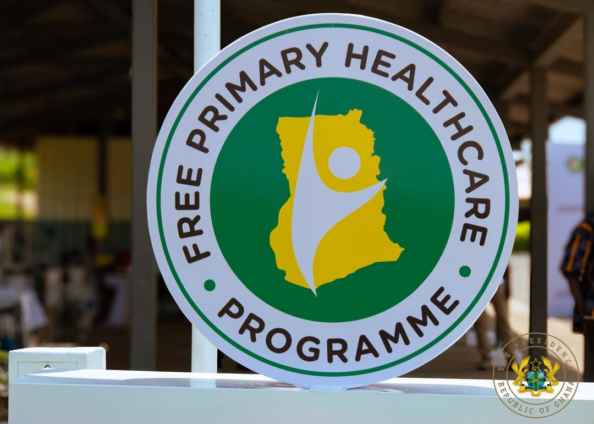
The Minister for Health, Kwabena Mintah Akandoh has said strengthening primary healthcare systems could save millions of lives globally, as Ghana rolls out its Free Primary Healthcare initiative.
Speaking at the launch of the government’s policy on Wednesday, April 14, the Minister pointed to global evidence to support the move.
“Global evidence is clear. Primary health care is the most effective pathway to achieving universal health coverage,” he said.
He added that the World Health Organisation (WHO) estimates that “scaling up primary health care could save up to 60 million lives worldwide by 2030.”
The Minister cited examples from other countries to show what can be achieved with sustained investment.
“Countries such as Thailand, Brazil, and Rwanda achieved universal health coverage by making a deliberate decision to invest first in primary health care,” he said.
Mr Akandoh acknowledged that Ghana has made progress over the years, including the expansion of Community-based Health Planning and Services (CHPS), the introduction of the National Health Insurance Scheme, and improvements in key health indicators. However, he said challenges remain.
“We must also be honest with ourselves. Out-of-pocket expenditure remains high at around 35% of total health spending,” he said.
He added that many Ghanaians still delay seeking care, while non-communicable diseases are increasing rapidly.
“Too many of our people enter the health system late, when conditions are worse, treatment is more costly, and outcomes are worse,” he explained.
According to the Minister, the new initiative is designed to address these gaps. “This is why this initiative is transformative,” he said.
He outlined several key benefits of the policy. First, it will provide financial protection. “Primary health care services within the defined package will now be free at the point of use for all Ghanaians,” he said, adding that uninsured persons would be encouraged to enrol on the National Health Insurance Scheme to access higher levels of care.
Second, the policy will shift focus towards prevention. Mr Akandoh said routine screening, early diagnosis, and community outreach would become standard practice rather than occasional efforts.
Third, the initiative aims to improve coordination within the health system. “CHPS compounds, health centres, and polyclinics will be linked into a single system that will improve continuity of care, efficiency, and outcomes,” he said.
He added that the reform also represents a major change in how healthcare is financed.
“We are moving towards paying for health and prevention, not just for illness and treatment. In other words, we are moving from sick care to health care,” he explained.
The Minister said the government has set targets. “By 2030, we expect to see out-of-pocket expenditure fall below 20%, to see over 95% of Ghanaians accessing essential primary health care services, to see reduced congestion at our hospitals, and to see a stronger, more resilient health system,” he stated.
He expressed confidence in the country’s readiness to implement the programme.
“I am pleased to report that we are ready. We have completed the costing and financing frameworks. We have initiated the necessary legislative reforms,” he said.
Latest Stories
-
Yaw Ampofo Ankrah hasn’t taken or received any money to facilitate visas – Lawyer insists
18 minutes -
World Cup visa scandal: Senyo Hosi urges focus on constitutional accountability
18 minutes -
La Beach demolition: Senyo Hosi condemns lack of consultation
29 minutes -
Russian glide bomb attack on Zaporizhzhia kills at least 15 people
44 minutes -
Jinapor warns underperforming energy sector CEOs of consequences, says no protection for failure
46 minutes -
Fire destroys head of tipper truck on Lower Volta Bridge
50 minutes -
Palmer signs new Chelsea contract until 2034
52 minutes -
World Cup visa scandal: Mahama will act on corruption allegations – Abass Nurudeen
54 minutes -
Abass Nurudeen accuses Minority of ‘scandal scavenging’ over World Cup visa controversy
55 minutes -
US Embassy recognised NSA, GFA and GTA as separate entities for visa applications – Sports Minister’s aide
1 hour -
Only 30% of Ghanaian teachers satisfied with their jobs – CAPCOE data reveals
1 hour -
Communities affected by construction of Akosombo Dam urge government to speed up compensation process
2 hours -
World Cup visa scandal: Sports Ministry not shielding anyone – Sports Minister’s special aide
2 hours -
World Cup visa scandal: Over 30 people misrepresented as GTA board members to US Embassy – Vincent Assafuah alleges
2 hours -
Fire destroys wooden structure near Yesu Mo Villa at Bush Road
2 hours