

Audio By Carbonatix
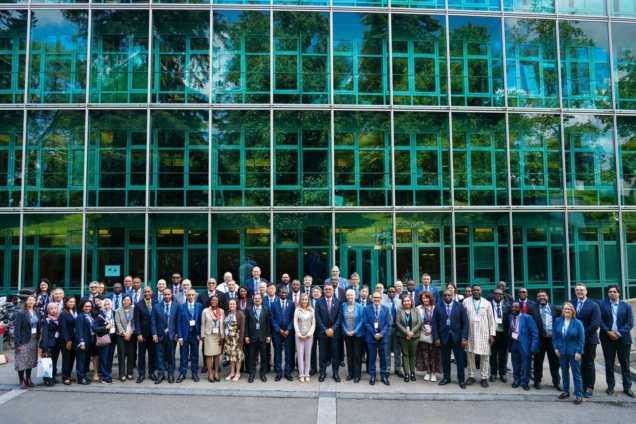
The annual meeting of the World Meteorological Organization (WMO) Executive Council to prioritise developing a comprehensive strategy for issuing early warnings for global natural disasters and outlining the implementation strategy for the new Global Greenhouse Gas Watch initiative.
Commencing from June 10 to 14 in Geneva, the EC meeting holds responsibility for executing resolutions set forth by the Organization's general assembly and highest governing body.
A recent report from the WMO indicates that the trend of record-breaking warming is expected to persist in the next five years. Again, a concerning US report highlights that carbon dioxide is accumulating in the atmosphere at an unprecedented rate, rapidly surpassing levels unprecedented in human history.

WMO Secretary-General Celeste Saulo expresses concern, stating that the world is moving in the wrong direction.
"As the UN Secretary-General says, we are playing Russian roulette with our planet," she said.
Celeste emphasizes that the growing impacts of climate change and the rise in extreme weather events underscore the critical importance of robust National Meteorological and Hydrological Services.
She highlights the significant potential of rapid advancements in satellite technology, supercomputing, and Artificial Intelligence to leverage scientific innovations for societal well-being.
Celeste urges the world to capitalize on these opportunities to effectively address the challenges ahead.
“Every single day we are working to support the adaptation and mitigation agenda to support sustainable development," she said.
Early Warnings for All
WMO says the Executive Council will examine the strategic rollout plan consisting of two pivotal phases: the catalytic phase and the sustained action phase.
“During the catalytic phase, countries identify gaps and mobilize stakeholders to accelerate universal multi-hazard early warning system coverage through national road maps. This is followed by the sustained action phase, which focuses on collectively implementing road maps and enhancing capabilities,” WMO said in a statement.
The statement said even 30 focus countries have been prioritized, the initiative is being expanded to other countries in order to meet the demand and need, adding that, the roadmap will guide WMO as it seeks to scale up and accelerate actions.
“To date, 22 countries have held their national EW4All workshops, demonstrating their commitment to fulfill the goal of universal MHEWS coverage by 2027. Fourteen more workshops are planned this year.”
EW4All Dashboard to provide transparent monitoring
At COP28, the launch of the EW4All Dashboard marks a milestone in providing transparent and continuous monitoring of the initiative's progress. The WMO Road Map, designed with a focus on capacity building and resilience, adopts an inclusive approach centered on people.
It underscores the importance of national authorities' sovereignty while advocating for coordination, integration, and alignment to facilitate rapid, large-scale action. Emphasizing coherence, consistency, accountability, and sustainability, the Road Map aims to harness technology and innovation, including Artificial Intelligence, to expedite progress.
It also delineates the vision, objectives, and strategies to improve the implementation and utilization of multi-hazard early warning systems for weather, climate, and water-related hazards from 2024 to 2027. The Road Map aligns with the target date set by United Nations Secretary-General, António Guterres, and includes detailed timelines and milestones for achieving its goals.
Early warning systems to decrease deaths, losses
According to WMO early warning systems have played a significant role in reducing the number of fatalities and mitigating losses and damages caused by hazardous weather, water, or climate events.
“They provide a nearly tenfold return on investment. But major gaps still exist, especially in small island developing states and least developed countries. Some 70% of all deaths from climate-related disasters have occurred in the 46 poorest countries over the past 50 years,” according to the statement from WMO.
WMO President Abdulla Al Mandous expresses that achieving the goal of Early Warnings For All is still a distant reality, particularly for millions in developing nations who lack access to crucial life-saving early warnings.
“Strong early warning systems require stronger political and policy support from the international community and governments, in addition to significant investment in infrastructure, technology, and training,” said Abdulla.
During the opening address at the ongoing Executive Council meeting, Abdulla emphasizes the imperative for the world to champion Early Warnings For All, advocating for heightened investment and political commitment towards this goal.
“Together, we can turn Early Warnings for All into a reality, saving lives and building resilience in a changing climate,” he said.
WMO responsible for detection, observation, monitoring, analysis and forecasting
The Early Warnings for All initiative is jointly led by the WMO and the United Nations Office for Disaster Risk Reduction (UNDRR), with support from the International Telecommunication Union (ITU), the International Federation of Red Cross and Red Crescent Societies (IFRC) among other partners.
Within this initiative, WMO is tasked with overseeing the pillar focusing on detection, observation, monitoring, analysis, and forecasting, aimed at addressing critical gaps among WMO Members and Territories.
Out of the 30 countries initially selected for coordinated assistance under Early Warnings for All, half of the National Meteorological and Hydrological Services (NMHS) currently possess only basic monitoring and forecasting capabilities, while close to a quarter operate with less-than-basic capacity.
Only a third of WMO Members and Territories report having multi-hazard monitoring and forecasting systems in place, highlighting significant deficiencies, particularly in surface and upper air meteorological observations across Africa, parts of the Pacific, and Western Latin America.
Additionally, 67 per cent of WMO Members report having warning and alerting services available 24/7.
The road map aims to utilize the full extent of the WMO network and strengthen the capacities of its National Meteorological and Hydrological Services (NMHSs) to safeguard lives and livelihoods. WMO Members have already approved the framework supporting the priority activities, with clear delineation of roles and responsibilities.
End
Latest Stories
-
GACL to hold full-scale emergency simulation exercise on October 15
2 minutes -
327 entries submitted for 30th GJA Media Awards
16 minutes -
Mahama proposes rent-to-own scheme for unfinished houses
18 minutes -
Mahama wants banks to introduce affordable housing loans within six months
19 minutes -
Photos from National Conference on Housing Finance
23 minutes -
Italy, Ghana unite 40 artists for ‘Beyond Creation’ exhibition at Accra Art Centre
42 minutes -
Premature to call for Sports Minister’s removal while CID probe is ongoing – Ernest Norgbey
1 hour -
NPP mourns Samuel Arthur Odoi-Sykes
1 hour -
Stay out of World Cup visa probe to avoid interfering with CID investigations – Ernest Norgbey to politicians
1 hour -
Bono East Minister inspects ‘Big Push’ roads; contractor on Tankor-Fiema-Busunya road ahead of schedule
2 hours -
Scrutiny is not disloyalty – Chief of Staff defends serious journalism at 30th GJA Awards launch
2 hours -
Abuse case: Nana Akua’s husband Harold unable to appear in court after hospital admission – Police
2 hours -
Mahmud Kabore picks NDC Ashanti Regional Communication Officer nomination forms
2 hours -
KNUST Career Services pioneer Selina Doe Angmor named among 2026 40 Under 40 honourees
2 hours -
Nana Akua domestic abuse case: Police to arraign husband after hospital discharge
2 hours