

Audio By Carbonatix
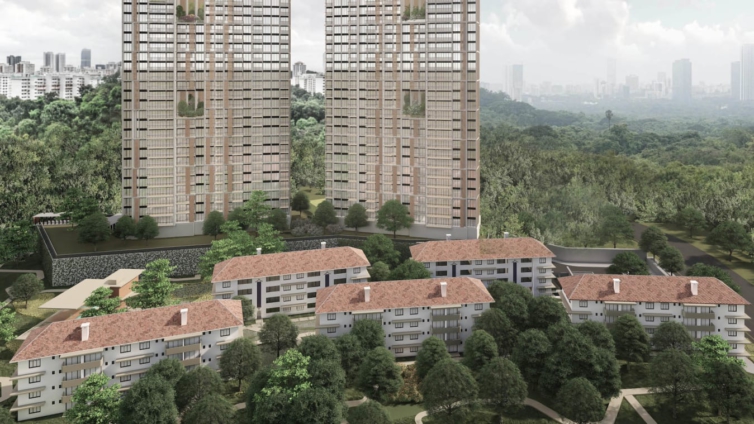
A pair of skyscrapers are set to become the tallest prefabricated buildings in the world.
And while the two 192-meter-tall (630 feet) towers will rise in densely populated Singapore, large parts of the structures are being built over the border in Malaysia.
The residential project, named Avenue South Residences, will see 988 apartments formed from almost 3,000 vertically stacked "modules." The firm behind the project, ADDP Architects, says the building method, known as Prefabricated Prefinished Volumetric Construction (PPVC), is less labor-intensive and can help reduce waste and noise pollution.

The individual modules are factory-made in Senai, Malaysia, where a series of six-sided boxes are cast in concrete. The units are then transported to a facility in Singapore to be fitted out and furnished before being moved to the construction site.
By the time they arrive, the boxes are 80% complete, according to ADDP Architects. They are then lifted into position by a crane and "stitched up" to form a strong, load-bearing frame, said one of the firm's associate partners, Markus Cheng Thuan Hann. Final touches, such as doors, are added afterward, the architect said.
"It's like a car manufacturing concept, but for the building industry," he added in a phone interview.
Benefits of prefabrication
Limiting the amount of construction work carried out at the site, which is located in Singapore's residential Bukit Merah district, can help minimize disruption to those living nearby, Hann said.
"But this construction (method) really helps to reduce noise," he said, of the benefit to the surrounding public housing estates. "And it can reduce waste... because the workmanship in a factory is much better controlled."
Another unforeseen benefit has emerged in the light of Covid-19: Fewer people are needed at the construction site at any one time. "It's easier to control safe distancing and logistical planning in the factory, rather than having all the (workers) on site," Hann pointed out.
The prefabrication industry first boomed in Europe and America during the post-war period, with urban planners using it to quickly and affordably address housing shortages. But the market for prefabs is now increasingly dominated by the Asia-Pacific region.
The building method has proven especially popular in Singapore, with the country's Building and Construction Authority actively encouraging the use of PPVC, citing an 8% cost saving and a 40% boost in productivity versus traditional construction means (it credits the latter to more productive "manpower," and "time savings"). Since 2014, the agency has even made prefabrication a requirement for certain sites.
Pushing the limits
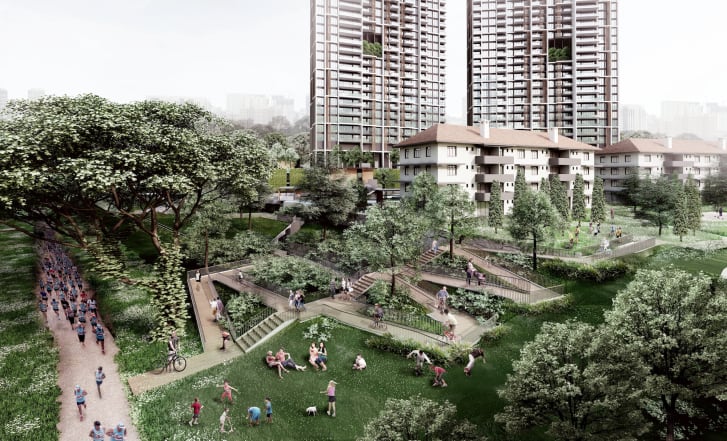
Construction on Avenue South Residences has already begun, and the developers hope to finish the project by the first quarter of 2023. Once complete, the towers' facades will feature balconies, sun-shading screens and a number of "sky terraces" filled with trees and plant life.
The project is set to overtake Singapore's -- and the world's -- current tallest prefab, the 140-meter-high (459 feet) Clement Canopy, which was also designed by ADDP Architects. Among the world's other tallest modular buildings is a 135-meter (443 feet) tower in Croydon, South London, and a 109-meter (359 feet) residential development in New York.

Hann said he cannot see his firm's latest project being surpassed in height anytime soon.
"We are (building upwards) progressively, working with the engineers, studying 3D simulations to make sure the design can withstand the wind loads," he said. "But I think 56 stories will be the tallest in Singapore for the time being. I don't think we will stretch any further.
"It's concrete, and we have to lift it very high. But depending on if new technology or more lightweight construction (is developed), maybe there's a chance we can go higher."
Latest Stories
-
Nearly 400 sentenced in Nigeria for links to militant Islamists
9 minutes -
Ghana’s recovery supported by gold strength despite global oil price pressures – Standard Bank Research
16 minutes -
Kwaku Azar writes: A-G vs OSP
49 minutes -
Mfantsipim–Adisadel rivalry built excellence, not division – Sam Jonah
1 hour -
Vice President launches Mfantsipim’s 150 years of shaping Ghana’s greatest mind
2 hours -
I assure Otumfuo, Mahama will join him to commission KNUST Teaching Hospital by end of this year – Haruna Iddrisu
2 hours -
Barcelona dominate derby to extend La Liga lead
2 hours -
Gov’t to roll out free special education for persons with disabilities from July 1 – Education Minister
3 hours -
Importers and Exporters Association declares full support for Publican AI port system
3 hours -
“We used it to test our officiating officials’ readiness” – Bawah Fuseini after CAA Athletics event
3 hours -
Volleyball emerges as Ghana’s fastest rising sport
3 hours -
National Sports Fund needs strong leadership from the top – Administrator David Wuaku
3 hours -
JoySports Exclusive: Steve McLaren in talks with GFA after expressing interest in Black Stars job
4 hours -
Fire guts auto parts warehouse at Bubuashie, one fire officer injured
4 hours -
I owe my victory to coach Ofori Asare – Allotey after winning WBA Africa Gold Super Flyweight belt
4 hours