

Audio By Carbonatix
Zimbabwe has declared a state of emergency in the capital Harare over a cholera outbreak.
The outbreak has so far killed dozens of people with more than 7,000 suspected cases.
The city authorities say the outbreak, spreading throughout the city, has invoked memories of a deadly outbreak in 2008, in which thousands died.
"We have declared a state of emergency because of cholera," local media quoted Mayor Ian Makone as saying.
The authorities are now asking for help to contain the spread and provide safe water, saying the aid being received is inadequate.
Health authorities have been struggling to contain the high number of admissions following the outbreak, according to the International Federation of the Red Cross (IFRC).
It cites a lack of health workers to manage the cases, as well as lack of supplies to stop the transmission.
Zimbabwe has been battling the deadly cholera outbreak in recent months amid a lack of access to clean water.
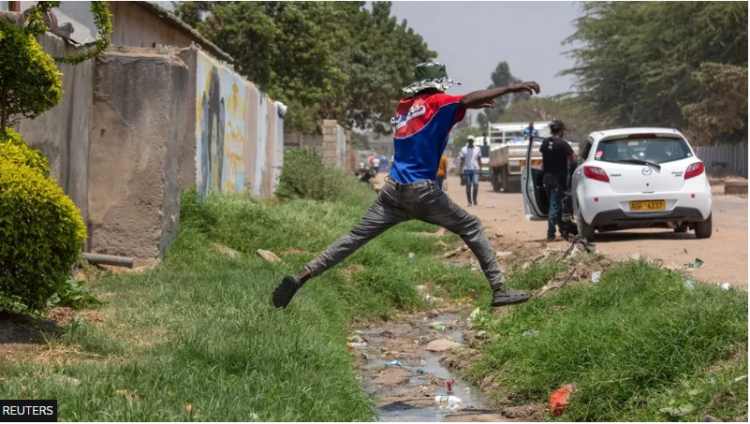
The epicentre of the latest outbreak is Harare's high-density suburb of Kuwadzana, which accounts for nearly half the reported cases, according to the authorities.
Cholera, an acute diarrhoeal infection is caused by consuming food or water contaminated with the bacterium Vibrio cholera.
On Thursday, the Harare mayor said the cholera outbreak had similarities to the 2008 outbreak.
The outbreak then led to the deaths of over 4,000 people, with at least 100,000 were infected, which led to a paralysis of basic services in the country.
This pushed then President Robert Mugabe into agreeing a historic power-sharing deal with his long-time rival, Morgan Tsvangirai.
In 2018, the country declared a state of emergency after 20 deaths and more than 2,000 cases related to typhoid and cholera were reported
"The cholera outbreak has come with vengeance," the mayor was quoted as saying on Thursday.
On Tuesday, the ministry of health announced that the country had recorded 7,398 suspected cases, 50 confirmed deaths, and 109 people in hospital.
It came as the health minister visited the epicentre, announcing measures to deal with the outbreak - including the removal of street food vendors, and trucking of safe water.
The IFRC says the disease is quickly spreading, affecting multiple geographical areas in 45 out of 62 districts and in all 10 provinces of the country.
It says the outbreak can be expected to cross the border.
Neighbouring countries including Malawi, South Africa, and Mozambique have also frequently experienced cholera outbreaks in the past.
Latest Stories
-
Ghana to host high-level conference on scaling education initiatives in emergencies
3 minutes -
Democracy must not be for sale: Who pays for Ghana’s politics, and how do we confront money, influence and accountability?
19 minutes -
Aburi Amanfrom landowners appeal for government support for Atwapim development project
22 minutes -
Cargill Ghana and International Cocoa Initiative celebrate 111 young graduates building skills for the future
45 minutes -
Video: Madina MP Francis-Xavier Sosu collapses while addressing students at GIMPA
47 minutes -
Hunnyboy reveals how social media landed him Shatta Wale feature
52 minutes -
I am a perfectionist – Actor William Lamptey
56 minutes -
No room for another false start as Ghana begin AFCON qualifying campaign
1 hour -
“We are grateful for what you have achieved” – AGI President tells Finance Minister
1 hour -
“No Nation is Inferior”: Mahama champions human dignity and security council reform at the UN
2 hours -
Manhyia South residents, NPP executives fume over botched EOCO arrest of MP
2 hours -
Mahama unveils new deal with global philanthropy
2 hours -
Daily Insight for CEOs: Building customer-centric leadership
2 hours -
Democracy must deliver food, jobs and healthcare, not just elections – Mahama
2 hours -
Capacity constraints must never be a barrier to restitution – Mahama
2 hours