

Audio By Carbonatix
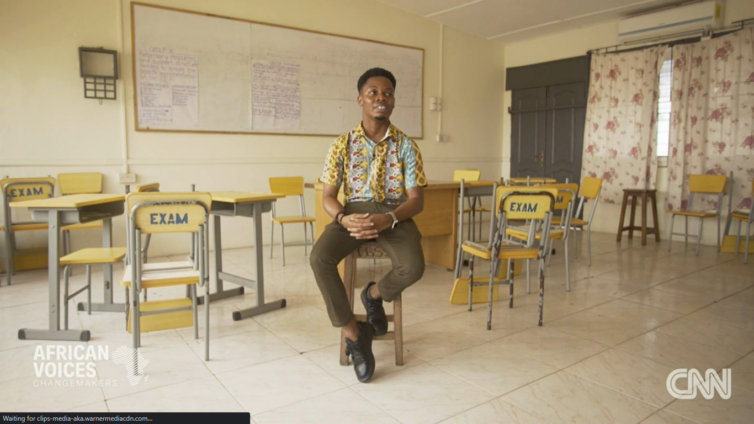
Jonathan Kennedy Sowah says wherever he goes, he's always looking for a problem to solve. His latest mission is to help transform Ghana's approach to STEM -- science, technology, engineering and mathematics -- and he believes he's found a solution.
His company, InovTech STEM Center, travels to schools across Ghana to teach students and teachers the ins and outs of STEM through robotics education.
"Computing [and coding] should be like a basic language -- every child should learn," Sowah, 23, says.
InovTech STEM Center offers lessons in web design, app development and 3D modelling and printing, among other skills. Workshops empower students to flex their creative muscles and find ways to apply the lessons they learn in the classroom to the tech field.
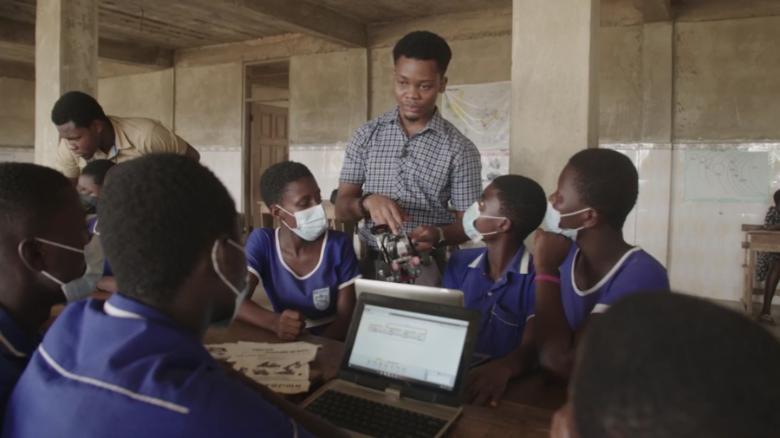
"Now they know the relevance of what they're learning in class. They know that if I'm able to learn geometry, this is what I can do with a robot," he says.
Digital skills are critical to learn as there is a growing demand for tech jobs throughout sub-Saharan Africa. A 2019 study by the International Finance Corporation estimated about 230 million jobs across the region will require digital skills by 2030 -- and more than nine million of those jobs will be in Ghana.
A defining moment
Like many entrepreneurs, Sowah's path to success was a bit unconventional. The Ghanaian was born and raised in the coastal township of Teshie, close to the capital Accra, where he spent most days working at his grandmother's provisions store.
He says he was interested in information technology (IT) from a young age, but he grew frustrated with how it was being taught in school. So, at 13 years old, Sowah decided to drop out and get a job at a local internet café.
"I knew I could do so much better, and I was so restricted," he recalls.
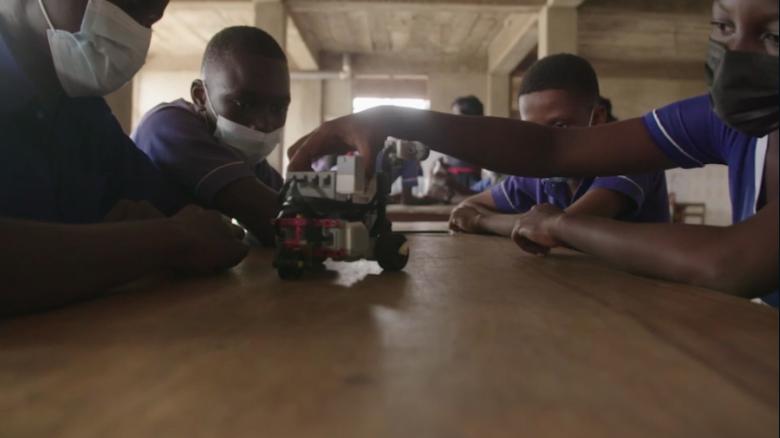
Once he had free access to the internet, he says he spent his spare time surfing the web to watch robotics tutorials, adding "I was always researching, I was learning new things."
The self-taught computer scientist eventually went back to school and enrolled in Labone Senior High School with dreams of becoming a neurosurgeon. But once again, Sowah says he was disappointed with a lack of emphasis on IT. This time, he took it upon himself to start a creative technology club called CREATECH.
"We started learning. We started teaching ourselves as well. And then we started going for robotics competitions," Sowah says.
He credits his geography teacher for pushing him to turn CREATECH into the InovTech STEM Center. Today, the company is reaching students and teachers throughout the country. It works closely with the Ghana Educational Service to buy robotics kits and work with schools. But Sowah tells CNN many rural areas still face significant challenges to education.
"You go to these places, and they don't have computers," he says. "It's up to us to learn it as the privileged ones and then go and teach the underprivileged ones."
A "learning nation"
In recent years, Ghana's Ministry of Education began implementing new policies to transform the country into a "learning nation," including an Education Strategic Plan that outlines ways to improve the quality of teaching STEM across all educational levels by 2030.
The ministry says it wants to achieve an enrollment ratio of 60:40 in favor of STEM subjects over humanities.
In January, it also announced plans to build 20 STEM centers and 10 STEM senior high schools across the country. It says the projects are in various stages of completion and some are expected to be operational this year.
In addition to improving access to resources, Sowah is determined to help close the gender gap in STEM.
According to UNICEF, girls are consistently underrepresented among top performers in STEM subjects and lack digital skills compared to their male peers. It found only 7% of girls in Ghana have digital skills compared to 16% of boys.
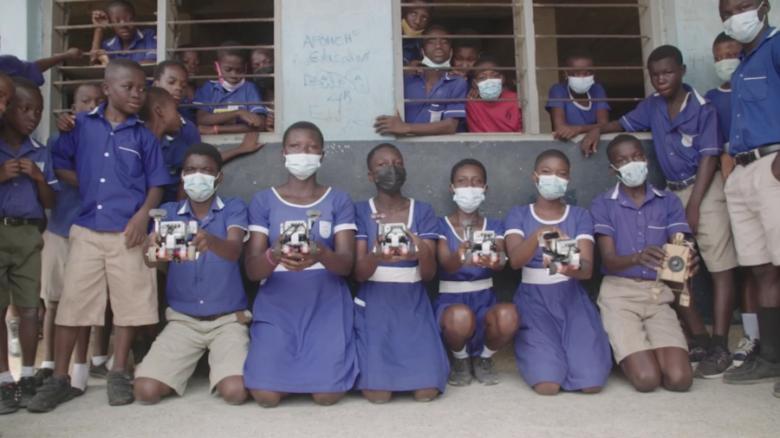
InovTech STEM Center empowers young women through its "STEM for Her" outreach program and also launched a "Girl Power Workshop" last year.
"We wanted to introduce girls to the exciting part of robotics, for them to meet those people that are already in the industry doing robotic or tech-related careers, and then mentor them, teach them and then guide them," Sowah says, adding he believes the government can do more to support the advancement of STEM.
Sowah asks the government and other international organizations to invest in STEM across Africa, particularly in Ghana, "because what we are doing, we are doing for our country."
"My dream for Ghana is a Ghana [where] every student [has] access to education ... no matter where they are," he adds. "A Ghana [where] every teacher is skilled ... [and] has the right to resources to train the students, to inspire them and empower them."
Latest Stories
-
Church of Pentecost supports over 2,000 BECE candidates in Obuasi with career guidance seminar
1 hour -
Brandon Asante and Coventry all but promoted to Premier League despite Sheffield Wednesday draw
1 hour -
GPL 2025/26: Late Kwartemaa strike downs Hearts in Tema
2 hours -
Ghana Faces Sierra Leone Moment as Prosecutorial Powers come under strain
2 hours -
Don’t consume fish or seafood from Tema Shipyard until further notice – FDA warns
2 hours -
Why volunteering might be Africa’s most underrated career accelerator
2 hours -
ActionAid Ghana raises concern over gender gaps in Feed Ghana Programme
2 hours -
Windstorm wreaks havoc in Gushegu, displacing nearly 2,000 residents and damaging schools
2 hours -
Friends of Bridget Bonnie Marks her 35th birthday with donation to Kasseh Model Health Centre
3 hours -
From Ekumfi Kokodo to the Pulpit Stage: Essi Donkor’s gospel journey takes shape
3 hours -
Landfilling waste management creates no value, it’s an economic waste
3 hours -
Photos: Speaker Bagbin Commissions MPs constituency office under parliamentary decentralisation programme
3 hours -
Black Stars technical advisor Winfried Schäfer sacked as GFA shakes up backroom staff
4 hours -
Wenchi water project almost complete, critical to gov’t agenda – GWL MD
4 hours -
Anti-LGBTQ+ bill not part of government’s legislative agenda – Inusah Fuseini
4 hours