


Audio By Carbonatix
For the longest time (we're talking millennia here), we had the Seven Wonders of the World.
There was just one problem for the demanding 21st-century travel set.
Except for the ever durable Great Pyramids of Egypt, the rest were nothing more than distant memories from a hazy history.
Want to see the Hanging Gardens of Babylon or the Colossus of Rhodes? You missed that boat by many centuries. A rendering in a book or online is the best you'll ever do.
The solution? In 2007, a global contest was held and more than 100 million votes were cast for the New Seven Wonders of the World.
And while many of them are very old, they're still here! These are durable destinations where we can actually go see the wonders -- and take a selfie for posterity.
Visit these seven magnificent sights, and you'll have checked off four continents on your travel list as well. Let's get started:
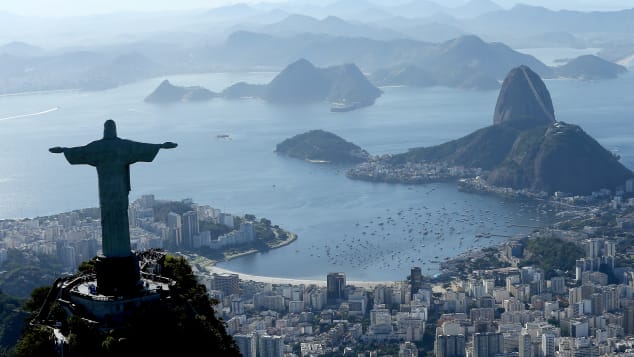 The view from Christ the Redeemer is part of its appeal. Matthew Stockman/Getty Images South America/Getty Images
By far the "baby" of this list, the Christ the Redeemer statue was finished in 1931 but has already taken its place in the pantheon of historic wonders. Standing 30 meters (98 feet) tall and outstretched arms spanning 28 meters (92 feet), the simple but mesmerizing white statue of Art Deco design has an amazing view over Rio de Janeiro.
It's one of the most magnificent meetings of natural and man-made beauty in the world.
Best time to go: Rio tends to be drier (better for those spectacular views) but also hotter in December through February. Afternoons have bigger crowds generally. Mornings are better for taking pictures of the statue; afternoons are better for taking pictures of the city panorama. Expect more people during weekends and Rio's Carnival.
The view from Christ the Redeemer is part of its appeal. Matthew Stockman/Getty Images South America/Getty Images
By far the "baby" of this list, the Christ the Redeemer statue was finished in 1931 but has already taken its place in the pantheon of historic wonders. Standing 30 meters (98 feet) tall and outstretched arms spanning 28 meters (92 feet), the simple but mesmerizing white statue of Art Deco design has an amazing view over Rio de Janeiro.
It's one of the most magnificent meetings of natural and man-made beauty in the world.
Best time to go: Rio tends to be drier (better for those spectacular views) but also hotter in December through February. Afternoons have bigger crowds generally. Mornings are better for taking pictures of the statue; afternoons are better for taking pictures of the city panorama. Expect more people during weekends and Rio's Carnival.
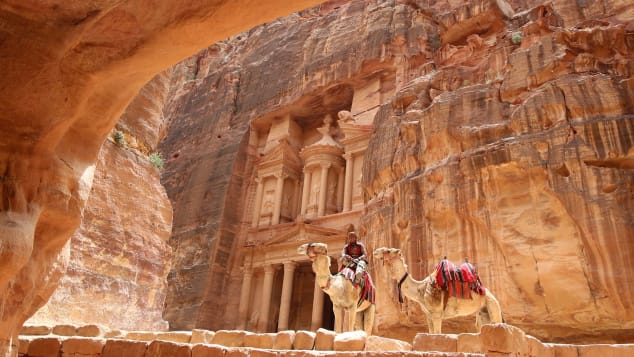 A Jordanian Bedouin sits on a camel in front of the Treasury Building in the ancient city of Petra in May 2016. KHALIL MAZRAAWI/AFP/AFP/Getty Images
Set in modern-day Jordan's southwestern desert region between the Dead Sea and the Red Sea, Petra was inhabited going back to prehistoric times.
People today may recognize it from the 1989 movie "Indiana Jones and the Last Crusade," but during the classical heydays of Greece and Rome, it was known as an important caravan stop between the Mediterranean and the Far East. By the 7th century AD, it was abandoned. But its desert location preserved much of it through the centuries
No wonder it mesmerizes visitors today -- its blend of Eastern and Hellenistic styles, half-built and half-carved into the natural red sandstone of the area, truly deserves the term "unique."
Best time to go: Summer can get very hot in Jordan, and winter is much colder than you may realize. Weatherwise, aim for spring or fall.
A Jordanian Bedouin sits on a camel in front of the Treasury Building in the ancient city of Petra in May 2016. KHALIL MAZRAAWI/AFP/AFP/Getty Images
Set in modern-day Jordan's southwestern desert region between the Dead Sea and the Red Sea, Petra was inhabited going back to prehistoric times.
People today may recognize it from the 1989 movie "Indiana Jones and the Last Crusade," but during the classical heydays of Greece and Rome, it was known as an important caravan stop between the Mediterranean and the Far East. By the 7th century AD, it was abandoned. But its desert location preserved much of it through the centuries
No wonder it mesmerizes visitors today -- its blend of Eastern and Hellenistic styles, half-built and half-carved into the natural red sandstone of the area, truly deserves the term "unique."
Best time to go: Summer can get very hot in Jordan, and winter is much colder than you may realize. Weatherwise, aim for spring or fall.
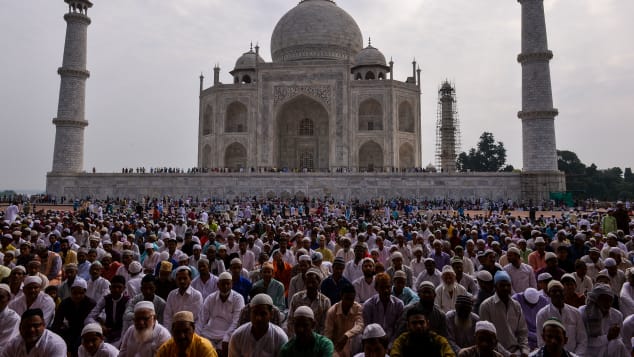 Indian Muslims pray during the Eid al-Adha festival at the mosque inside the Taj Mahal in Agra on September 13, 2016. CHANDAN KHANNA/AFP/AFP/Getty Images
Did you know the world-famous Taj Mahal is actually an incredibly elaborate tomb and an enduring symbol of love?
Mughal Emperor Shah Jahan ordered construction in 1632 as a monument to his wife, Mumtaz Mahal. The stunningly beautiful structure, considered the height of Indo-Islamic architecture, was completed in 1648.
The white marble structure is in Agra, about 212 kilometres (132 miles) south of India's capital, New Delhi.
Indian Muslims pray during the Eid al-Adha festival at the mosque inside the Taj Mahal in Agra on September 13, 2016. CHANDAN KHANNA/AFP/AFP/Getty Images
Did you know the world-famous Taj Mahal is actually an incredibly elaborate tomb and an enduring symbol of love?
Mughal Emperor Shah Jahan ordered construction in 1632 as a monument to his wife, Mumtaz Mahal. The stunningly beautiful structure, considered the height of Indo-Islamic architecture, was completed in 1648.
The white marble structure is in Agra, about 212 kilometres (132 miles) south of India's capital, New Delhi.
Chichen Itza (Mexico)
One of numerous UNESCO World Heritage Sites on the list, the complex of Chichen Itza is the most famous symbol of the once-mighty Mayan civilization. Archaeologists believe Chichen Itza emerged as a major economic and cultural centre around 600 AD and grew for several centuries. It was eventually abandoned and lost to nature in modern Mexico's Yucatán Peninsula. The ruins weren't uncovered until 1841, and it's only become a big tourist destination in recent decades. The pyramid of El Castillo ("The Castle") is probably the best-known structure of the once vast city. Best time to go: Go early in the morning before it gets too hot and cruise ship passengers from Cancun arrive. People also go for spring and fall equinoxes for an unbelievable shadow show -- but expect huge crowds then.Christ the Redeemer (Brazil)
The view from Christ the Redeemer is part of its appeal. Matthew Stockman/Getty Images South America/Getty Images
By far the "baby" of this list, the Christ the Redeemer statue was finished in 1931 but has already taken its place in the pantheon of historic wonders. Standing 30 meters (98 feet) tall and outstretched arms spanning 28 meters (92 feet), the simple but mesmerizing white statue of Art Deco design has an amazing view over Rio de Janeiro.
It's one of the most magnificent meetings of natural and man-made beauty in the world.
Best time to go: Rio tends to be drier (better for those spectacular views) but also hotter in December through February. Afternoons have bigger crowds generally. Mornings are better for taking pictures of the statue; afternoons are better for taking pictures of the city panorama. Expect more people during weekends and Rio's Carnival.
Colosseum (Italy)
Those Romans sure did enjoy their games -- gladiator fights, man vs. animal contests, chariot races and even mock naval battles. And say what you will about their entertainment choices, they built a Colosseum to last. Emperor Vespasian ordered the construction around 71 AD, and it was dedicated in 80 AD during the rule of his son Titus. It held around 50,000 spectators and even had a retractable awning to shield Romans. Given how quickly stadiums come and go in the modern age, it makes this feat of engineering all the more amazing. And this freestanding structure sits in the middle of a bustling, modern-day Rome. Best time to go: You'll find fewer tourists there during Rome's low season (winter), weekdays and during the opening hour (8:30 a.m.) or near closing time (varies during the time of year). If you show up in summer at midday, it's going to be hot!Great Wall (China)
The Great Wall began around 220 BC, and construction continued for millennia. Its purpose: Keep nomadic people to the north out of China. Eventually, it couldn't hold back the Mongols, who successfully invaded in the 13th century anyway and set up shop in what's now Beijing under the direction of Kublai Khan. However, the Great Wall has turned out to be a great way to usher an invasion of tourists (and their money) into China in recent decades. Stretching for 8,852 kilometres (5,500 miles) along the best-preserved Ming Dynasty portion of the superstructure, its travel appeal is obvious. In the words of UNESCO's page on the wall: It's "an outstanding example of the superb military architecture, technology and art of ancient China." Best time to go: Plan for a spring or fall trip when the weather is nicer and fewer people visit. Summertime is often hot and crowded, and winter can be bitterly cold in northern China.Machu Picchu (Peru)
Machu Picchu is the most isolated and challenging-to-reach of the New Seven Wonders of the World (among other things, you have to adjust to the high altitude of the Peruvian Andes). But oh what rewards you'll find: the most splendid example of Incan architecture placed in a jaw-dropping landscape of tropical mountain forest. There are about 200 structures in this religious and agricultural centre set on a steep ridge crisscrossed by terraces of stone. Amazingly, it was in active use only a short time, historically speaking. The Inca built it in the 15th century, but it was abandoned after the Spanish invasion in the 16th century. Best time go: Dry season, which runs April to October (though weather in the Andes is hard to predict). Peak crowds are June through August. Because of the fragile nature of the area, new ticketing rules limit the number of tourists at any given time -- so you must book for a morning or afternoon slot.Petra (Jordan)
A Jordanian Bedouin sits on a camel in front of the Treasury Building in the ancient city of Petra in May 2016. KHALIL MAZRAAWI/AFP/AFP/Getty Images
Set in modern-day Jordan's southwestern desert region between the Dead Sea and the Red Sea, Petra was inhabited going back to prehistoric times.
People today may recognize it from the 1989 movie "Indiana Jones and the Last Crusade," but during the classical heydays of Greece and Rome, it was known as an important caravan stop between the Mediterranean and the Far East. By the 7th century AD, it was abandoned. But its desert location preserved much of it through the centuries
No wonder it mesmerizes visitors today -- its blend of Eastern and Hellenistic styles, half-built and half-carved into the natural red sandstone of the area, truly deserves the term "unique."
Best time to go: Summer can get very hot in Jordan, and winter is much colder than you may realize. Weatherwise, aim for spring or fall.
Taj Mahal (India)
Indian Muslims pray during the Eid al-Adha festival at the mosque inside the Taj Mahal in Agra on September 13, 2016. CHANDAN KHANNA/AFP/AFP/Getty Images
Did you know the world-famous Taj Mahal is actually an incredibly elaborate tomb and an enduring symbol of love?
Mughal Emperor Shah Jahan ordered construction in 1632 as a monument to his wife, Mumtaz Mahal. The stunningly beautiful structure, considered the height of Indo-Islamic architecture, was completed in 1648.
The white marble structure is in Agra, about 212 kilometres (132 miles) south of India's capital, New Delhi.DISCLAIMER: The Views, Comments, Opinions, Contributions and Statements made by Readers and Contributors on this platform do not necessarily represent the views or policy of Multimedia Group Limited.
DISCLAIMER: The Views, Comments, Opinions, Contributions and Statements made by Readers and Contributors on this platform do not necessarily represent the views or policy of Multimedia Group Limited.
Latest Stories
-
Credit Risk Management Directive: BoG to begin implementation for banks, others from July 1, 2027
12 minutes -
Ghana Brands Awards 2026: Leading brands, business trailblazers to shine on November 20
28 minutes -
T-bills auction: Demand improves as government exceeds target by about 76%; interest rates soften
34 minutes -
Ziope undertakes initiative to build a technologically inclined community, commissions self-help ICT lab
58 minutes -
ECG announces power outage in parts of Tema, Central Region due to network fault, maintenance
1 hour -
When the Gospel Becomes a Weapon: The church, blackmail and the abuse of faith
2 hours -
JoyNews’ Jacqueline Ansomah Yeboah selected for UK Media Excellence for Emerging Technology Fellowship
2 hours -
Mental Health Alliance urges government to operationalise Mental Health Fund
2 hours -
Ghana–Holy See agreement heads to Parliament after Cabinet approval
2 hours -
Luv FM Corporate Games 2026: Kumasi Central Prisons, Amanfiman Bank win big amid fun
3 hours -
WAFU B U17: Ghana top Group A after win over Togo
3 hours -
Ho Central Mosque reopens amid unresolved leadership dispute that led to closure
4 hours -
Minority caucus questions GH¢16.4m in Ablakwa’s SA evacuation spending, demands independent audit
5 hours -
Gender Ministry meets Nana Akua Addo’s husband over domestic violence after hospital discharge
5 hours -
UG Vice-Chancellor urges swift operationalisation of National Research Fund
6 hours