

Audio By Carbonatix
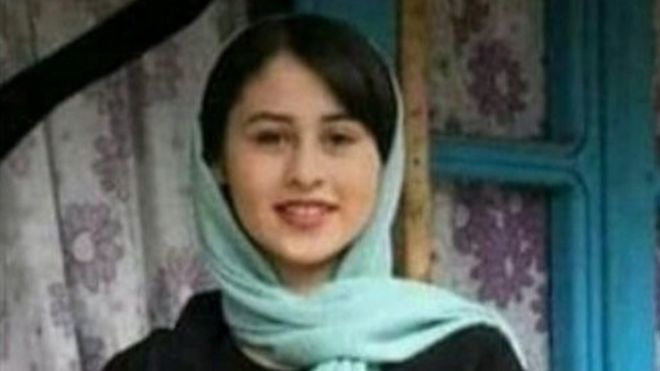
Police in northern Iran have arrested a man accused of murdering his 14-year-old daughter in an "honour killing" that has sparked widespread outrage.
Romina Ashrafi ran away from home in Gilan province with her 35-year-old boyfriend after her father objected to their marriage, local media said.
The pair were found by police and Romina was sent home despite reportedly telling them she feared for her life.
Last Thursday night, she was allegedly attacked by her father in her bedroom.
News outlet Gilkhabar.ir reported that Romina was "decapitated" with a sickle, and that afterwards the father walked outside the house "with the sickle in his hand and confessed".
On Wednesday, a number of national newspapers highlighted Romina's story on their front pages.
"Insecure paternal home", read the headline in the pro-reform Ebtekar, which lamented the failure of existing legislation to protect women and girls.
Meanwhile, the Persian hashtag #Romina_Ashrafi has been used more than 50,000 times on Twitter, with most users condemning the killing and the patriarchal nature of Iranian society in general.
Shahindokht Molaverdi, a former vice-president for women and family affairs and the current secretary of Iran's Society for Protecting Women's Rights, wrote: "Romina is neither the first nor will she be the last victim of honour killings."
She added that such murders would continue "as long as the law and dominant cultures in local and global communities are not deterring enough".
4-As long as the current laws discriminating against girls and empowering abusive parents exist, unfortunately the cycle of violence will continue. Iran will see more Ruminas and Atefehs tragically killed by their fathers. This cycle of violence needs to end
— Masih Alinejad 🏳️ (@AlinejadMasih) May 26, 2020
Iran's Islamic penal code reduces punitive measures for fathers and other family members who are convicted of murder or physically harming children in domestic violence or "honour killings".
If a man is found guilty of murdering his daughter, the punishment is between three and 10 years in prison, rather than the normal death sentence or payment of diyeh (blood money) for murder cases.
There are no statistics on the prevalence of "honour killings" in Iran, but human rights activists reported last year that they continued to occur, particularly among rural and tribal populations, according to the US state department.
Latest Stories
-
Digitalisation, AI key to Ghana’s tourism transformation – GHATOF
5 minutes -
Stronger GTA-private sector partnership needed to grow tourism – GHATOF
15 minutes -
Amazon eyes Ghana for broadband expansion after talks with Mahama
60 minutes -
National Investment Quiz 2026: Six schools qualify for quarter-finals
1 hour -
‘Do not let Russia pay for its madness with lives of your people’ – Zelensky to Ghana, 46 other countries
2 hours -
6,079 promotion cases fully processed and paid – CAGD says amid nationwide teachers’ strike
2 hours -
Teacher unions to meet government Monday over nationwide strike
2 hours -
Photo story: Republic Bank-JoyNews Habitat Fair clinic wraps up after three days of housing solutions, expert engagement
2 hours -
National Peace Council urges investment in youth to sustain Ghana’s peace
3 hours -
Afenyo-Markin urges youth to speak up against injustice
3 hours -
CAF annuls Edo Queens victory, orders WAFU B final to resume from extra time
3 hours -
Interior Minister urges traditional authorities to enforce anti-bushfire bye-laws
3 hours -
3rd Republic Bank-JoyNews Habitat Fair Clinic ends on a high note after three days of strong patronage
3 hours -
Ten climbers missing after avalanche hits Himalayan base camp
4 hours -
NPP had more permanent fuel relief measures than current GH¢2 diesel cut – Amin Adam
4 hours