

Audio By Carbonatix
The coronavirus that is now threatening the world is subtly different from the one that first emerged in China.
Sars-Cov-2, the official name of the virus that causes the disease Covid-19, and continues to blaze a path of destruction across the globe, is mutating.
But, while scientists have spotted thousands of mutations, or changes to the virus's genetic material, only one has so far been singled out as possibly altering its behaviour.
The crucial questions about this mutation are: does this make the virus more infectious - or lethal - in humans? And could it pose a threat to the success of a future vaccine?
This coronavirus is actually changing very slowly compared with a virus-like flu. With relatively low levels of natural immunity in the population, no vaccine and few effective treatments, there's no pressure on it to adapt. So far, it's doing a good job of keeping itself in circulation as it is.
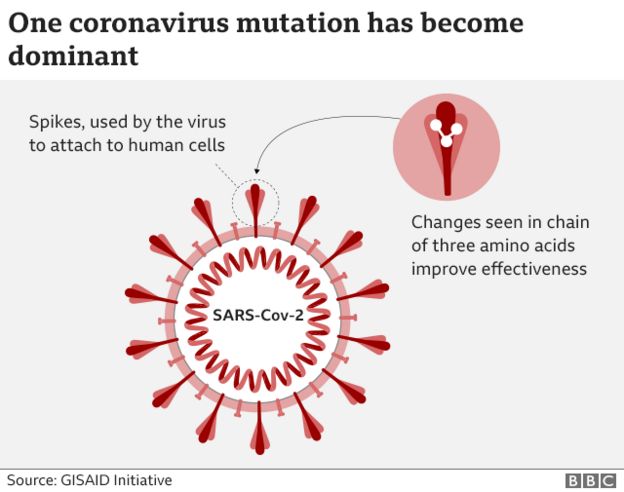
The notable mutation - named D614G and situated within the protein making up the virus's "spike" it uses to break into our cells - appeared sometime after the initial Wuhan outbreak, probably in Italy. It is now seen in as many as 97% of samples around the world.
Evolutionary edge
The question is whether this dominance is the mutation giving the virus some advantage, or whether it's just by chance.
Viruses don't have a grand plan. They mutate constantly and while some changes will help a virus reproduce, some may hinder it. Others are simply neutral. They're a "by-product of the virus replicating," says Dr Lucy van Dorp, of University College London. They "hitch-hike" on the virus without changing its behaviour.
The mutation that has emerged could have become very widespread just because it happened early in the outbreak and spread - something known as the "founder effect". This is what Dr van Dorp and her team believe is the likely explanation for the mutation being so common. But this is increasingly controversial.
A growing number - perhaps the majority - of virologists now believe, as Dr Thushan de Silva, at the University of Sheffield, explains, there is enough data to say this version of the virus has a "selective advantage" - an evolutionary edge - over the earlier version.
Though there is still not enough evidence to say "it's more transmissible" in people, he says, he's sure it's "not neutral".
When studied in laboratory conditions, the mutated virus was better at entering human cells than those without the variation, say professors Hyeryun Choe and Michael Farzan, at Scripps University in Florida. Changes to the spike protein the virus uses to latch on to human cells seem to allow it to "stick together better and function more efficiently".
But that's where they drew the line.
Prof Farzan said the spike proteins of these viruses were different in a way that was "consistent with, but not proving, greater transmissibility".
Lab result proof
At the New York Genome Center and New York University, Prof Neville Sanjana, who normally spends his time working on gene-editing technology Crispr, has gone one step further.
His team edited a virus so that it had this alteration to the spike protein and pitted it against a real Sars-CoV-2 virus from the early Wuhan outbreak, without the mutation, in human tissue cells. The results, he believes, prove the mutated virus is more transmissible than the original version, at least in the lab.
Dr van Dorp points out "it is unclear" how representative they are of transmission in real patients. But Prof Farzan says these "marked biological differences" were "substantial enough to tilt the evidence somewhat" in favour of the idea that the mutation is making the virus better at spreading.
Latest Stories
-
Ghana showcases tourism expertise at Siberian Hospitality Forum in Russia
7 minutes -
WAFCON 2026: Black Queens to face Nigeria in pre-tournament friendly after Côte d’Ivoire win
9 minutes -
Western Region GJA launches 2026 media and corporate impact awards
13 minutes -
NDC Central Regional Chairman apologises to Obaatanpa Radio over chaotic station incident
15 minutes -
UN warns of widening terrorist threat across West Africa and the Sahel
29 minutes -
You can’t use parliamentary rules to suppress oversight – Afenyo-Markin tells First Deputy Speaker
30 minutes -
BoG Governor calls for collaborative approach to build digital-driven financial system
38 minutes -
Joy Business and Super Morning Show host high-level roundtable on Ghana’s poultry industry
42 minutes -
Finance Minister urges GSS to publish quarterly employment rate data
44 minutes -
Prioritise GDP and CPI rebasing through 2027 – Finance Minister to GSS
48 minutes -
NPP Savannah Regional Chairman seeks third term, promises unity and victory in 2028
49 minutes -
Republican presses Blanche on Trump-IRS settlement at Senate hearing
49 minutes -
World Cup 2026: Didi Dramani’s tactical preview of England vs Argentina
57 minutes -
Sam George introduces new NITA Director-General, outlines digital sector reforms
1 hour -
COCOBOD settles GH¢162m outstanding debt owed to non-DDEP Cocoa Bill holders
1 hour