

Audio By Carbonatix
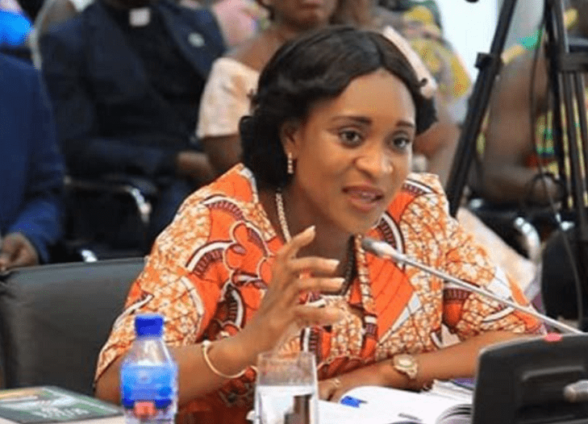
The Deputy Minister of Finance, Mrs. Abena Osei-Asare has stated that government's prudent management of Ghana's economy in the midst of global crisis has shown tenacity to return the country onto the path of rapid growth and development.
“The government has demonstrated that in bad times, the best policies, programmes and character will keep the economy stable and going.
"It has demonstrated its relentless caring virtue through numerous social interventions with determined focus and firm leadership to bring development to all regardless of one's location."
Government, she indicated, had picked up the economy strongly and warmly rallied the collective efforts of all to win the December election as the Party launched its manifesto for election 2020.
The event was held on the theme "Leadership of service, protecting our progress, transforming Ghana for all".
Mrs. Osei-Asare who is also the Member of Parliament for Atiwa East said within a period of three years, the government has essentially stabilised Ghana's economy through fiscal consolidation and micro-prudency.
"We have moved growth to an average of 7 percent over the period, reduced inflation from 15.4 to 7.9, $2 billion of trade balance, and systematically and diligently exited International Monetary Fund (IMF) programme."
She said the government on realizing the fragility of the financial system, completely restructured it with a much stronger and more robust financial system.
On youth in agriculture to feed the nation, Mr. Sammy Awuku, the National Organizer of the Party said government was committed to investing in the agricultural sector to create jobs and make the nation self-reliant in food production.
In that regard, he announced that government had secured $37million from the African Development Bank (ADB) for commercial farming activities in the Savannah and Northern Regions.
To encourage and support the local poultry industry and meat processing, government had succeeded in supporting three farms including; Darko farms, Asamoah, and Yamoah farms in Ashanti Region and Anglo farm in Cape Coast in the Central Region.
Through its flagship programme to revolutionize the agric sector, the government introduced planting for Food and Jobs (PFJ) leading to increased farmer participation of 202,000 in 2017 to 1.2 million in 2019.
That according to him, resulted in yields of maize, rice, and soybean increasing by 131 percent,59 percent, and 69 percent respectively in three years.
Latest Stories
-
Promotion pay row: Gov’t gives teachers September to complete salary adjustments
5 minutes -
Financial irregularities plummet by 62.9% as state tightens fiscal controls
5 minutes -
DVLA to expand mobile services to underserved communities in Ghana’s Eastern Corridor of the Northern Region
21 minutes -
GUTA urges GPHA to act swiftly to end Tema Port congestion to avert rising business costs
21 minutes -
Port congestion could undermine 24-hour economy policy – GUTA
22 minutes -
NSA opens three-day window to resolve national service biodata mismatches
31 minutes -
Abu Jinapor highlights increased gold exports after Domestic Gold Purchase Programme
36 minutes -
NPP UK branch calls for independent audit into gold purchasing operations and parliamentary probe
1 hour -
Zanetor Agyeman-Rawlings pledges decisive action on climate change, galamsey and environmental degradation
1 hour -
Bawumia was brainchild behind Domestic Gold Purchase Programme – Samuel Jinapor
1 hour -
Fuel prices set to go up from September 1, Petrol to sell at GHC 16.69 and Diesel, GHC 17.90 – COMAC
1 hour -
Our World Our People withdrawn due to curriculum duplication, not politics – Adutwum’s spokesperson
1 hour -
GANRAP is essentially a rebranding of Domestic Gold Purchase Programme – Abu Jinapor
1 hour -
I am tired of being in opposition, my goal is to win in 2028 – Boakye Agyarko
2 hours -
Ghana’s road maintenance funding gap deepens as only 37% of needs met – World Bank
2 hours