

Audio By Carbonatix
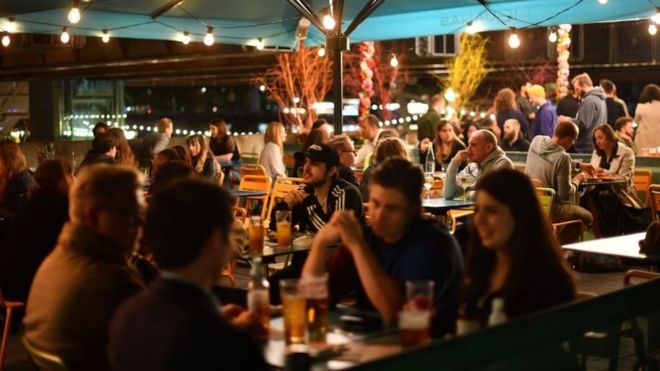
All pubs, bars, restaurants and other hospitality venues in England must have a 22:00 closing time from Thursday, to help curb the spread of coronavirus.
The sector will also be restricted by law to table service only.
Cabinet Office minister Michael Gove said people should also work from home "if they can" and trials of spectators at sports fixtures would be "paused".
The full measures will be set out by the prime minister in the House of Commons later.
Boris Johnson will also address the nation in a live broadcast at 20:00 BST on Tuesday.
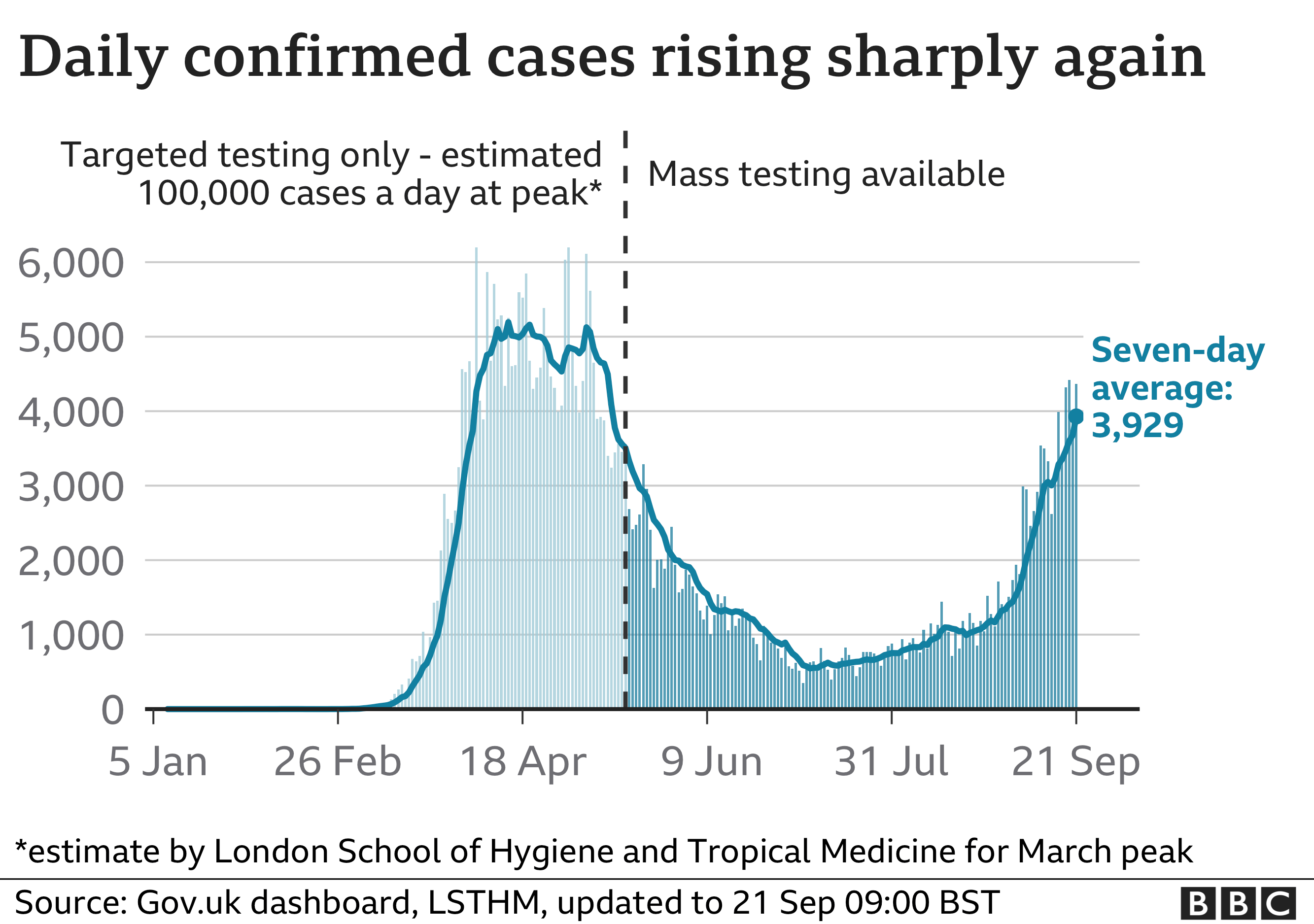
It comes as the UK's Covid-19 alert level moved to 4, meaning transmission is "high or rising exponentially".
Mr Gove told BBC Breakfast that there was evidence the 22:00 closing time has a "beneficial effect" in the areas where the restriction has already been tried.
He denied that the government was wrong to relax coronavirus measures against the virus in the summer, describing the new restrictions as a "recalibration which we hope and believe will be enough to check the spread".
"We're not going back to the sorts of measures that we had in the spring," he said.
He said that "if people can work from home they should" and said sport with live audiences was being halted because of the risk of fans mixing on the way to the stadium or during half-time.
The government's chief scientific adviser Sir Patrick Vallance has warned there could be 50,000 new coronavirus cases a day by mid-October without further action - which, he said, could lead to more than 200 deaths per day by mid-November.
Prof Callum Semple, an expert in outbreak medicine at the University of Liverpool, told BBC Breakfast current data was "tracking the worst-case scenario quite accurately".
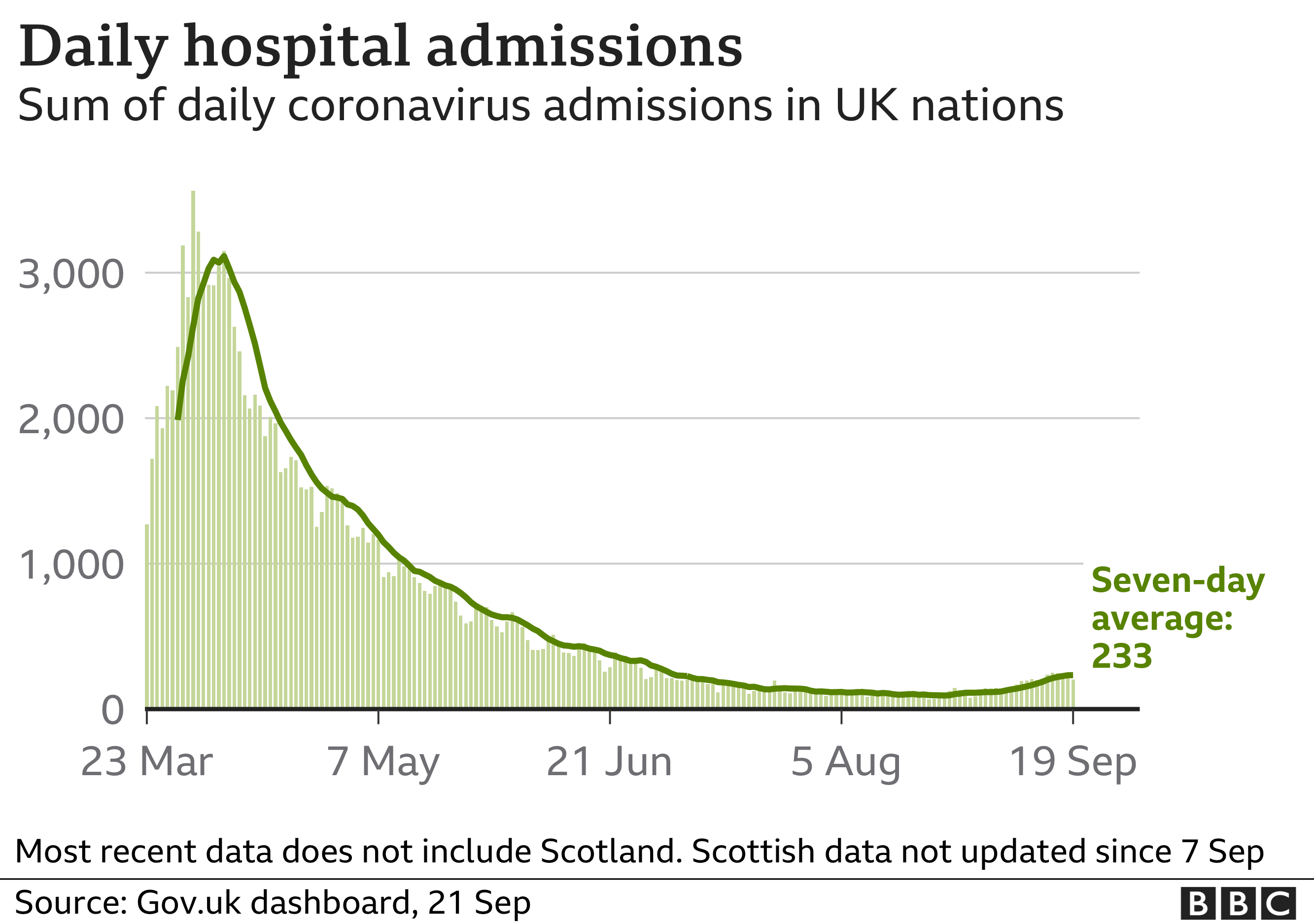
He said there was now a rise in hospital admissions, including among women aged 20 to 40, who were at risk of exposure to the virus because of their work in hospitality, caring roles or because they were parents of schoolchildren.
The UK needed "quite a lot more" restrictions in place to prevent the spread, and the hospitality industry will probably have to take another "hit", Prof Semple said.
Andy Wood, chief executive of the Adnams brewery, told the Today programme that the pub industry had "taken the health messages seriously" and it seemed "incongruous" that it was being singled out.
He said the industry was still "on life support" and about 900,000 jobs were at risk.
On Monday, a further 4,368 daily cases and 11 deaths were reported in the UK. Also:
- Further restrictions will also be announced in Scotland on Tuesday
- Restrictions on households mixing indoors will be extended to all of Northern Ireland
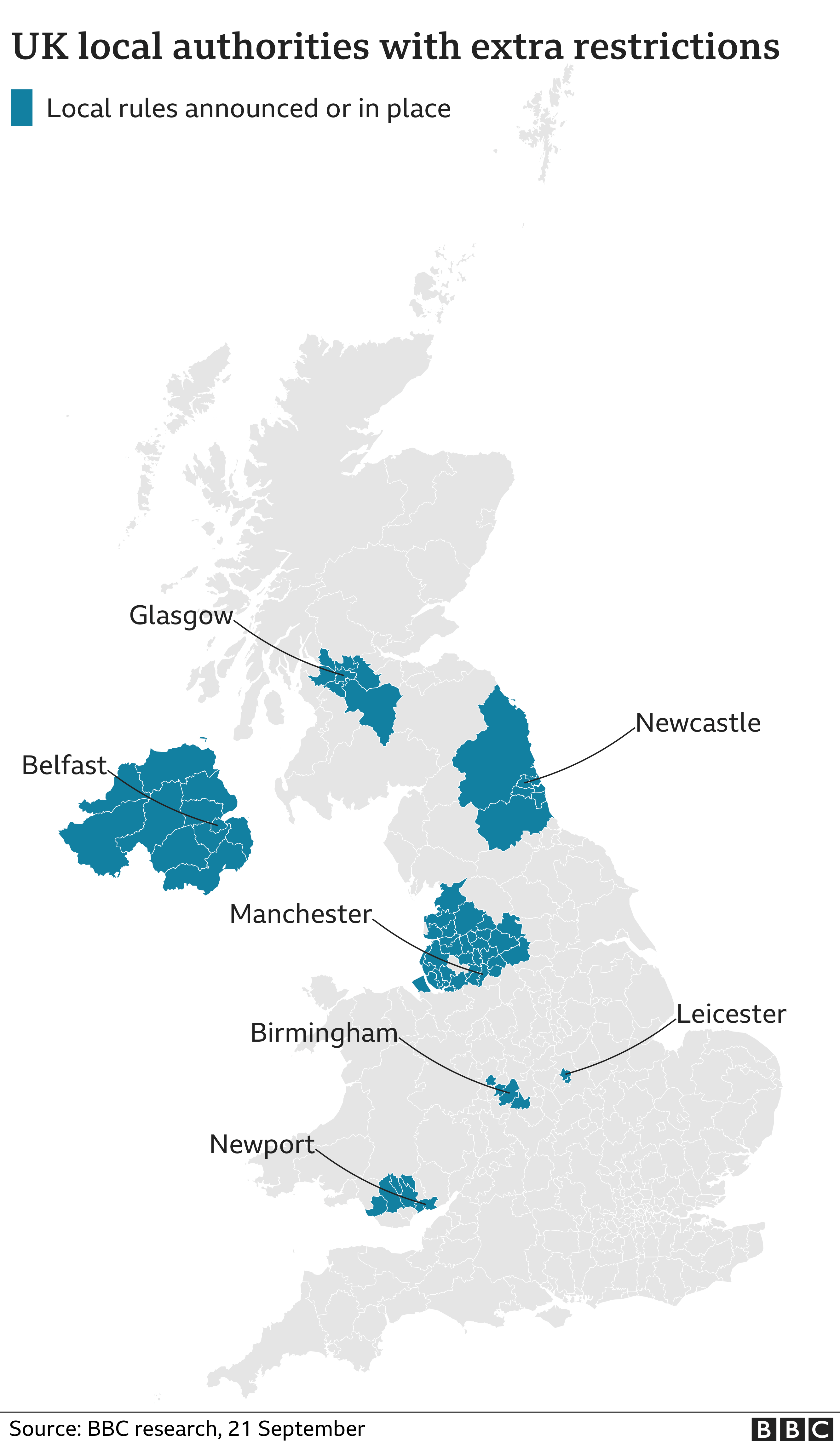
- Also from 18:00 on Tuesday, four more counties in south Wales will face new measures, including a 23:00 curfew for pubs and bars
- New measures will also come into force in Lancashire, Merseyside, parts of the Midlands and West Yorkshire from Tuesday.
- Other areas of England, Scotland and Wales are already under local lockdown, with restrictions including a ban on mixing with other households.

What difference will it make?

People are understandably asking what difference closing at 22:00 makes. Coupled with the table service law, it will be little more than a marginal gain.
But what ministers hope is that the move, along with the rule of six, will act as a warning to the public that efforts to curb the virus need to be redoubled.
What remains to be seen is whether any other restrictions will accompany this move.
It seems inevitable that the virus will continue to spread - that's what respiratory viruses do d
uring winter, especially one for which there is limited immunity and no vaccine.
But how quickly and widely no one knows.
The risk of trying to suppress the virus is the government will soon find itself having to make another decision about further steps.
How far are ministers prepared to go? Every restriction that is taken has a negative consequence to society.
But the nature of the virus means lives will undoubtedly be lost the more it spreads. Balancing those two harms will define the next six months.
The cabinet will meet on Tuesday morning and Boris Johnson will also chair a Cobra emergency meeting - which will be attended by the first ministers of Scotland, Wales and Northern Ireland.
Speaking about the new closing times, a No 10 spokesperson said: "We know this won't be easy, but we must take further action to control the resurgence in cases of the virus and protect the NHS."
Tighter restrictions on pub and restaurant opening times are already in place in parts of north-east and north-west England, and Wales.
Liberal Democrat leader Sir Ed Davey described the new rules as "a step backwards", as he urged the government to fix the test and trace system and help the hospitality sector.
"After people have already been through so much hardship, we cannot allow thousands of jobs to disappear overnight," he said.
There were also calls for support from within the hospitality sector.
Kate Nicholls, chief executive of trade body UKHospitality, said the new rules should be "applied with flexibility", and that a 22:00 closing time was "bad for business and bad for controlling the virus".
She added: "Table service has been widely adopted in some parts of the sector since reopening, but it is not necessary across all businesses, such as coffee shops."
Meanwhile, Michael Kill, chief executive of the Night-Time Industries Association, warned the move would result in a "surge of unregulated events and house parties".

If Boris Johnson had decreed a year ago that he was going to call last orders on the pub at 22:00, the ravens might have left the Tower.
But given the terrible warnings from the government's top scientists on Monday, the kind of strict measures that ministers had been discussing - and the extent of restrictions that many people are already living with in some of our towns and cities you might wonder if what the prime minister has ended up deciding is less stringent than it might have been.
As we have talked about many times, Downing Street is all too aware of the economic havoc the restrictions around the pandemic have caused.
Logically, therefore, it has always only wanted to take action when it has felt absolutely urgent. It is also the case that, as we enter a second surge, more is understood about the virus itself.
That means the government ought to be able to take a more sophisticated approach to managing the spread, rather than blunt, blunderbuss nationwide measures.
At least for now, the prime minister has concluded there is a narrow, but real chance to put the brakes on the outbreak before taking more draconian steps.
It comes as Christopher Snowdon, head of lifestyle economics at free-market think tank the Institute of Economic Affairs, said the latest restrictions seemed "to have emerged from a random policy generator" as he called on the government to publish the evidence upon which it was based.
"While mandatory table service has been part of the successful Swedish approach and may have merit, the new closing time will be devastating to a hospitality sector that was already suffering after the first lockdown," he said.
The prime minister's announcement on closing times comes after a series of meetings over the weekend, including with the government's chief medical adviser Prof Chris Whitty, Chancellor Rishi Sunak and Health Secretary Matt Hancock.
Latest Stories
-
Russia opens neo-Nazism exhibition at International Festival of Youth 2026
5 minutes -
VC inaugurates three committees ahead of UG’s 80th anniversary celebration
11 minutes -
Today’s Front pages: Monday, September 14, 2026
19 minutes -
The Or Foundation to launch recycled textiles platform Foose Materials during London Design Week
25 minutes -
110 children at Cardiothoracic Centre get second chance at life as Ghana Medical Trust Fund marks first year
29 minutes -
‘I’m suffering’ – Motherless 12-year-old who lost both legs, father in Ofankor-Pokuase crash seeks support
33 minutes -
Education Ministry extends 2026 SHS placement exercise by one week
2 hours -
Better roads will create sustainable jobs for Ghana’s youth – Joyce Bawah Mogtari
2 hours -
Kumasi Expressway to cut travel time, boost economic activity – Joyce Bawah Mogtari
2 hours -
GOIL could hold fuel prices despite $100 crude oil shock – Edward Bawa
2 hours -
Fitch lifts Ghana’s 2026 current account surplus forecast to 7.8%
2 hours -
Do not identify yourself as Ziavi Paramount Chief or Queen – Volta Region House of Chiefs warns
2 hours -
Sosu demands probe into $260m cocaine shipment seized in France
2 hours -
Mahama to receive cleared Accra-Kumasi Expressway right-of-way today
3 hours -
Mahama to cut sod for US$1.3bn Sentuo Airport Garden City on Tuesday
3 hours