

Audio By Carbonatix
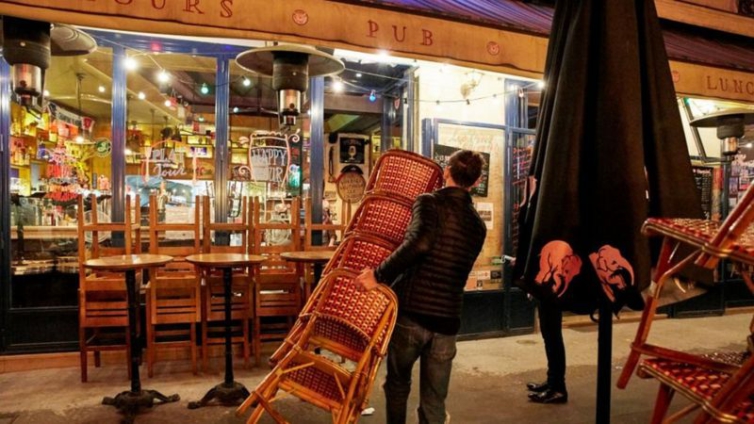
The French government is imposing a curfew on two-thirds of the country - 46 million people - from Friday night for six weeks, after a record 41,622 new coronavirus infections in one day.
The total infected in the epidemic has now passed one million. In Europe, only Spain and Russia have reached that.
A week ago night curfews were introduced in Paris and eight other French cities. Now 38 more areas will have curfews from 21:00 to 06:00.
France puts 46 million people under night curfew in bid to stem spread of coronavirus https://t.co/9ff3oehwvm
— BBC News (World) (@BBCWorld) October 23, 2020
Most of Europe has rising infections.
Slovakia is to impose a partial lockdown for a week from Saturday, allowing only travel to work, shopping for essentials and school for younger children.
New lockdowns have come into force in the Czech Republic and Republic of Ireland.
There are also high infection rates in Belgium, Spain and Italy, putting many hospitals under severe pressure.
Italy's Lazio and Campania regions begin night curfews on Friday, a day after one took effect in Lombardy in the north.
The wider French curfew comes into effect at midnight (22:00 GMT) on Friday, then at 21:00 from Saturday onwards.
It has drawn complaints from restaurant and bar owners, whose businesses are already suffering after the two-month lockdown in the spring.
In several regions of France, more than half the intensive care beds are now occupied by Covid-19 patients. Over the past 24 hours France recorded 162 more deaths.

A new French app called "#TousAntiCovid" has been launched, to replace the previous one "#StopCovid" that was downloaded by only 2.7 million people - far below the take-up of similar anti-Covid apps in the UK and Germany.
#TousAntiCovid is a smartphone tracing tool with more local information than the previous app.
French Prime Minister Jean Castex said "circulation of the virus has today reached a very high level" - 251 infections per 100,000 people in the past week.
He said that was a 40% increase in one week and the reproduction (R) rate was around 1.35, "which basically means a doubling of the number of cases every two weeks". The R rate measures how many others each infected person is passing the virus on to.
Latest Stories
-
Russia opens neo-Nazism exhibition at International Festival of Youth 2026
13 minutes -
VC inaugurates three committees ahead of UG’s 80th anniversary celebration
19 minutes -
Today’s Front pages: Monday, September 14, 2026
27 minutes -
The Or Foundation to launch recycled textiles platform Foose Materials during London Design Week
33 minutes -
110 children at Cardiothoracic Centre get second chance at life as Ghana Medical Trust Fund marks first year
37 minutes -
‘I’m suffering’ – Motherless 12-year-old who lost both legs, father in Ofankor-Pokuase crash seeks support
41 minutes -
Education Ministry extends 2026 SHS placement exercise by one week
2 hours -
Better roads will create sustainable jobs for Ghana’s youth – Joyce Bawah Mogtari
2 hours -
Kumasi Expressway to cut travel time, boost economic activity – Joyce Bawah Mogtari
2 hours -
GOIL could hold fuel prices despite $100 crude oil shock – Edward Bawa
2 hours -
Fitch lifts Ghana’s 2026 current account surplus forecast to 7.8%
2 hours -
Do not identify yourself as Ziavi Paramount Chief or Queen – Volta Region House of Chiefs warns
3 hours -
Sosu demands probe into $260m cocaine shipment seized in France
3 hours -
Mahama to receive cleared Accra-Kumasi Expressway right-of-way today
3 hours -
Mahama to cut sod for US$1.3bn Sentuo Airport Garden City on Tuesday
3 hours