

Audio By Carbonatix
Minister for Environment, Science, and Technology Dr. Kwaku Afriyie has charged the National Biosafety Authority (NBA) to take Science-based decisions on GMOs for the country.
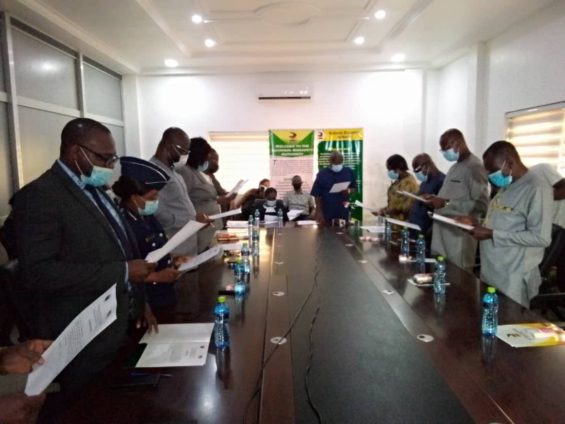
Speaking during the inauguration of the board of the NBA, the minister said although the issue of genetically modified organisms (GMOs) is a contentious one, it has to be settled.
“Look at the issue backed by Science and not by sentiments. Because in my office I know that (there are) GMO linked products which are waiting for go ahead for the next phase… You have to make sure that biological products are used for the benefit of the country,” he urged.
He told the board members that “It’s a very contentious issue. It raises its head and cools down. But it will never go away. Because as you know, we are using a lot of GM products in this country. In fact, it’s something that must be settled once and for all. So, your onus is to give education to Ghanaians”.
Prof. Charles Antwi Boasiako who is the re-nominated chair of the board said they will work in the interest of Ghanaians.
“The GMOs, this is what is going on in the whole world. We will ensure it benefits Ghanaians. We will not do anything that goes against the law,” he told the media in a subsequent interview.
Stalled GMO cowpea situation
Although scientists have completed the development of the GM cowpea variety also known as Bt cowpea, the absence of a governing board for the National Biosafety Authority (NBA) has stalled the approval processes.
Scientists at the state-run Savannah Agricultural Research Institute (SARI) of the Council for Scientific and Industrial Research (CSIR) in January this year submitted documents to the authority requesting for environmental release of the variety following 12 years of research.
But the authority asked the scientists to hold on and re-apply after it gets a new governing board, following the expiration of the mandate of the earlier one in January 2021. Now, the board is in place, clearing the way for a re-application and eventual decision.
“Now, with the board in place, they can submit. The board’s role is to ensure risk assessment is done, the various processes are followed, and a decision is taken on that,” Chief Executive Officer of the NBA Eric Okoree explained in an interview.
“We have heard about the campaign of some Ghanaian farmers for the release of the Bt cowpea which SARI has been working on. When the application gets into our hands, we will look at it transparently and objectively and seek public opinion in the decision.
“As per the act, the board is the decision-making body and they define the policy direction of the authority. They have now the task of leading in the decision making of the authority. The decisions are on the safe use, transfer, handling and development of GMOs in Ghana,” Mr. Okoree added.
What next?
The scientists at the Savannah Agricultural Research Institute have indicated they will soon re-apply for environmental release of the GM cowpea variety. It will take between 90 and 180 days before the authority returns with a decision after the request for approval is done.
“It’s supposed to be released into the environment. In doing so, we look at the information provided by the application, the risk assessment to be done by the technical assessment committee, and then we look at the socio-economic considerations, and then the information provided by the public. That is the transparency side,” Mr. Okoree explained.
“The intention is not to cause any genetic erosion. We will make sure that when we use this cowpea, still our traditional varieties will play hand in hand,” Prof. Boasiako stated.
What is GM cowpea?
Cowpea or beans is a popular, protein-rich staple crop that is usually cooked and eaten with other carbohydrate sources. It is considered the “poor man’s meat” and is popular in low-income homes that struggle to afford animal protein sources. The crop is however highly vulnerable to the deadly Maruca pod borer pests, which sometimes causes farmers to lose 80 to 100% of their cowpea grains.
To control the pest, farmers typically spray their fields with pesticides between eight and 12 times in the 12-week life cycle of the crop. But the genetically modified cowpea variety, into which a gene from a naturally occurring bacteria has been introduced, is resistant to the pest. Confined field trials have shown it reduces the need to spray fields with chemicals to only 2, and offers up to 5 times higher yields due to reduction in pest destruction.
Latest Stories
-
Livestream: NPP National Delegates Conference underway in Kumasi
25 minutes -
‘We are waiting for the delegates’ – NPP explains delay in voting at Kumasi conference
39 minutes -
Drug fight will yield results as Mahama steps up action – Dzimega
48 minutes -
‘It’s bizarre’ – Freddie Blay questions EOCO’s handling of Baffour Awuah case
50 minutes -
NPP conference to reinforce support for Bawumia ahead of 2028 – Evans Nimako
59 minutes -
France and Ghana’s Gender Ministry explore cooperation on women’s economic empowerment
1 hour -
Ghana’s growing drug trafficking links are deeply troubling – Victoria Bright
1 hour -
‘The MP’s tears are crocodile tears’ – Kofi Bentil on La Pleasure Beach demolition
1 hour -
Freddie Blay alleges Mahama ordered demolition of son’s Polo Beach Club at La Beach
1 hour -
‘We’ve complied with all the rules’ – NPP assures transparency in national elections
2 hours -
‘Who is financing all this?’ – Victoria Bright questions networks behind Ghana-linked drug trade
2 hours -
If we don’t know Baffour Awuah’s charge, there’s a fishing expedition going on – Kofi Bentil
2 hours -
Parliament questions continued detention of Baffour Awuah by EOCO, demands due process
2 hours -
Baffour Awuah did not report to EOCO voluntarily; an arrest warrant forced him – Theophilius Dzimega
3 hours -
Baffour Awuah case risks looking like a display of state power – Sulemana Braimah
3 hours