

Audio By Carbonatix
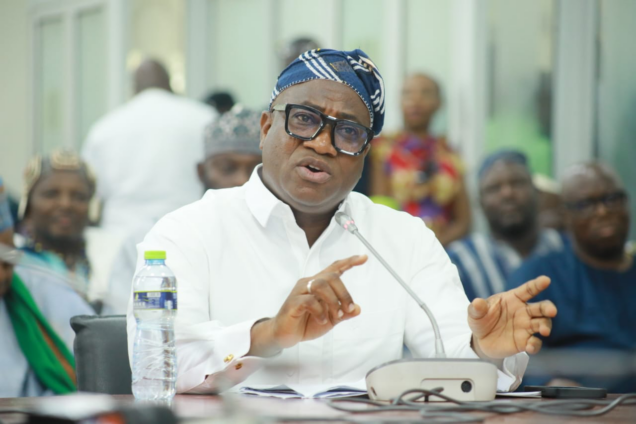
Dr. Ibrahim Murtala Muhammed, Minister of Environment, Science and Technology, has stated that Ghana’s proposed ban on plastics will be a gradual process to ensure a smooth transition to sustainable alternatives.
Dr. Muhammed emphasised that an immediate ban could have adverse effects, as viable options must be easily accessible.
The Minister said this at the Environmental Sustainability Summit organised by the Business and Financial Times in Accra.
The event was on the theme: “Ending Plastic Waste in Ghana: A Sustainable Future for all.”
The event featured a high-level panel discussion, and impactful case studies on climate financing, green energy transitions, circular economies and, corporate sustainability practices.
The Minister said, “You do not just ban plastics overnight, because you are dealing with people’s livelihoods and habits.”
He said as a country “We must first provide affordable and practical alternatives before enforcing restrictions.”
Ghana generates between 840,000 and 1.1 million tonnes of plastic waste annually with over 50 per cent uncollected and only 9 per cent recycled.
Dr Muhammed said that reckless disposal of waste clogged drains, polluted water bodies, and posed severe health risk, costing the economy $6 billion yearly which is 11 per cent of Gross Domestic Products (GDP).
He said Ghana was currently studying successful circular economies on the African continent, notably Rwanda and Kenya where plastic bans were implemented alongside robust recycling systems.
He revealed that the government circular economic strategy would prioritise taxes and regulations, promote local alternatives and extend producer responsibility.
The Minister called for a change in habits from Ghanaians, citing real-life situations where traders resisting reusable containers due to convenience.
Dr. Godwin Acquaye, the Chief Executive Officer for Business and Financial Times, highlighted the impact of plastics notably remnants of plastics being found in the reproductive organs of human beings.
“So, there was research done outside the country, and they saw microplastics in the testicles of those who were examined. So reproductive organs and fluids have plastics in them. So, the questions are that what children are we giving birth to?, “he said.
He urged the government to remain committed to the circular plastics roadmap and other international commitments such as the one advocated by the Global Plastic Action.
He called for an effective collaboration between state institutions and the private sector to promote Ghana’s circular economic initiatives.
Latest Stories
-
Livestream: NPP National Delegates Conference underway in Kumasi
24 minutes -
‘We are waiting for the delegates’ – NPP explains delay in voting at Kumasi conference
39 minutes -
Drug fight will yield results as Mahama steps up action – Dzimega
48 minutes -
‘It’s bizarre’ – Freddie Blay questions EOCO’s handling of Baffour Awuah case
50 minutes -
NPP conference to reinforce support for Bawumia ahead of 2028 – Evans Nimako
59 minutes -
France and Ghana’s Gender Ministry explore cooperation on women’s economic empowerment
1 hour -
Ghana’s growing drug trafficking links are deeply troubling – Victoria Bright
1 hour -
‘The MP’s tears are crocodile tears’ – Kofi Bentil on La Pleasure Beach demolition
1 hour -
Freddie Blay alleges Mahama ordered demolition of son’s Polo Beach Club at La Beach
1 hour -
‘We’ve complied with all the rules’ – NPP assures transparency in national elections
2 hours -
‘Who is financing all this?’ – Victoria Bright questions networks behind Ghana-linked drug trade
2 hours -
If we don’t know Baffour Awuah’s charge, there’s a fishing expedition going on – Kofi Bentil
2 hours -
Parliament questions continued detention of Baffour Awuah by EOCO, demands due process
2 hours -
Baffour Awuah did not report to EOCO voluntarily; an arrest warrant forced him – Theophilius Dzimega
3 hours -
Baffour Awuah case risks looking like a display of state power – Sulemana Braimah
3 hours