

Audio By Carbonatix
Super Typhoon Rai, known locally as Odette, slammed into the eastern coast of the Philippines Thursday afternoon, bringing torrential rain and the threat of widespread flooding across the archipelago.
The storm rapidly intensified on Thursday morning and was upgraded from a typhoon to a super typhoon. By the time it made landfall on Siargao Island on the central east coast, it had reached sustained winds of 260 kilometers per hour (160 miles per hour) with gusts over 300 kilometers per hour (185 miles per hour) - equivalent to a Category 5 hurricane in the Atlantic.
Around 198,000 people have already evacuated from their homes to government shelters, the country's National Disaster Risk Reduction and Management Council (NDRRMC) said on Thursday.
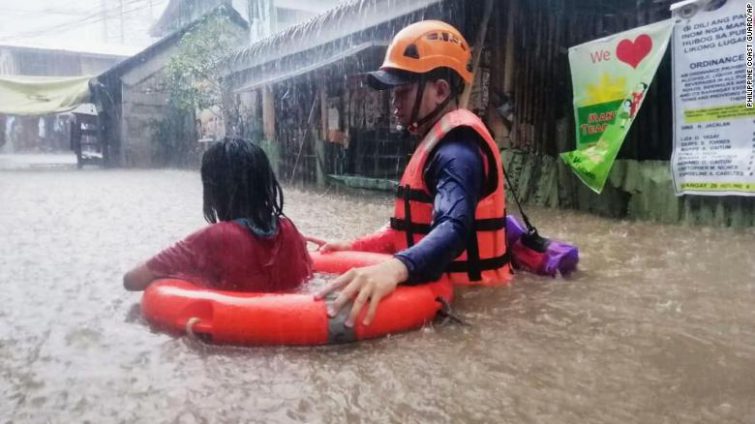
Many preemptive evacuations and storm preparations began earlier in the week as the country began seeing heavy rain. In central Misamis Oriental province, the Agay-ayan River overflowed on Tuesday, flooding streets and homes with muddy brown water.
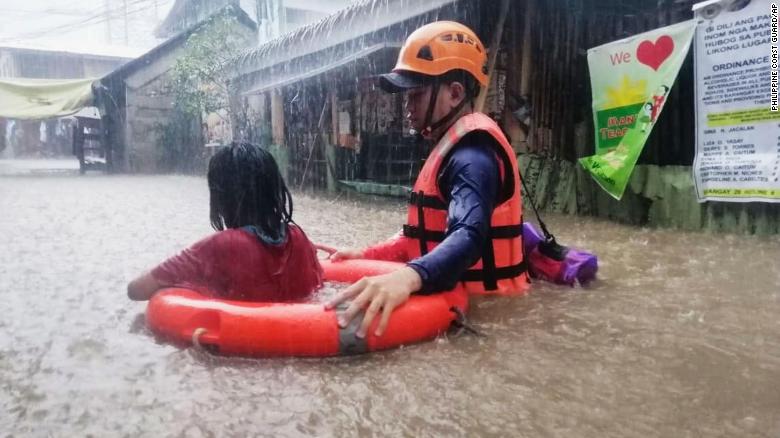
The storm is expected to travel through the country's central and southern regions. Some of the worst conditions are expected in Surigao Province, which lies on the northern tip of Mindanao, one of the country's major islands.
The storm is also expected to hit a number of provinces in the country's Visayas region, a central group of islands. More than 20 million people live in the Visayas, according to 2020 official figures.
In Surigao Province, more than 2,600 people have been evacuated as of Wednesday evening, according to the state-owned Philippine News Agency.
Photos from Surigao show one sports complex turned into an evacuation center, with plastic tents set up in a large hall and families asleep on rugs and tarps on the floor.
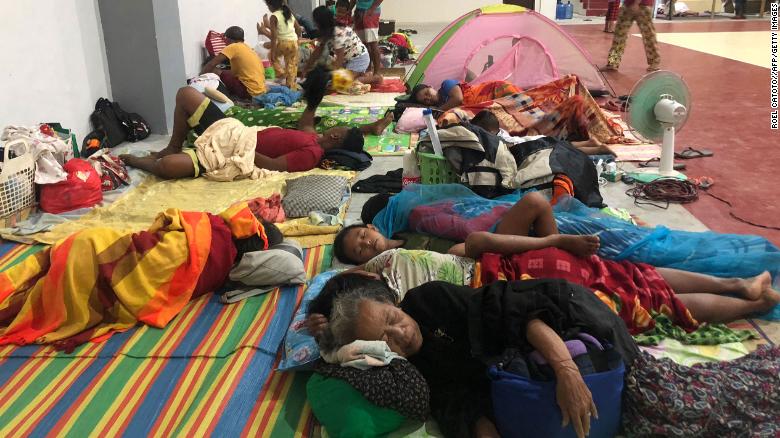
Meanwhile in Eastern Visayas, more than 45,000 people have evacuated to government shelters in the Eastern Visayas region, according to the National Disaster Risk Reduction and Management Council on Thursday.
"We are getting pounded already by strong wind and rain," said Governor Ben Evardone of Samar Province, located in Eastern Visayas.
In Tacloban City, just outside Samar, hundreds of residents have also taken shelter in evacuation sites. Many lived through Super Typhoon Yolanda, which killed more than 6,000 Filipinos in 2013 - and they're not taking any chances now.
"We are concerned that this storm is taking the same path as the typhoon in 2011, and the other in 2013," said Karen Janes Ungar, the country representative for the humanitarian organization Catholic Relief Services Philippines.

"However, we have learned a lot from both of those previous disasters, and in a lot of disaster preparedness...for this emergency."
The biggest concern, she added, are smaller towns on the coast, home to fishermen and poorer populations that might not have access to government announcements or are unable to evacuate.
Thousands of villages in the storm's projected path are at high risk of flooding and landslide, with the region's soil already saturated and unsteady from the week's heavy rain, according to the country's Mines and Geosciences Bureau, which urged local authorities to prepare evacuation plans.
Airlines have canceled dozens of flights, while transport authorities banned sea and land travel in the central and southern Philippines, leaving thousands stranded at ports.
Humanitarian organizations and aid agencies are also on the ground, working with local authorities to prepare for the storm and assist in evacuations. Teams from the Philippine Red Cross are spread out across the east coast, helping organize first aid teams, food and water, and supplies such as blankets and safety equipment.
"Filipinos are tough but this Super Typhoon is a bitter blow for millions of people who are still recovering from devastating storms, floods and Covid-19 in the past year," said Philippine Red Cross Chairman Richard Gordon in a news release on Thursday.
Super Typhoon Rai is the 15th storm to hit the country this year - compounding the struggles of people still recovering.
Millions are still rebuilding their homes and livelihoods, especially after several devastating storms late last year, according to the Red Cross.
Latest Stories
-
Video: Immunity should be exercised without creating classism – Inusah Fuseini on cocaine bust
4 minutes -
Ghana Air Force passes out 293 recruits after six months of intensive training
12 minutes -
EOCO vrs Baffour Awuah: EOCO should have secured warrant before arrest attempt at court – Inusah Fuseini
16 minutes -
Triple fibre cuts disrupt telecom services across Northern, Oti regions – Sam George
19 minutes -
Politicisation could undermine parliamentary probe into cocaine seizures – Dr Osae-Kwapong
25 minutes -
EOCO chases MP: Can Section 41 cure lacuna in EOCO Act? – Inusah Fuseini asks
28 minutes -
GNFS, GWL inspect fire hydrants in Ministries enclave; 23 found faulty
34 minutes -
Gov’t directs release of 50,000 bags of grain to ECOWAS
36 minutes -
Ghana, Germany deepen cooperation on railways, labour mobility
41 minutes -
Huge crowds greet Pope in Paris for open-air Mass
52 minutes -
‘I never said I’ll declare a state of emergency’ – President Mahama on galamsey
2 hours -
Bobby Banson condemns EOCO’s attempted arrest of Nana Agyei Baffour Awuah
2 hours -
When Kumasi begins to look like somebody is in charge
2 hours -
Parliamentary probe into cocaine seizure would be a waste of time – Inusah Fuseini
2 hours -
Cocaine seizure: Focus on Ghana’s reputation, not partisan blame – Osae-Kwapong
2 hours