

Audio By Carbonatix
There are times in my life—in many lives—when multiple identities come into play. I was born in Due West, South Carolina, during Jim Crow, and was what was known in some quarters as a P.K., a preacher’s kid. Both my grandfather and my father were ministers in the A.M.E. church. My father was an Army chaplain, and so we moved around a lot. At an Army school in Alaska, I was the one Black kid in class, and when we moved to Atlanta things weren’t a whole lot better.
When it came time to go to college, my friend Hamilton Holmes and I arrived at the University of Georgia as the first Black students to attend, and we were met with all kinds of ugly rejection. And so when I first met Archbishop Desmond Tutu—“the Arch,” as he was widely and affectionately known in South Africa and beyond—all those identities came into play. And apartheid, the focus of his worldwide campaign, was something I knew a little about.
This was 1986. After having worked as a reporter at The New Yorker and the Times, I was now a correspondent for “PBS NewsHour,” and the previous year I had done a five-part series called “Apartheid People.” These were violent times, the thick of the uprisings and political battles in South Africa against the entrenched system of racist hierarchy.
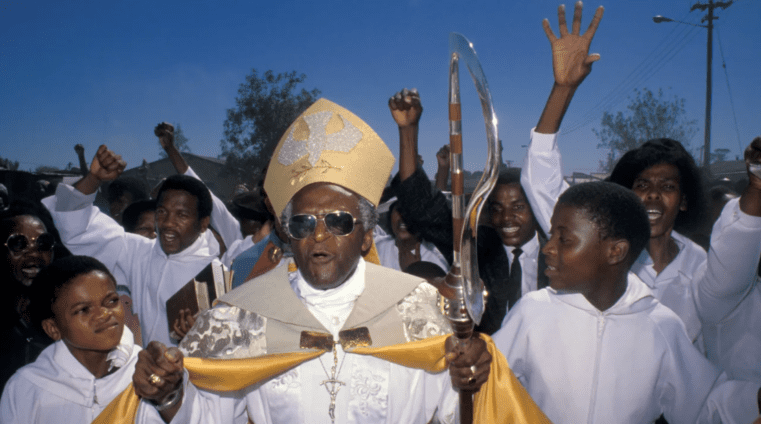
Archbishop Tutu, who died Sunday at the age of ninety, had come to the United States to encourage American opposition to apartheid, which was still in its full oppressive flower. Nelson Mandela and other leaders of the anti-apartheid movement were locked up. The Reagan Administration refused to apply direct pressure on the South African government to reform its system. Although Tutu met with Reagan at the White House, Tutu concluded that Reagan was an “unmitigated disaster for us Blacks” and called the American President “a racist pure and simple.”
Tutu, who was an Anglican bishop and won the Nobel Peace Prize, in 1984, was born to a poor family in the city of Klerksdorp. Like the Reverend Martin Luther King, Jr., Desmond Tutu could not abide violence, which made him an outlier for some in the anti-apartheid campaign. Though there were more radical voices, certainly, in the movement, his bravery as a cleric was consistent: he became a powerful advocate of gay rights, and spoke out against the U.S. invasion of Iraq.
When I had the chance to spend some time with Tutu before interviewing him, I was struck by how warm and charming he was. He wore a nearly constant smile and loved to laugh, often letting loose a high-pitched chuckle. But, when our interview began, his seriousness took over as he fielded questions from me and from viewers who phoned in.
One viewer was particularly curious to know about the differences and similarities between the civil rights movement in the United States and the anti-apartheid struggle in South Africa. Tutu told the caller that the difference was that, although both movements aimed to achieve social justice, Black men and women in the U.S. at least had a Constitution that theoretically guaranteed fundamental rights. “In South Africa, the Constitution is against us,” he said.
In 1997, I moved to Johannesburg to be the South Africa correspondent for National Public Radio. Apartheid, of course, had been defeated, Nelson Mandela had ascended to the Presidency, and Tutu was now the chairman of the Truth and Reconciliation Commission.
As I said in one of my reports at the time: “Archbishop Tutu has shown himself to be a man of many faces. . . . hopeful faces that opened the Commission, promising forgiveness and reconciliation, the emotional face that broke down at one of the earlier hearings after listening to the testimony of a crippled old man who had been tortured by apartheid agents. And . . . the face of Tutu that chided and cajoled reluctant, if not resistant, whites to come forward and testify about their apartheid past,” arguing that it was important for people to tell their stories because it is part of the healing process.
I went on to say, “There was also the face of Tutu who praised other top apartheid-era officials for appearing, and the face that begged Blacks to apologize when their zeal for liberation crossed over into abuse.”
While Tutu was chairing these gruelling public sessions, he was ailing with prostate cancer. And, once again, his unique brand of godly humor proved to be good medicine. “The best kind of healer is a wounded healer,” he said.
And now the wounded healer has “transitioned”—a word I came to know and appreciate during my seventeen years of living in Johannesburg. South Africans prefer “transitioning” to “death,” believing that the end of life on earth is not the end.
Many visit the graves of family and friends because they have faith that the spirit of those who have passed on will help them solve whatever problems they are facing. And so as we face challenging times in both countries—not least the struggle in the United States over the legacy of slavery, Jim Crow, and persistent structural racism—I remain, in all my multiple identities, inspired by the spirit and words of Desmond Tutu, who left us saying, “Hope is being able to see that there is light despite all of the darkness.”
Latest Stories
-
NAGRAT urges gov’t to communicate early if September deadline cannot be met
31 minutes -
We trust government to meet September deadline on teachers’ promotions – NAGRAT
43 minutes -
“We dare not fail” – Gov’t promises to honour teachers’ promotion pay deal
49 minutes -
The GH¢19.8 billion mirage: Inside Ghana’s state enterprise turnaround
57 minutes -
Luv FM High School Debate: KNUST SHS and Osei Adutwum SHS set up thrilling final after dramatic semi-finals
1 hour -
KNUST AI Coordinator urges structured adoption of AI in teacher education
1 hour -
Nepal rescuers blast hillside in search of hydropower workers as families wait anxiously
2 hours -
Teachers who pass promotional exam to get January 2026 start date after gov’t resolves promotion dispute – Dr Apaak assures
2 hours -
NSMQ 2026: St. John’s School rally from slow start to book semi-final spot
2 hours -
Promotion pay row: Gov’t gives teachers September 2026 to complete salary adjustments
2 hours -
Financial irregularities plummet by 62.9% as state tightens fiscal controls
2 hours -
DVLA to expand mobile services to underserved communities in Ghana’s Eastern Corridor of the Northern Region
2 hours -
GUTA urges GPHA to act swiftly to end Tema Port congestion to avert rising business costs
2 hours -
Port congestion could undermine 24-hour economy policy – GUTA
2 hours -
NSA opens three-day window to resolve national service biodata mismatches
2 hours