

Audio By Carbonatix
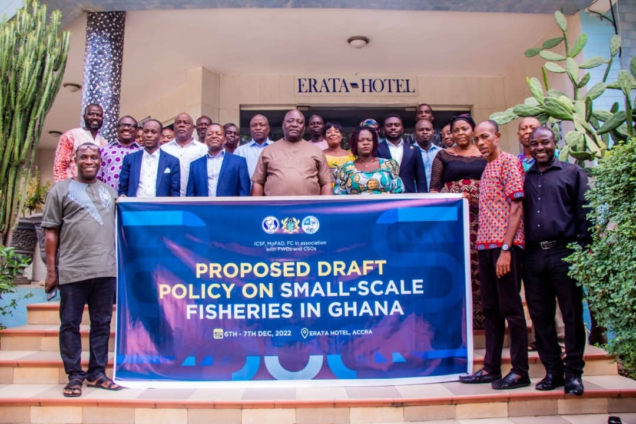
The International Collective in Support of Fishworkers (ICSF) and Technical Service for Community Development (TSCD) has held a workshop to deliberate on a newly proposed draft policy on small-scale fisheries in Ghana.
The workshop sought to subject the feedback from the consultative meetings to further discussions, review and validation by the major small-scale fisheries stakeholders.
Delivering a speech on behalf of the Minister for Fisheries and Aquaculture Development, Ishmael Adjei Browne highlighted the significant economic growth the Small-Scale Fishing (SSF) contributes to the country.
He also noted that the sector provides employment, boosts the nation’s Gross Domestic Product (GDP) and nutritional food security.
He expressed strong support for the proposed draft policy as well as satisfaction with the human rights-based approach and the involvement of MoFAD and FC in the consultative process.

He also drew attention that recent policy intervention in the SSF sector was stemming the tide of IUU and called for the stakeholders to critique the proposed draft policy and offer constructive inputs.
Peter Adjei of TESCOD/ICSF presented an overview of the proposed draft policy; noting that it was not a replacement for existing legislative and policy instruments on the SSF sector but complementary: and to offer specific, targeted interventions to respond to the needs and aspirations of fishers and fish workers in line with human rights standards. He also outlined the key issues the proposed policy seeks to address, the proposed policy objectives and strategies including:
- Small-scale Fisheries Development Secretariat: Establish a small-scale fisheries development secretariat to effectively oversee, coordinate and implement the social development objectives outlined in the draft policy;
- Small-scale Fisheries Development Fund: Establish a small-scale fisheries development fund to cater explicitly for the implementation of the proposed draft policy; or amend Section 36 of the Fisheries Act of 2002 (Act 625) to make explicit provision to fund direct small-scale fisheries programmes, projects and activities;
- Legislation: Enact legislation to:
- recognise customary tenure rights;
- rights of women fishers/fish workers to secure tenure;
- protect fishers from arbitrary eviction and/or denial of access to fishing grounds and
- to require mandatory social, economic and environmental assessments of risks and impacts of large-scale projects in fishing communities before they are undertaken
- Enforceable regulation: Develop enforceable regulations on large-scale project implementation in fishing communities;
- Guidelines: Develop guidelines on:
- customary tenure rights in consultation with fishing communities to harmonize existing practices with human rights standards paying attention to women rights, migrant fishers, and support services along the fish value chain;
- guideline on decent work in the SSF sector to improve conditions of work safety, health and sanitation;
- Educational campaign: Provide educational campaigns and training to encourage participatory co-management
- Monitoring and enforcement of laws/regulations: Strengthen the institutional capacity of Fisheries Commission among others to monitor and enforce greater compliance with fisheries laws and regulations.
- Grievance and redress mechanism on tenure rights: Establish a grievance and redress mechanism on tenure rights to:
- effectively address all tenure related complaints and issues raised by fishing communities;
- function in a way that is accessible and transparent; and in a format and local language/s understandable to persons with limited or no formal education;
- afford persons or communities whose tenure rights are affected or likely to be affected to air their grievances without external interference, intimidation, discrimination or threat;
- take specific measures/s for remedial action, (where violation has occurred, consistent with human rights standards) including but not limited to: restoration, appropriate and gender-equitable compensation or reparation.
- Intervention Plans:
- a Health Intervention Plan for the SSF sector will be developed to translate the benefits of the national health policy to fishing communities;
- an Education Intervention Plan will be developed to further increase access to basic education, improve the quality of teaching and learning and make non-formal education more accessible to majority of adults in fishing communities;
- a Housing Intervention Plan will be developed to address the peculiar needs of fishing communities by fostering institutional dialogue between central/local government and intersectoral MDAs on housing with fishing communities to examine priorities and options in social housing including; community-led and government-supported schemes;
- a Water and Sanitation Hygiene (WASH) Intervention Plan will be developed in order to translate national policies on sanitation and potable water to effectively address the needs of fishing communities, including improving access and delivery and prioritize the needs of women and children who suffer disproportionately;
- a Clean, Affordable and Reliable Energy Intervention Plan will be developed to improve upon existing interventions and ensure among others that; CAREIP safeguards the nutritional quality of fish and health of both processors and consumers, and reduce the cost of processing and post-harvest losses through cost-efficient technologies, education and training;
- Policy review of Sexual and Gender-Based Violence (SGBV): to effectively address sexual and gender-based violence, MoFAD will review and update its Gender Mainstreaming document in the light of this proposed policy. The review will spell out specific provisions to support victims of SGBV including, but not limited to:
- support with safe shelters, medical bills and legal fees to encourage reporting of SGBV and prevent cases from being discontinued;
- Intensify efforts at SGBV education, training and public awareness within fishing communities.

During the discussion session, the SSF stakeholders, representatives of MoFAD and FC was incorporating all the comments and proposals to the draft text document including; adjustments and additions to the policy strategies as well as suggested wording and terminology.
In its entirety, the FWOs expressed strong support for the proposed SSF policy as it aims to transform the current paradigm from an economic and legislative based approach to a more social and fisher-centred approach to addressing challenges in the SSF sector.
Latest Stories
-
Teacher unions strike: Gov’t presents fresh proposals as talks end inconclusively
41 minutes -
51,000 teachers’ promotion arrears to be validated for October payment – Education Minister
1 hour -
Kwabena Boamah appointed Board Chair for Impact Investing Ghana
1 hour -
Striking teacher unions to meet Fair Wages and Salaries Commission on October 6
2 hours -
EOCO working with AG to arraign Nana Baffour Awuah before weekend court
2 hours -
Duraplast reassures customers after fire, announces October 5 reopening
2 hours -
Call off strike, gov’t will not renege on promotion arrears pledge – Haruna Iddrisu appeals to teacher unions
2 hours -
Committee set up to validate teachers eligible for 20% deprived-area allowance – Education Minister
2 hours -
Five-member committee to search for new Black Stars coach after Sports Ministry-GFA meeting
2 hours -
Pinktober: Breast cancer survival exceeds 90% when detected early – Breast Society of Ghana
3 hours -
TCDA to adopt Upper West’s MATCO mango farm as northern prototype, issues warning against felling shea trees
3 hours -
‘Fear delegates’ tag: Afoko touts genuineness among delegates ahead of NPP delegates conference
3 hours -
John Boadu: The leader our party needs at this time – Amb. Edward Akwasi Boateng
3 hours -
Baffour Awuah: EOCO arrested, detained MP after hours of waiting, questioning – Afenyo-Markin
3 hours -
EOCO court warrant authorised search of Baffour Awuah’s law firm, not residence – Afenyo-Markin
3 hours