

Audio By Carbonatix
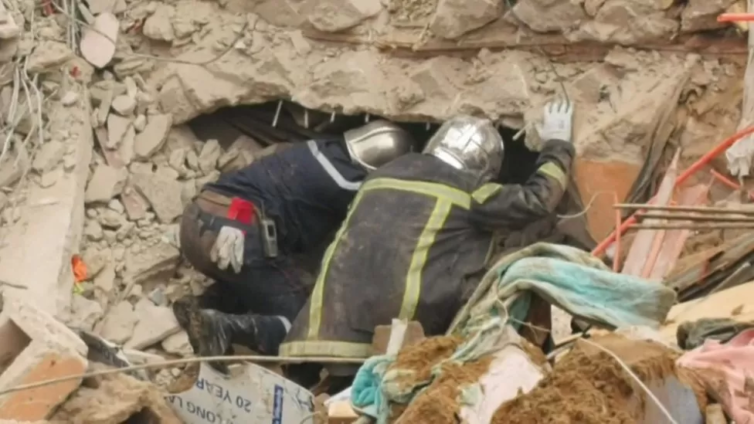
Thirty-three people are now known to have died in Cameroon's biggest city, Douala, after a four-storey building collapsed and fell onto another residential block.
It happened early on Sunday morning in the city's Ange Raphaël neighbourhood and the cause is still not clear.
At least 21 people have been injured, many of whom are receiving treatment at the nearby Laquintinie Hospital.
A three-year-old girl who was taken to hospital on Sunday later died.
Distressed neighbours have been searching the rubble for survivors along with emergency services.
The regional governor, Samuel Dieudonné Ivaha Diboua, has sought to reassure people - saying the situation is under control and rescue teams will make sure nobody is left beneath the wreckage.
A top official tells the BBC he is bitterly disappointed that lives have been lost despite strides made in recent years to improve safety.

"We'd been happy not to have had any such disasters for a while now - especially in Douala where the mayor is really trying to bring order," says Kizito Ngoa, the head of Cameroon's Order of Civil Engineers which regulates housing in the country.
Since Douala's last big building collapse in 2016, the city council has been knocking down homes deemed at risk from flooding or landslides, but the four-storey block that collapsed on Sunday was not earmarked for demolition.
Residents told journalists that it looked dilapidated but local officials have not confirmed what caused the accident.
In a statement on Sunday they reminded anyone wanting to build homes in Douala that they must first get an official permit and then "stick rigorously to the approved design".
Mr Ngoa tells the BBC that the failure to follow planning rules is one of the biggest causes of building collapses across the country, and says the true cost of a construction project should be made clear to the public.
"There is a widespread feeling that everyone can just do what they want" and "there is obviously this desire to save money at all stages of a project".
Sometimes council workers are complicit in this, he says, and when sanctions and inquiries do happen they are not publicised enough.
Latest Stories
-
GPRTU opposes auctioning broken-down vehicles after 21 days
24 minutes -
Nigerian Goodnews Aina crowned J30 Accra champion as Ghana’s Gwendolyn Duvor Klu retires in final
2 hours -
WACCE urges gov’t to declare state of emergency in galamsey-prone areas
3 hours -
NACOC boss calls for practical cross-border action against drug trafficking
3 hours -
Ghana calls for stronger regional cooperation to combat drug trafficking
3 hours -
Ablakwa presents bicycles to 100 North Tongu day students
3 hours -
Ablakwa supports 2,269 North Tongu SHS students with essential items
3 hours -
Dr Bawumia expresses sympathy with farmers over their inability to sell their produce even at reduced prices
4 hours -
Constitutional review: Govt must keep discussions open – Dr Tandoh
4 hours -
GPL 2026/27: David Gyamfi hat-trick fires Ashantigold to historic first victory
4 hours -
Ericsson celebrates 150 years of global innovation, 30 years of partnership and digital transformation in Ghana
4 hours -
Ghana’s Ambassador to Serbia hosts African ambassadors’ September meeting in Belgrade
5 hours -
Ghana closer to terrorism threat than ever before – WACCE
5 hours -
Gov’t must focus on quality everywhere, not categorisation of public schools – Ben Boakye
5 hours -
Tanko Computer backs comprehensive review of 1992 Constitution
5 hours