

Audio By Carbonatix
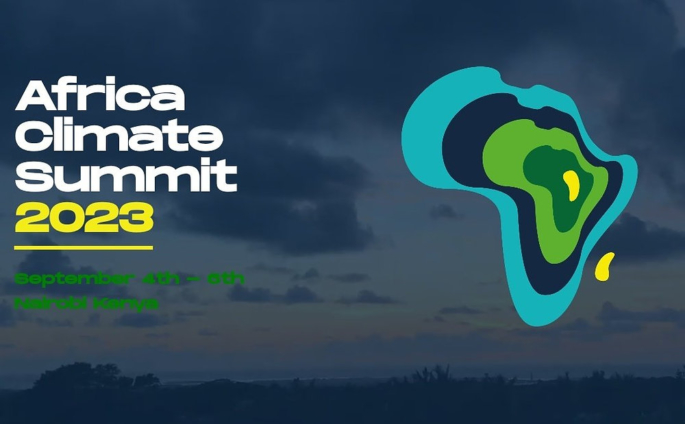
The upcoming African Climate Summit in Nairobi, Kenya, is expected to provide an opportunity for African leaders to support big ideas that drive climate resilience, adaptation and mitigation efforts.
Many stakeholders are keen to see solutions and action-oriented goals laid out in the Nairobi Declaration which is scheduled to be adopted on the final day of the summit on September 6.
Africa is presently facing some of the worst climate consequences ranging from drought and desertification to floods and frequency of cyclones in countries like Mozambique and Malawi, which saw half a million people displaced and 500 killed by floods and landslides in March of 2023.
The Africa Development Bank (AfDB) estimates that the increasingly frequent climate-related disasters are costing countries between $7 billion to $15 billion a year, with an estimated projection of these losses rising to $50 billion annually by 2030.
To adapt, African countries need to raise $124 billion annually by 2030, but the current situation is that the continent only receives $28 billion a year. Africa is not adapting fast enough and is not adequately prepared to address the current and projected climate change threats.
The African Climate Summit (ACS) is therefore a key opportunity to highlight the need to prioritise adaptation investment as a development imperative not only for Africa, but the world.
“Discussions on adaptation finance must be prioritised. Africa is home to most people grappling with the weight of climate change, especially smallholder farmers. It is, therefore, time to bridge the gap between the urgency of the needs and the disparity in climate financing,” said Mwandwe Chileshe, Global Policy Lead for Food Security and Agriculture at Global Citizen. “Discussions at the summit must also focus on the urgency to reform food systems. This summit must mark the beginning of a unified drive towards sustainable solutions that safeguard both our environment and our livelihoods.”
With the ACS being a key moment that will lay the ground for COP28 in UAE, there is anticipation that the continent must see more commitments towards the delivery of the $100bn funding target and more support from Multilateral Development Banks for climate adaptation.
For example, an estimated $630 billion of private capital per year is available for investment in food systems. Building on the Paris Summit, Africa needs a commitment from both governments and the public sector to mobilise funds for the huge shortfall in climate finance required for agriculture.
There is expectation for the Summit to underlie the need to recognise and support the critical role played by Africa’s smallholder farmers -the backbone of Africa’s agriculture sector- towards realising food sovereignty for the continent.
“With the global food crisis continuing to impact millions in Africa, it is imperative that our approach to the challenge transcends mitigation. At the Africa Climate Summit, we need a discourse that gives precedence to climate adaptation.
“This discussion should be focused on communities most impacted by climate change. This entails not just recognising their suffering, but also driving substantial funding towards helping them to adapt to the changing world. The discussion must also have special focus on smallholder farmers as a critical group,” noted Chilufya Chileshe, food policy expert at SDG2 Advocacy Hub.
ACS to build on road to COP28
The African Climate Summit is expected to address four issues on adaptation to build on going into COP28.
1. Reforming finance to enable post-disaster reconstruction.
2. Strengthening African Adaptation Initiative and delivering UNFCCC Loss & Damage Fund- put pressure on rich nations to set up and operationalise the fund sooner. 3. Financial investments in universal coverage of early warning and early action systems for disaster risk reduction.
4. With the first Global Stocktake (GST) concluding at Dubai-COP28, the Summit is expected to demonstrate how African and global leaders have unlocked and will operationalise the Global Goals on Adaptation. The GST will be critical to increase ambition for finance and related action post 2025.
According to Professor Patrick Verkooijen, CEO at Global Center on Adaptation, “Africa is more relevant to future global prosperity than ever before, with its young population, vast renewable energy and mineral resources and large tracts of uncultivated arable land.
“The Africa Climate Summit needs to lay the groundwork for more financial resources to transform climate adaptation and the Sustainable Development Goals into a new growth agenda for the continent.”
Latest Stories
-
Government has improved sanitation in one-and-a-half years — Salaga South MP
1 hour -
Nkwanta North Assembly to appear before Parliament over DACF sanitation spending
1 hour -
Mourinho prints out ‘red card’ incidents after Real lose derby
2 hours -
Atletico beat 10-man Real in feisty Madrid derby
2 hours -
Twelve Tribes of Israel Ghana to mark 40 years with anniversary celebration
2 hours -
GPL 2026/27: Hearts held by Bechem as Kotoko, Samartex share spoils
3 hours -
My Story (Kwaku Antwi-Boasiako)
3 hours -
We expect growth rate to re-accelerate in second-half of 2026 – IC Insights
3 hours -
The ungodliness and unrighteousness underlying the National Cathedral mess!
3 hours -
T-bills auction: Government fails to achieve target; yield on 91-day-bill remains unchanged
3 hours -
It’s Ghana’s shame to denigrate Nkrumah when the whole world honours him as African of the Century – Asiedu Nketiah
3 hours -
No other nationalist can compare to Nkrumah – Asiedu Nketiah
3 hours -
Collateral Registry: Foreign banks accounted for GH¢19.9bn of secured credit in quarter 2, 2026
3 hours -
This government should expect scrutiny – Asiedu Nketiah
4 hours -
Two-year-old girl dies in domestic fire at Cantonments
5 hours