

Audio By Carbonatix
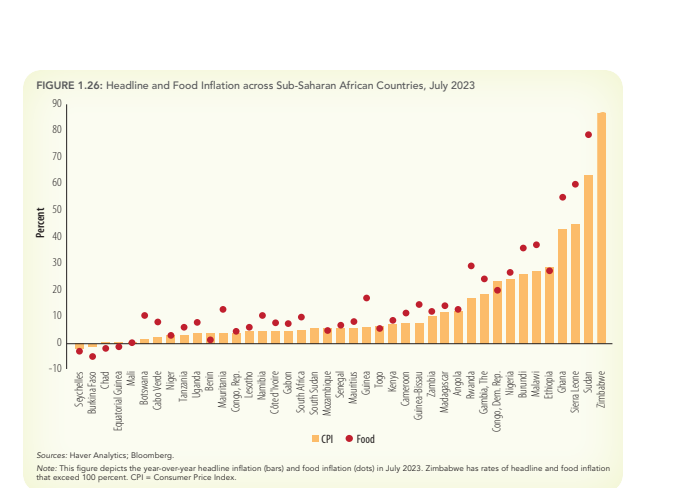
Ghana’s inflation of 40.1% is the 4th highest in Sub-Saharan Africa in 2023, the World Bank October 2023 Africa Pulse Report has revealed.
Zimbabwe is 1st with more than 80% inflation and is followed by Sudan (60%) and Sierra Leone (42%).
According to the report, food and energy prices are still contributing to driving headline inflation in most countries in the region.
By July 2023, it said, nearly half of the countries in the region with monthly available information on food prices (20 of 41 countries) had double-digit year-on-year rates of food inflation, with the fastest increases experienced in Burundi, Ghana, Malawi, Sierra Leone, Sudan, and Zimbabwe.
The report furthered that there has been progress in the fight against inflation in several countries in the region with some of them having already reduced inflation to near or within the central bank target band for example, Kenya, South Africa, and Uganda.
“In other countries, inflation still remains above target and has been for a prolonged period of time and/or shows no sign of having peaked Ghana, Nigeria, and Sierra Leone”, it added.
Despite the disinflation trend exhibited by some countries in the region, the report stressed that the rates of consumer price growth are still high, above target, and above pre-pandemic levels for others.
In contrast, the rate of inflation in four countries in the region is expected to accelerate by more than 10 percentage points in 2023 from last year, namely, the Democratic Republic of Congo, Ghana, Sudan, and Zimbabwe.
Inflation for August 2023 falls to 40.1%
The year-on-year inflation for the month of August 2023 fell to 40.1% from the 43.1% recorded in July 2023, the lowest in 12 months.
According to data from the Ghana Statistical Service, Food inflation witnessed a decrease to 51.9% in August 2023, from 55.0% the previous month.
Non-food inflation also dropped by 2.9% to 30.9% in August 2023.
For the first time in the year, inflation for imported products recorded a rate lower than locally produced items. Whilst inflation for locally produced items was 42.4%, inflation for imported items was 36.2%.
Latest Stories
-
Government brings home remains of Ghanaian killed in alleged South Africa mob attack
2 minutes -
41 more Ghanaians return home from South Africa after xenophobic attacks
4 minutes -
GH¢70,000 gift allegation gives Parliament chance to clean up vetting process – Dr Dramani
6 minutes -
Ghana will be present at Prof Arday’s funeral to pay our respects – Ablakwa
7 minutes -
CJ must avoid appearing as government ‘cheerleader’ – Prof Boadi
9 minutes -
ATU launches HND in Paramedical Trichology to formalise hair and scalp care training
10 minutes -
Health HR practitioners charged to lead sector transformation at 2nd Annual AHRMPHG conference
12 minutes -
NCCE steps up efforts to consolidate nation’s democratic gains
13 minutes -
Government raises GH¢3.15bn in 4-year bond at 12%
24 minutes -
Ampem Darkoa Ladies set sight on CAF Champions League return with Edo Queens the hurdle
39 minutes -
Government unveils five-pillar plan to build resilient economy
40 minutes -
GJA opens entries for 30th Media Awards, introduces 2 new categories
45 minutes -
Ghanaian winger Ibrahim Sadiq joins Colorado Rapids in MLS
57 minutes -
Sister Love by Naina J.M.D. draws international praise ahead of October release
59 minutes -
Ghana Gas CEO calls for more investment in gas infrastructure
1 hour