


Audio By Carbonatix
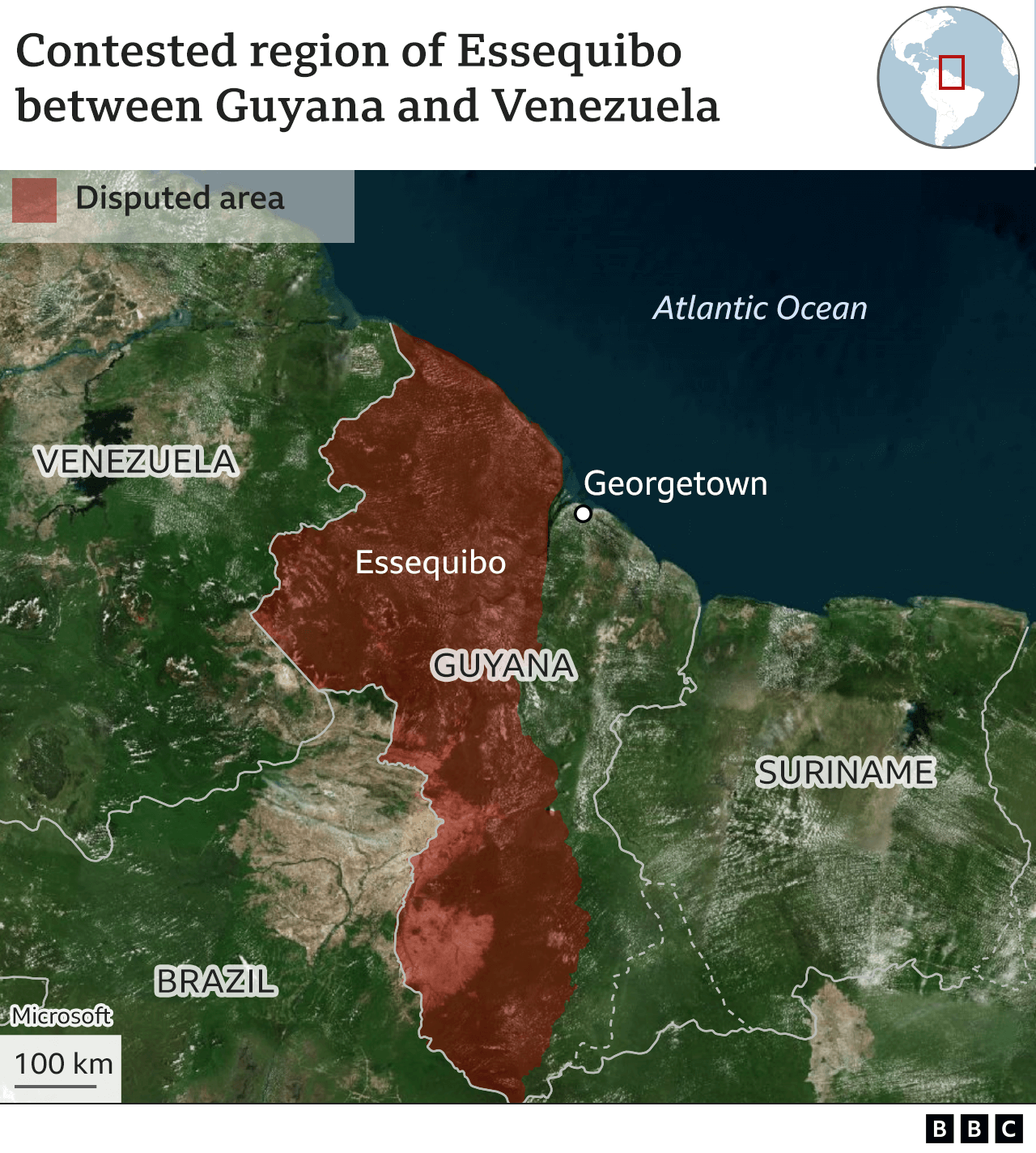
Venezuelan President Nicolás Maduro is plunging ahead with its plans to take over Essequibo, the oil-rich region controlled by neighbouring Guyana.
He has ordered the state oil company to issue extraction licences there and proposed the National Assembly pass a bill making the area part of Venezuela.
Guyana has put its defence forces on full alert in response.
Venezuelan voters on Sunday approved a referendum claiming rights over Essequibo, ratcheting up tensions.
In a Facebook address slamming Mr Maduro's "missteps", Guyana's President Irfaan Ali said he had already spoken to the UN secretary general and is asking the UN Security Council to consider intervening.
"This is a direct threat to Guyana's territorial integrity, sovereignty and political independence," he said. "Guyana views this as an imminent threat... and will intensify precautionary measures to safeguard its territory."
He also sought to reassure the country's investors - mainly oil companies - that their money is safe.
On Sunday, more than 95% of voters in Venezuela's referendum approved establishing a new Venezuelan state in the region. While only two million people voted - making up roughly 10% of eligible voters - Venezuela's claim to Essequibo enjoys broad support in the country.
The country has long maintained that an 1899 decision to award the 159,500-sq-km (61,600-sq-mile) region to the UK was unfair.
The matter is currently before the International Court of Justice, although Venezuela says the court does not have authority to rule on it. The court has warned Venezuela not to take any action that may alter the status quo in Essequibo.
Essequibo has been under the authority of Guyana - and before it British Guiana - for more than a century, but Venezuela has long sought to control it.
The discovery of oil in waters off Essequibo's coast in 2015 helped fire up the current dispute. Tensions increased further in September this year, when Guyana held an auction for exploration licences in those waters.
Guyana's wealth is mostly based on oil production and exports, which has made its economy one of the fastest growing in the world in recent years.
Venezuela, meanwhile, is trying to pull out of a multi-year economic crisis, which has been exacerbated by US sanctions imposed on its oil sales over the 2018 election of Mr Maduro. The country has the largest proven oil reserves in the world.
Latest Stories
-
Ghana closer to terrorism threat than ever before – WACCE
2 minutes -
Gov’t must focus on quality everywhere, not categorisation of public schools – Ben Boakye
16 minutes -
Tanko Computer backs comprehensive review of 1992 Constitution
20 minutes -
2026 SHS placement crisis was caused by changes to established model – Former Dept. GES Director
21 minutes -
GMet forecasts thunderstorms, rain across parts of Ghana tonight
22 minutes -
GETFund to allocate GH¢250m to expand Category A SHS infrastructure
22 minutes -
From dream homes to mortgage plans: JoyNews-Repubic Bank Habitat Fair closes Day 2 on a high
23 minutes -
Afoko: Women’s inclusion key to NPP’s electoral comeback
29 minutes -
2026 U-20 WWC: Black Princesses suffer another group stage exit after defeat to France
40 minutes -
No policy to teach Arabic, Chinese in all public schools – Mahama
41 minutes -
Students’ academic freedom central to Africa’s democratic future – Prof Appiagyei-Atua
55 minutes -
Ɔdadeɛ Global Executives congratulate PRESEC on historic 9th NSMQ trophy
57 minutes -
Mahama announces maize processing plant for Sissala area to tackle glut
1 hour -
Ghana undertaking Africa’s largest road infrastructure programme – Agbodza claims
2 hours -
Prospective homeowners troop to Day 2 of JoyNews-Republic Bank Habitat Fair, engage experts on homeownership
2 hours