

Audio By Carbonatix
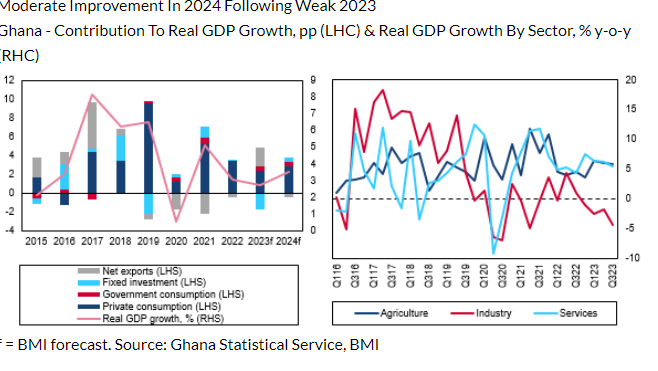
Fitch Solutions has revised Ghana’s Gross Domestic Product (GDP) growth rate in 2024 to 3.5%, from the earlier forecast of 3.7%.
This is however higher than the expected 2.7% growth rate in 2023, but lower than the pre-Covid-19 pandemic average of 5.0%.
According to the UK-based firm, it expects that the Ghanaian economy will enter a recovery phase in 2024, driven by stronger private consumption.
“We expect that the Ghanaian economy will enter a recovery phase in 2024, driven by stronger private consumption”.
“Soaring consumer price inflation over 2022-23 – due to the sharp sell-off of the Ghanaian cedi – weakened purchasing power of households and weighed on domestic consumption. However, we expect that price growth will moderate from an average of 40.3% in 2023 to 17.8% in 2024, driven by statistical base effects and more favourable exchange rate dynamics, it pointed out.
Indeed, it said the government will make progress regarding the restructuring of Ghana’s external debt under the G20 Common Framework in the coming quarters.
It added that a more expansionary fiscal stance will inject additional demand into the economy.
Growth in final quarter of 2023 to remain subdued
It further stated that growth in the final quarter of 2023 will remain subdued.
This is because Ghana’s purchasing managers’ index (PMI) for October and November remained broadly in line with quarter 3, 2023 – averaging 51.1 – pointing to only a slight expansion in the manufacturing sector (PMI values above 50 represent an expansion).
Meanwhile, both consumer and business confidence remained subdued going into quarter 4, 2023, suggesting that a notable recovery in domestic demand is unlikely at the end of 2023.
National accounts data published by Ghana Statistical Service shows that economic growth decelerated sharply to just 2.0% year-on-year in quarter 3, 2023 – from 3.2% in the preceding quarter – marking the weakest outturn since quarter 3, 2020 when the economy contracted by 3.5% due to the Covid-19 pandemic.
The slowdown in growth was primarily caused by a deeper contraction in the secondary sector – as a result of a downturn in the oil and gas industry – and weaker conditions in the services industry.
Latest Stories
-
“I don’t see any rational basis” – Inusah Fuseini rejects proposed five-year term
2 minutes -
Constitution shouldn’t be amended simply because years have passed – IEA
2 minutes -
Access Bank, Visa launch ‘Visa Accept’ in Ghana
25 minutes -
‘Our young people must inherit story of what Africa created, not lost’ – Mahama
27 minutes -
Afreximbank, GIIF and 24-Hour Economy Authority pact marks real progress toward 24-hour economy agenda
56 minutes -
IMANI, Local Government Ministry discuss reforms on sanitation, local revenue and urban infrastructure
1 hour -
Ghana’s international reserves drop to US$11.04 billion in August as BoG pushes for significant build-ups in coming months
1 hour -
Four years enough for any government to deliver – IEA rejects five-year term
1 hour -
‘The most important players are here’ – Queiroz shrugs off Ghana’s injury crisis
1 hour -
Ayariga pledges stakeholder-led approach to Nzema, Kokomba Market redevelopment
1 hour -
Professional collaboration is key to Ghana’s land and property development – Western Regional Minister
2 hours -
‘When you play Ghana, it’s a derby’ – Kessié sets tone for AFCON qualifying showdown
2 hours -
Mahama urges global institutions to invest in Africa’s cultural infrastructure
2 hours -
Kuami Eugene joins UNICEF Ghana to promote universal birth registration
2 hours -
Renard warns Côte d’Ivoire against complacency Ahead of Ghana clash
2 hours