

Audio By Carbonatix
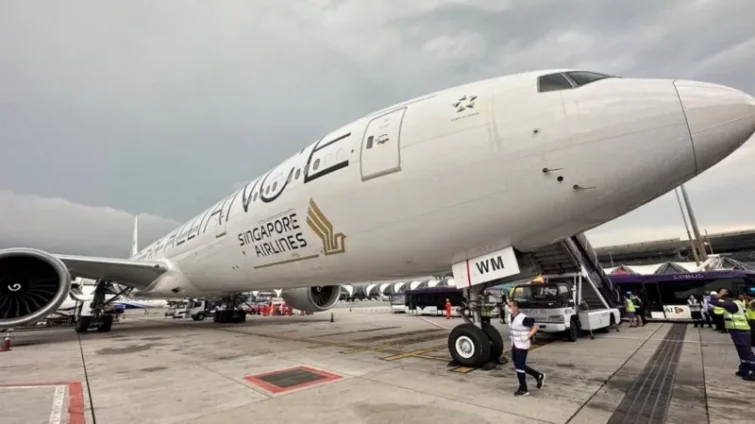
One person has died and several others injured on a Singapore Airlines flight from London that was hit by severe turbulence.
The Singapore-bound Boeing 777-300ER was diverted to Bangkok and landed at 15:45 local (08:45 GMT).
Flight tracking data suggests the airliner dropped 6,000 feet (2,000m) in a matter of minutes after crossing the Bay of Bengal.
Flight SQ 321 was carrying a total of 211 passengers and 18 crew, the airline said in a statement.
"Singapore Airlines offers its deepest condolences to the family of the deceased," it said.
The airline added that it was working with Thai authorities to provide medical assistance to passengers, and was sending a team to Bangkok to provide any additional help needed.
Thai authorities have despatched ambulances and emergency teams to Suvarnabhumi Airport.
Singapore's Transport Minister Chee Hong Tat said the government would provide assistance to the passengers and their families.
"I am deeply saddened to learn about the incident onboard Singapore Airlines flight SQ321 from London Heathrow to Singapore," he posted in a statement on Facebook.
What happened on board the flight is still unclear.
One passenger told Reuters news agency that the aircraft suddenly started "tilting up and there was shaking".
"So I started bracing for what was happening, and very suddenly there was a very dramatic drop so everyone seated and not wearing seatbelt was launched immediately into the ceiling," 28-year-old student Dzafran Azmir said.
"Some people hit their heads on the baggage cabins overhead and dented it, they hit the places where lights and masks are and broke straight through it."
Turbulence is most commonly caused by aircraft flying through cloud but there is also "clear air" turbulence which is not visible on a jet's weather radar nor is it possible to predict.
“Injuries from severe turbulence are relatively rare in the context of millions of flights operated.
"However, severe turbulence can be dramatic and lead to severe injuries or sadly in this case a fatality," aviation expert John Strickland told the BBC.
Flight crews are also trained in how to respond to turbulence, he added.
"It is not for nothing that airlines recommend keeping seat belts loosely fastened throughout a flight be it long or short," he added.
Research has shown that climate change will make severe turbulence more likely in the future.
Latest Stories
-
Africa’s food systems must be judged by what farmers earn – AGRA
21 minutes -
Raphinha & Lamine Yamal score twice as Barcelona beat Rayo Vallecano
1 hour -
Everton agree £40m fee for Monaco striker Balogun
2 hours -
Mudryk to Spurs as Chelsea’s Sanchez heads to Como
2 hours -
Saka scores agaian as Arsenal beat Aston Villa
2 hours -
Man City open talks with Chelsea over Enzo Fernandez move
2 hours -
Man City agree £65m deal for Everton’s Ndiaye
2 hours -
Kushner states regret over World Cup sell-off plan
2 hours -
50,000-litre LPG tanker fire contained on Tema Motorway as Fire Service averts disaster
3 hours -
Supreme Court clears way for Trump to keep building White House ballroom
3 hours -
Amazon rigged billions in ad pricing, lawsuit from states and US watchdog alleges
3 hours -
US singer D4vd’s celebrity lawyers withdraw from murder case
3 hours -
How Shein lost its shine ahead of long-awaited stock market debut
3 hours -
OSP faces crucial test to deliver after years of public support – CDD-Ghana’s Pumpuni Asante
4 hours -
CDD calls for constitutional protection for OSP to shield anti-corruption fight
4 hours